Would a zookeeper pass the way we live?
When a polar bear swam in figure eights, the zoo inspected his life. Scored the same way, the places people live and work fail on 17 of 18 measures.
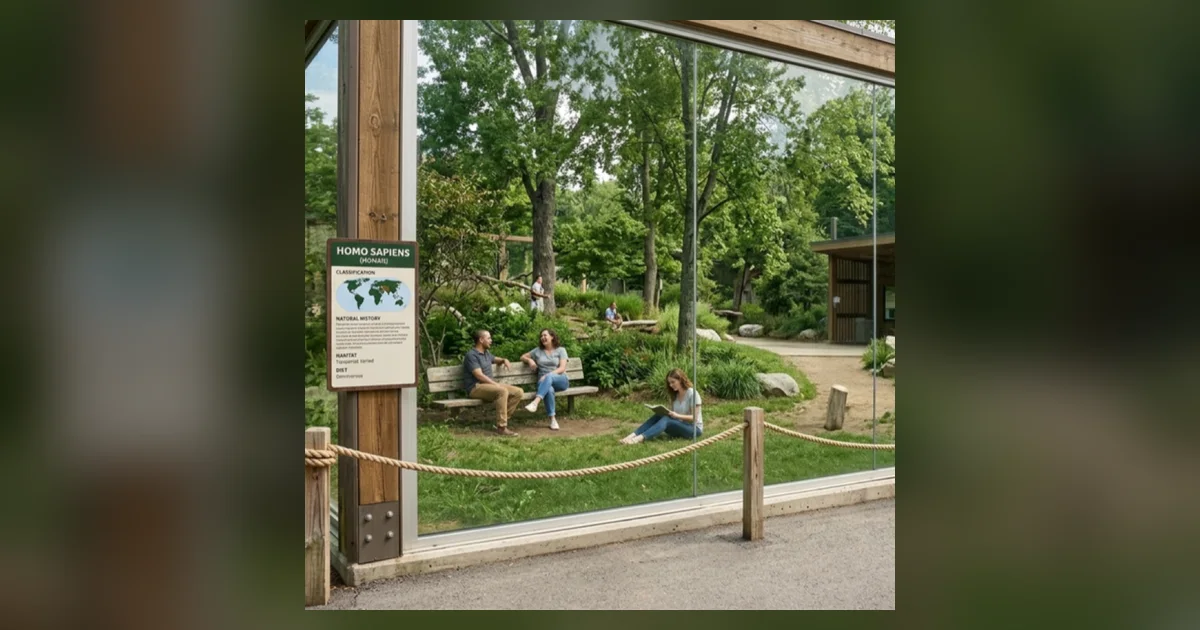
Cover of The Human Enclosure (Omxus Press)
8 min read
 articleworld4u
Cover of The Brain Under Duress (Omxus Press)
In August 1980 a dingo took Azaria Chamberlain from a tent at Uluru. Her mother Lindy didn't cry the way Australia thought a mother should, and people took note. She was convicted of murder in 1982 and served more than three years before the evidence fell apart (Bryson, 1985). What if she had faced a machine instead of a nation? It wouldn't have helped.
Twenty years of research have looked for a brain signature of lying, and early results looked impressive. One team picked out which object a volunteer had stolen in a mock crime for 90% of 31 people (Kozel et al., 2005). But those volunteers lied on instruction, about nothing that mattered. When researchers taught people to make small covert finger and toe movements during the scan, accuracy fell from 100% to 33% (Ganis et al., 2011). A 2026 review of twenty years of studies found the method "is not suited for use as a lie detector" (Rustad & Brennen, 2026). At least three US courts have already been asked to admit such scans (Farah et al., 2014).
Better machines won't fix it. The brain states linked to lying are effortful control, conflict monitoring and heightened arousal. Those are also the states of being accused, frightened or traumatised. No clean signal separates a liar from an innocent person having the worst day of their life.
Now put yourself in that room: windowless, searched, awake for a long time. Someone asks you to explain yourself. The law calls your answer "voluntary" if no one forced it.
Under stress we can't control, hormones flood the brain. The part that weighs consequences and resists pressure goes quiet, and older, faster circuits take over. The neuroscientist Amy Arnsten calls it a flip "from reflective to reflexive" (Arnsten, 2009). Healthy volunteers watching a disturbing film in a scanner showed weaker working-memory activity in exactly that region (Qin et al., 2009). They could leave any time. A person in custody can't, so the laboratory likely understates it.
Lost sleep makes people more suggestible under questioning (Blagrove, 1996). Trauma primes the threat system and leaves memories in fragments (Fenster et al., 2018). So the honest frightened person gives a broken, shifting story, which is what we expect a liar to give.
Then there are the eyes. Averted eyes are the sign of lying most people in the world believe in (Global Deception Research Team, 2006), and autistic people make eye contact through measurably different brain networks (Hirsch et al., 2022). When 1,410 people watched truthful interviews, they rated autistic adults as more deceptive and less credible than other adults telling the truth (Lim et al., 2022). Across 206 studies, people catch lies 54% of the time, barely better than a coin (Bond & DePaulo, 2006). We are all confident, and we are all guessing.
Look back at that paragraph about hormones and circuits. Did it make you trust this article more? It should worry you if it did.
In 2008 Deena Weisberg and colleagues showed ordinary readers explanations of psychology, some sound and some circular. A sentence of neuroscience that explained nothing made the circular ones more convincing (Weisberg et al., 2008). A team in Germany later posted every rating from a preregistered study of 430 people (Väth et al., 2024), so we ran the numbers. For readers without a science degree, a bad explanation with a sentence about the brain scored +0.79 on a scale from −3 to +3. A good explanation without one scored +0.77. The brain was worth as much as the logic. Neuroscientists weren't fooled at all.
We used that power on you, and now we've told you. A brain image alone does little; the language carries the allure (Michael et al., 2013). So discount every brain sentence here if you like. The behavioural record stands by itself: people can't spot lies, and fear looks like guilt. The brain only explains why.
That study tested explanations of psychology, not courtroom testimony, so the jury test is still to come. But juries are made of non-experts. Combine a technology that can't tell a lie from fear with an audience that over-believes the language of the brain, and an innocent person in a scanner faces something worse than a coin toss.
A coroner finally ruled in 2012 that a dingo took Azaria, 32 years after a mother was judged on her face. Most of what convicted her in the public mind was something you can refuse to do.
If you ever sit on a jury, ignore the eyes and the tears. Ask what the person said and whether anything outside the room supports it. If you hear a brain scan offered as proof of a lie, ask what the error rate is on frightened innocent people; nobody has that number. And if someone you love is autistic, traumatised or just exhausted and police want a chat, get them a lawyer first and a support person beside them. It isn't what guilty people do. It's what the science says everyone should do.
When a polar bear swam in figure eights, the zoo inspected his life. Scored the same way, the places people live and work fail on 17 of 18 measures.
Cover of The Human Enclosure (Omxus Press)
In 2008 Denmark began paying night workers with breast cancer. Sleep advice still blames your habits. In a US sample, the job predicts who sleeps too little.
Cover of The Stolen Night (Omxus Press)
Twenty years of American time diaries show young people's time with friends fell from 137 minutes a day to 51, and the hours went to being alone.
Art: Omxus Press