Why did you really vote? Six words in a subject line
A small lottery lifted student turnout by 32%. Paying for blood drove women away. What moves us is rarely what we say it is, and somebody designs it either way.
Art: Omxus Press
6 min read
 articleworld4u
Art: Omxus Press
In December 2010 two Swiss mountain farmers, Armin Capaul and Daniel Wismer, wrote an open letter to the federal agriculture office. Farmers who leave the horns on their cows and goats, they said, should get a franc a day for each animal. The office wasn't interested (Burger, 2019).
So they wrote to the minister, and to parliament. They held horn festivals. A petition with 18,000 signatures went nowhere. Then, in September 2014, Capaul and a committee of farmers and others started collecting signatures for a change to the Swiss Constitution. By 2016 they had 119,626 valid ones, comfortably above the 100,000 needed. The government recommended against it, and parliament did too, 117 votes to 49 in the lower house (Burger, 2019).
It made no difference. On 25 November 2018, a whole country voted on cows' horns. They lost, with 45.27% in favour (Année Politique Suisse, 2026), and plenty of people thought horns had no place in a constitution. But think about what happened. Two farmers had a question, and nobody who held power wanted to hear it, and in the end everybody had to answer it.
Now try that in Australia.
On 21 May 1977, Australians voted on four changes to their Constitution and agreed to three. Casual Senate vacancies would be filled from the departing senator's own party. Federal judges would retire at 70. And people in the ACT and the Northern Territory would at last get a vote in referendums. All three won in every state (Parliamentary Library, 2014).
Nobody knew it at the time, but that was the last yes. Australia has held nine referendums since, and lost all nine. The most recent, on an Indigenous Voice to Parliament in October 2023, won 39.94% of the national vote and no state (Australian Electoral Commission, 2023). Across the whole history of federation, 8 of 45 proposals have passed. After losing one himself in 1951, Robert Menzies called getting a yes out of Australians one of the "labours of Hercules".
We tell ourselves a story about that. Australians are cautious. Australians always vote no. Are we?
Switzerland's Constitution can only be changed by a double majority too: a majority of all voters and a majority of the cantons. We counted every Swiss national vote since 1848, using the Swissvotes database kept by the University of Bern (Année Politique Suisse, 2026). Between 1906 and 2023 the Swiss parliament asked its people to change the Constitution 170 times. The people said yes 135 times, or 79%. Over the same years Australia's parliament asked 45 times and heard yes eight times, or 18%.
That's not a gap you could explain by luck. The odds of a proposal passing were about 18 times higher in Switzerland. Same rule, near enough the same kind of people, wary of being told what to do. So the difference must lie somewhere else.
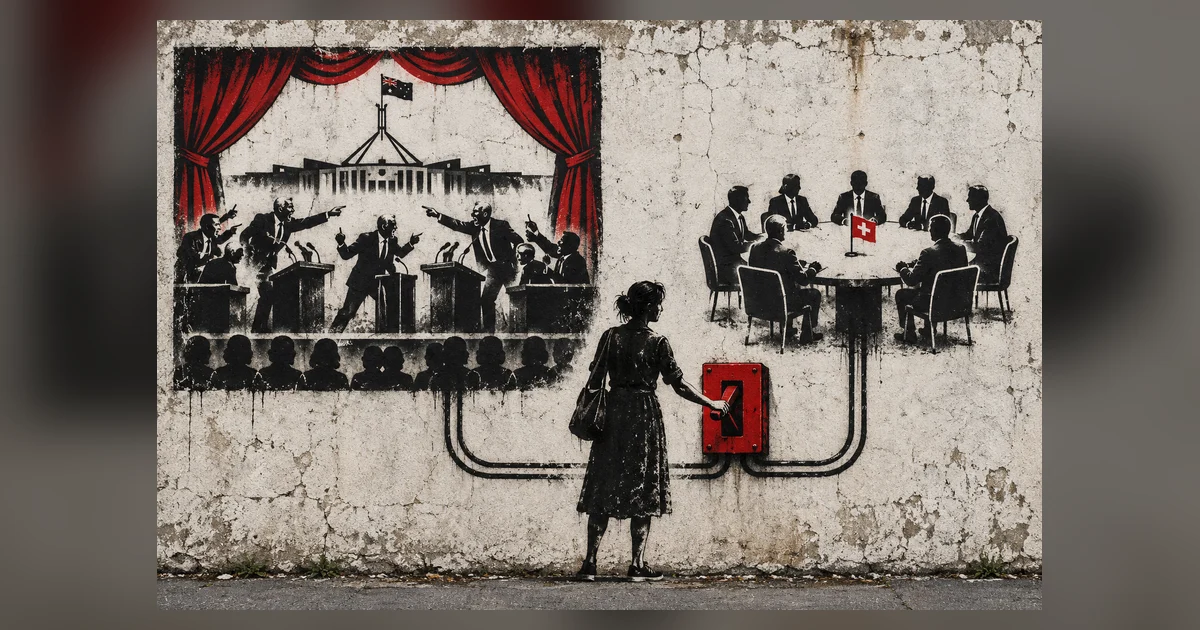
The rule for changing the Constitution is the same. What's different is everything around it. Since 1874, any 50,000 Swiss citizens can force a national vote on a law their parliament has just passed. Since 1891, any 100,000 can put their own change to the Constitution on the ballot (Linder, 2010). Australians can do neither. A referendum here happens only when the government of the day decides to hold one.
That one difference changes how a parliament behaves. If any group with enough signatures can drag a law to a vote, the cheapest way to pass the law is to bring that group in before it's written. So the Swiss parties learned to govern together. Since 1959 the big parties have shared the seven seats of the national executive, and laws are negotiated with their likely opponents before they reach the voters (Kriesi & Trechsel, 2008).
You can see Parliament learning in the numbers. In the 1800s, Swiss voters went against their parliament's advice on 59% of the questions put to them. In the first half of the 1900s it was 26%. Since 2000 it's 19%. Most of that fall came early, once the citizens' tools were in place. A parliament that knows it can be overruled stops writing laws that will be.
Australia's parliament has never had to learn that. Almost all of our eight successful referendums had the support of both major parties. When one side brings a proposal, the other side campaigns against it, and voters offered a fight say no.
The fear is that ordinary people, handed the pen, will vote themselves something reckless. The Swiss record says otherwise. Of 244 citizens' initiatives put to a national vote, 26 passed. That's about one in ten. When Swiss voters overrule their parliament, it's usually to say no to something it wanted: 157 times, against 19 times when they passed something it opposed. The horns were typical. People heard the farmers out, and said no thanks.
In 2001, 84.7% of them voted to put a debt brake in their Constitution (Année Politique Suisse, 2026). Researchers later estimated it improved the federal budget balance by about 3.7 percentage points on average over its first five years (Pfeil & Feld, 2024). In 2025, 62% of Swiss people said they trusted their national government, against 40% across the OECD, and 65% said the system lets people like them have a say, against about 31% (OECD, 2026).
It isn't perfect. Swiss men voted down women's suffrage in 1959 and only granted it in 1971. In 2009 voters banned new minarets against the advice of their government (Année Politique Suisse, 2026). Those are real failures, and they're the kind any majority can commit, in a referendum or in a parliament. The same voters also legalised prescribed heroin for people addicted to it in 1999 and same-sex marriage in 2021.
There's a weakness in every referendum, Swiss or Australian. A yes/no ballot counts heads, not stakes. If 51 people mildly prefer one thing and 49 people will be badly hurt by it, the 51 win, and the count shows nothing of the difference. One Swiss vote in twelve was decided within two points of 50%.
Economists have a fix called quadratic voting. Everyone gets the same budget of credits, say 100, across a set of questions. One vote on a question costs 1 credit, two cost 4, three cost 9, ten cost the lot. You can spread your credits thinly or spend them on the one thing that matters to you, but you can't do both. Mathematicians have shown that, in a large population, this pricing brings the result close to what's best for everyone overall (Lalley & Weyl, 2018). It has been tried at small scale: Colorado lawmakers used it to rank spending bills, and the legislator who designed it said "people felt like their voice was heard" (Zeger, 2021). A court later ruled that lawmakers can't use it in secret, which is fair: representatives' votes should be public (KUNC, 2024).
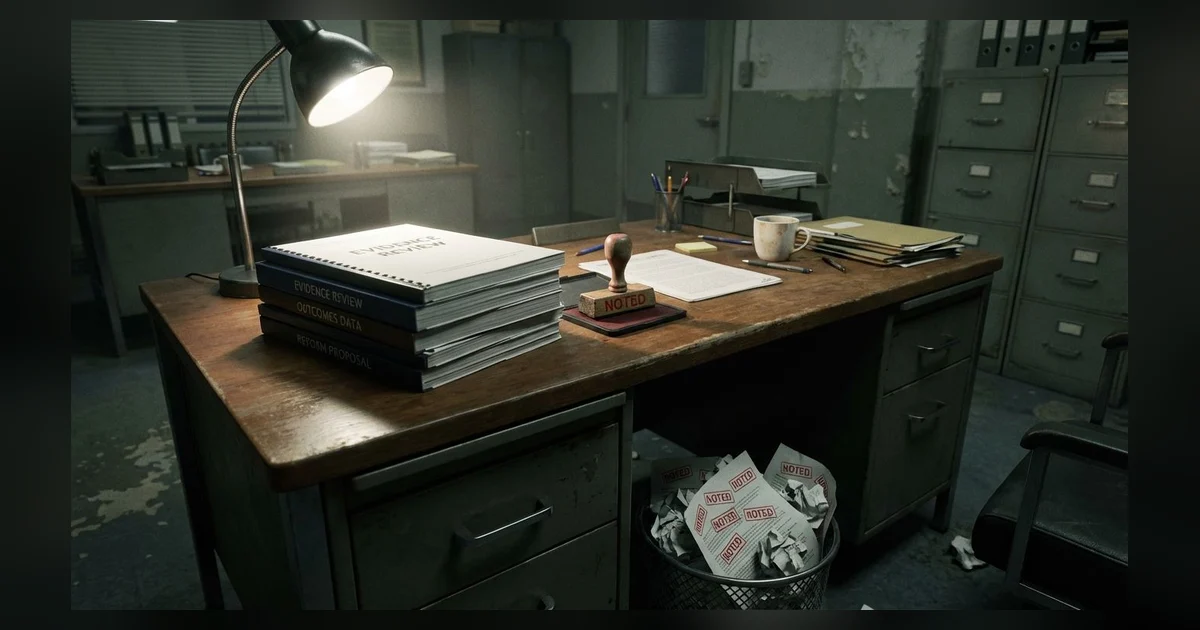
A vote is an instruction, and in most democracies nobody checks whether it was carried out. Software engineers have a tool worth borrowing: a measurable public target, a published way of measuring it, and an error budget. When an outcome falls short, further changes in that area pause until it recovers, and citizens review the results and spend their credits again. That's a design proposal, not a finding, and nobody has tested it.
Life goes wrong in ways nobody in Canberra is thinking about. The person who notices first is usually a farmer or a nurse or somebody's mum, and what they need is a way to make the rest of us look.
Australians already have the hardest part of a working direct democracy. We enrol, we turn up, and we have done for a century, with turnout near or above 90% at federal elections (Australian Electoral Commission, 2024). Switzerland's average turnout is under half. What we lack is the right to ask our own questions. Proposals for citizen-initiated referendums have come before Australian parliaments again and again, from every side of politics, and none has been adopted (Williams & Chin, 2000).
Give Australians the right to ask their own questions, and a ballot that can say how much they care, and the next yes won't take another 49 years. It might even be about cows.
A small lottery lifted student turnout by 32%. Paying for blood drove women away. What moves us is rarely what we say it is, and somebody designs it either way.
Art: Omxus Press
A dead salmon lit up in a brain scanner because the method expected it to. When a clinician's belief decides the finding, what choice is always safe?
Cover of The Lonely Whisper of the Wind (Omxus Press)
Australia cut its road toll by 84% and young children's drowning by 87%. Harsher punishment didn't do it. People who refused to call the deaths accidents did.
Art: Omxus Press