Why does Australia almost never change its Constitution?
Two Swiss farmers forced a national vote about cows' horns. Australians can't ask a question at all, and haven't said yes since 1977. Here's why.
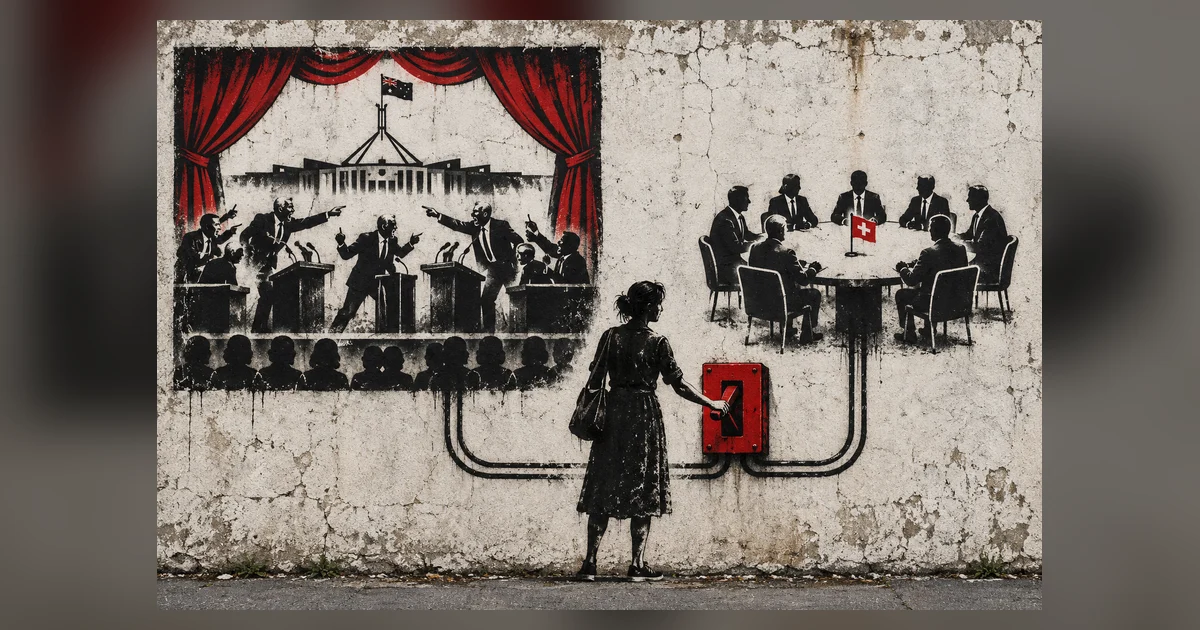
Art: Omxus Press
8 min read
 articleworld4u

Cover of 176 Years of Direct Democracy (Omxus Press)
On 1 February 1959, Swiss men went to the polls to decide whether Swiss women could join them. Two in three said no. Twelve years later the same electorate, still all men, voted again, and this time they said yes. That pair of Sundays holds most of what you need to know about the only country that lets its citizens make national law directly.
The first vote was 33.1% yes, on a turnout of 66.7%, with only three cantons in favour (Swissvotes, 2026). Every other democracy in Western Europe had already given women the vote. Critics of direct democracy have quoted that afternoon ever since. Put a right to a popular vote, they say, and the majority keeps it for itself.
On 7 February 1971 the question came back. This time 65.7% said yes (Swissvotes, 2026). Nobody stormed a palace. No court ordered it. A majority that had refused to share power changed its mind and shared it, by the same instrument it had used to refuse.
What happened between those Sundays is the part worth knowing. Two years before the first one, on the night of 3 March 1957, in the mountain village of Unterbäch, the council president, Paul Zenhäusern, gave the village's women a ballot on a national question about their own compulsory civil defence service. The federal government objected. His wife, Katharina, voted first. Thirty-three of the 86 women came, after dark, to avoid their neighbours. Nobody ever counted their ballots. "It's not something you forget very easily," she said decades later (Ochsenbein, 2009).
Twelve years of arguing at kitchen tables, in cantons and in newspapers turned two in three against into two in three for. The brake has real costs, and those women paid them: every year of that wait was a year without a vote. The question is whether a system like this does more good than harm, not whether it comes free. The whole record is there to read.
Since 1874, if Swiss citizens collect 50,000 signatures within 100 days of Parliament passing a law, the law goes to a national vote. Since 1891, 100,000 signatures can put a constitutional amendment of their own on the ballot (Linder & Mueller, 2021). Every household gets an official booklet with both sides' arguments before each vote. Most people vote by post, several times a year.
The Swiss vote on about 15 issues a year (Federal Department of Foreign Affairs, 2024), and have decided over 700 national questions this way since 1848 (Swissvotes, 2026). Every one is on the public record.
The University of Bern publishes every result in a free database called Swissvotes. Count them and this is what you find.
| Question | Answer from the record |
|---|---|
| Do citizens' own proposals usually win? | No. About 25 of some 230 initiatives had passed by 2023, roughly one in ten. |
| Do voters just do what Parliament says? | No. They matched Parliament's advice 74.8% of the time, against 49.0% by chance. |
| When citizens challenge a law, does it matter? | Yes. Voters struck down 91 of 218 challenged laws (41.7%). |
| Is low turnout apathy? | No. Turnout rises when more is at stake, and people leave the questions they care less about blank. |
(Counted from Swissvotes, 2026.) Put plainly: on one question in four, the people overruled their own Parliament. And when they were asked to stop a law, they did, almost half the time.
Average turnout since 1990 is 45.7%, which sounds low to Australians used to compulsory voting. But it moves: from 26.7% on the quietest day to 78.7% for the 1992 vote on joining the European Economic Area. When the press covers a question more, more people come; and people who come often leave the low-profile questions blank. Swiss voters do not skip politics. They choose which politics to show up for.
The effect that matters most is indirect. Because any law can be taken to a referendum if 50,000 people sign, Parliament builds the likely opponents' demands into a law before it passes. Legislating becomes consensus-building rather than majority bargaining (Hug, 2004; Linder & Mueller, 2021). When citizens do pull the brake, it stops the law 41.7% of the time, which is why the threat is real.
Nor is it a trick of wealth. Switzerland was not rich when it adopted direct democracy in 1848: it was a mountainous country with few natural resources, just out of a civil war. Its wealth accumulated under direct democracy.
If letting people vote on everything made a country reckless, it should show. Switzerland has the highest income per person among nine democracies set side by side, including Australia, the United States and Germany, the longest life expectancy, and public debt of about 30% of its economy against 97% across the euro area, measured the same way (Federal Finance Administration, 2021; Eurostat, 2021). Its homicide rate is about 0.5 per 100,000, against 6.3 in the United States (World Bank, 2026). In 2001 its voters wrote a debt limit into their own constitution with 84.7% of the vote (Swissvotes, 2026).
And the Swiss trust their government. In the OECD's 2023 survey, 62% did, against 39% across OECD countries. Asked whether the political system lets people like them have a say, 58% of Swiss said yes, against 30% across the OECD (OECD, 2024). That 28-point gap, in the share who feel heard, may be the most telling number here. Plenty of people would take being heard over being rich.
The record isn't all good, and pretending otherwise would be dishonest. Nineteen times, voters passed an initiative their Parliament told them to reject. Some protected moors, the Alps, nurses and pensioners. Some were aimed at Muslims and foreigners: the 2009 minaret ban passed with 57.5% (Swissvotes, 2026).
The clearest evidence comes from citizenship. Until the early 2000s, some Swiss towns decided citizenship applications by popular vote. Applicants from the former Yugoslavia and Turkey drew about 40% more "no" votes than similar applicants from richer European countries (Hainmueller & Hangartner, 2013). When courts moved those decisions to elected councils, which have to give reasons, naturalisation rates rose by about 60% (Hainmueller & Hangartner, 2019).
This is a genuine failure of direct democracy. Picture the applicant, a neighbour for years, waiting to hear what the town thinks of their surname. A ballot gives no reasons and nobody to appeal to; a council must justify a rejection and can answer for it in court. A yes/no ballot also counts someone mildly in favour the same as someone whose life the measure changes. Quadratic voting is one attempt at a fix: you can spend more votes on what matters to you, at a rising price. So the honest design question isn't people or politicians. It's which decisions need a crowd's veto and which need someone who must give reasons.
Australia already has the hardest part: everyone votes. Our constitution already uses a double majority, of voters and of states. Of 45 referendums since 1901, 8 have passed (Australian Electoral Commission, 2024). But every one of them was put to us by Parliament. Australians can't put a question on the ballot by petition. Bills for citizen-initiated referendums have gone into parliaments around the country for decades, and none has passed (Williams & Chin, 2000). The barrier is political, not structural: neither major party has much reason to hand power from its members to citizens.
On 1 February 1959, the men of Switzerland refused women the vote. On 7 February 1971 they gave it. Between those two Sundays sits everything that is hard about direct democracy, and everything that is right about it. The people can be wrong. The people can also change their minds, by the same instrument, without a revolution and without a court, and the result belongs to them.
Switzerland works not because it is small, rich or homogeneous but because its institutions make consensus necessary, spending accountable and law legitimate. It does so with four languages, a quarter of its residents foreign citizens, and voters who decide everything from tax rates to minarets to their own pensions. It isn't perfect. Perfection isn't the standard. The standard is the alternative.
The claim that direct democracy can't work at national scale sounds like theory. It's a claim about what happens, and it has been tested continuously since 1848.
A lot of what makes life hard gets decided in rooms we never see, and most of us have stopped expecting otherwise. Feeling you have no say is its own kind of misery, and the Swiss numbers suggest it isn't a law of nature.
Check any of this yourself: Swissvotes is free, and you can look up every vote since 1848. Then ask your federal member one question, in writing: would you support a bill letting citizens put a question on the ballot, with safeguards for minorities, and if not, why not? Australia already has the hard parts: everyone votes, and we've used a double majority since 1901. And if a vote you care about comes up short, remember the 33 women who walked out after dark for ballots nobody counted. It took fourteen years. They won.
Two Swiss farmers forced a national vote about cows' horns. Australians can't ask a question at all, and haven't said yes since 1977. Here's why.
Art: Omxus Press
A small lottery lifted student turnout by 32%. Paying for blood drove women away. What moves us is rarely what we say it is, and somebody designs it either way.
Art: Omxus Press
A dead salmon lit up in a brain scanner because the method expected it to. When a clinician's belief decides the finding, what choice is always safe?

Cover of The Lonely Whisper of the Wind (Omxus Press)