Would a zookeeper pass the way we live?
When a polar bear swam in figure eights, the zoo inspected his life. Scored the same way, the places people live and work fail on 17 of 18 measures.
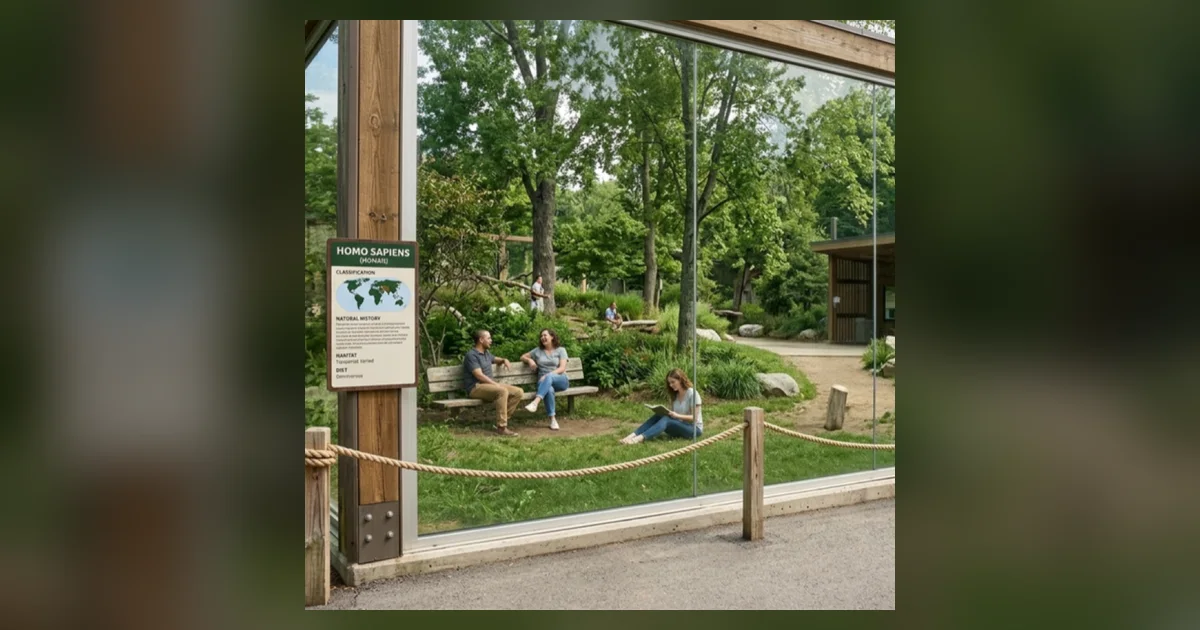
Cover of The Human Enclosure (Omxus Press)
8 min read
 articleworld4u

Cover of Sanctuary (Omxus Press)
For 27 years, a gorilla in Atlanta named Willie B. lived alone indoors with a tyre swing, a caretaker and a television (Associated Press, 2000). He was fed. He was safe. His name came from the mayor, and people loved him. If you'd asked whether he had what he needed, plenty of them would have said yes.
Then the zoo built an outdoor habitat, and in 1988 Willie B. moved outside. He'd spent nearly his whole life without touching one of his own kind. He went on to lead a troop and father several offspring (Atlanta History Center, n.d.). Nobody changed the gorilla. They read what a gorilla is, and built for that.
Zoos didn't always think this way. In 1950 Heini Hediger, the founder of zoo biology, set out a principle: when a captive animal behaves pathologically, look first at the gap between the enclosure and what the species evolved to need (Hediger, 1950). Modern zoos made it a method. Before anyone draws an enclosure, a keeper writes the species file: diet, range, group size, what the animal does all day. The enclosure gets built to the file and judged by how the animal responds (Mellor et al., 2020).
Nobody ever wrote the file for us. Nobody designed the human enclosure. It accumulated. Money, courts, schools, media and government each grew to solve a real problem, and each grew past the scale at which it worked. And when we start pacing the bars, we get told something's wrong with us. So what would the file say?
Zoo welfare science set a floor: freedom from hunger, discomfort, pain, fear and distress. Then it learned that an animal can have all five and still be unwell. Willie B. had all five. The Five Domains Model added play, bonding, agency and exploration, and looks at the whole animal, because a well-fed gorilla without a group isn't "well fed with a social problem". That animal is unwell.
Humans are the same. Across 148 studies, people with stronger relationships had 50% greater odds of survival over the follow-up period, about as strongly as smoking predicts it (Holt-Lunstad et al., 2010). Animals that can't affect what happens to them stop trying, even when the door opens (Seligman, 1972).
Can money stand in? Take public data on 145 countries in the 2025 World Happiness Report (Helliwell et al., 2025).
| What we knew about each country | Share of differences in life ratings explained |
|---|---|
| Income and healthy life expectancy | 63% |
| Plus: someone to count on, and freedom to choose | 83% |
Income's coefficient fell by 76% once connection and control got counted, and the pattern held among the richest third of countries and every year from 2019 to 2024. Money matters. It just doesn't replace the herd, or the keys to your own enclosure. That table can't show cause: nobody can randomly assign a country more friends. The causal case rests on what follows, where the setting changed and the outcomes moved.
Across primates, brain size predicts group size, and for humans the prediction is about 150 people (Dunbar, 1992). English households sent Christmas cards to networks of about that size (Hill & Dunbar, 2003). Below that number, trust runs on knowing each other. Above it, we need stand-ins: contracts, police, credit scores.
Elinor Ostrom spent a career showing that people manage shared forests, fisheries and water for centuries, with no privatisation and no state, when the people who use them make and enforce the rules at a scale where they can see each other (Ostrom, 1990). She won a Nobel for it. Few councils have read her.
In Britain in the 1960s, domestic gas carried carbon monoxide and was a common means of suicide. As the supply switched to natural gas, the suicide rate fell by about a third, and most of the fall wasn't made up by other methods (Kreitman, 1976). In Stockholm, a trial sent text alerts to trained volunteers near a cardiac arrest, and bystander CPR rose from 48% to 62% (Ringh et al., 2015). The capacity to help was already in the neighbourhood. Nobody had connected it.
In a university coffee room, a picture of eyes above the honesty box brought in 2.76 times as much per litre of milk as a picture of flowers (Bateson et al., 2006). On Nauru, phosphate royalties replaced fish and coconut with imported food, and surveys in the 1970s found one of the highest rates of diabetes ever recorded (Zimmet & Taft, 1978). None of these changed the people. Each changed the setting.
Malice isn't the reason. The people who kept Willie B. indoors weren't cruel. They named him after their mayor and brought him a television. They just hadn't read the file, and for years nobody around them had either. That's good news, because what was never designed can be.
A keeper's brief for us would be short. Build at a scale where people know each other. Prevent before you respond: remove the means, add the cues, connect the help already nearby. Address every need, because fixing one while another starves is no fix. Make fairness visible; a capuchin throws the cucumber when it can see the grape (Brosnan & de Waal, 2003). And judge a system by whether the people in it eat, move, sleep, connect, make, help, grow and shape their own surroundings.
We aren't gorillas, and a metaphor can't settle this. People choose, argue and build their own cages, and some of us love them. But a keeper's question is still a good one. Not "is this idealistic?" but "does it match the species?"
Life sucks in a lot of ways that have nothing wrong with you behind them. If you've got food, a roof and a screen and you still feel like something's missing, you may be reading the file correctly.
Write your own. How many people know you by name? Who'd notice if you didn't turn up? What did your hands make this week? What can you change about the place you live? Pick the emptiest line and fix one small thing: a meal with a neighbour, a walk with someone, a meeting you could actually sway.
Then ask it of the places you have some say over. Would a keeper sign off on your school, your workplace, your aged-care home, your street? If not, what's the first change? Willie B. spent 27 years inside and still led a troop once someone opened the door. It's a long way from too late.
Associated Press. (2000, February 3). Gorilla Willie B. dies at 41 in Atlanta. The Seattle Times. https://archive.seattletimes.com/archive/20000203/4002814/gorilla-willie-b-dies-at-41--in-atlanta
Atlanta History Center. (n.d.). Willie B. Atlanta in 50 objects. https://www.atlantahistorycenter.com/exhibitions/atlanta-in-50-objects/willie-b/
Bateson, M., Nettle, D., & Roberts, G. (2006). Cues of being watched enhance cooperation in a real-world setting. Biology Letters, 2(3), 412–414. https://doi.org/10.1098/rsbl.2006.0509
Brosnan, S. F., & de Waal, F. B. M. (2003). Monkeys reject unequal pay. Nature, 425(6955), 297–299. https://doi.org/10.1038/nature01963
Cordain, L., Lindeberg, S., Hurtado, M., Hill, K., Eaton, S. B., & Brand-Miller, J. (2002). Acne vulgaris: A disease of Western civilization. Archives of Dermatology, 138(12), 1584–1590. https://doi.org/10.1001/archderm.138.12.1584
Dunbar, R. I. M. (1992). Neocortex size as a constraint on group size in primates. Journal of Human Evolution, 22(6), 469–493. https://doi.org/10.1016/0047-2484(92)90081-J
Hediger, H. (1950). Wild animals in captivity. Butterworths Scientific Publications.
Helliwell, J. F., Layard, R., Sachs, J. D., De Neve, J.-E., Aknin, L. B., & Wang, S. (Eds.). (2025). World happiness report 2025. Wellbeing Research Centre, University of Oxford.
Hill, R. A., & Dunbar, R. I. M. (2003). Social network size in humans. Human Nature, 14(1), 53–72. https://doi.org/10.1007/s12110-003-1016-y
Holt-Lunstad, J., Smith, T. B., & Layton, J. B. (2010). Social relationships and mortality risk: A meta-analytic review. PLoS Medicine, 7(7), e1000316. https://doi.org/10.1371/journal.pmed.1000316
Kreitman, N. (1976). The coal gas story: United Kingdom suicide rates, 1960–71. British Journal of Preventive and Social Medicine, 30(2), 86–93. https://doi.org/10.1136/jech.30.2.86
Mellor, D. J., Beausoleil, N. J., Littlewood, K. E., McLean, A. N., McGreevy, P. D., Jones, B., & Wilkins, C. (2020). The 2020 Five Domains Model: Including human–animal interactions in assessments of animal welfare. Animals, 10(10), 1870. https://doi.org/10.3390/ani10101870
Nettle, D., Nott, K., & Bateson, M. (2012). 'Cycle thieves, we are watching you': Impact of a simple signage intervention against bicycle theft. PLoS ONE, 7(12), e51738. https://doi.org/10.1371/journal.pone.0051738
Ostrom, E. (1990). Governing the commons. Cambridge University Press. https://doi.org/10.1017/CBO9780511807763
Ringh, M., Rosenqvist, M., Hollenberg, J., Jonsson, M., Fredman, D., Nordberg, P., Järnbert-Pettersson, H., Hasselqvist-Ax, I., Riva, G., & Svensson, L. (2015). Mobile-phone dispatch of laypersons for CPR in out-of-hospital cardiac arrest. New England Journal of Medicine, 372(24), 2316–2325. https://doi.org/10.1056/NEJMoa1406038
Seligman, M. E. P. (1972). Learned helplessness. Annual Review of Medicine, 23, 407–412. https://doi.org/10.1146/annurev.me.23.020172.002203
Zimmet, P., & Taft, P. (1978). The high prevalence of diabetes mellitus in Nauru, a central Pacific island. Advances in Metabolic Disorders, 9, 225–240. https://doi.org/10.1016/B978-0-12-027309-6.50016-1
When a polar bear swam in figure eights, the zoo inspected his life. Scored the same way, the places people live and work fail on 17 of 18 measures.
Cover of The Human Enclosure (Omxus Press)
In 2008 Denmark began paying night workers with breast cancer. Sleep advice still blames your habits. In a US sample, the job predicts who sleeps too little.
Cover of The Stolen Night (Omxus Press)
Twenty years of American time diaries show young people's time with friends fell from 137 minutes a day to 51, and the hours went to being alone.

Art: Omxus Press