Who decides when you sleep?
In 2008 Denmark began paying night workers with breast cancer. Sleep advice still blames your habits. In a US sample, the job predicts who sleeps too little.
Cover of The Stolen Night (Omxus Press)
8 min read
 articleworld4u
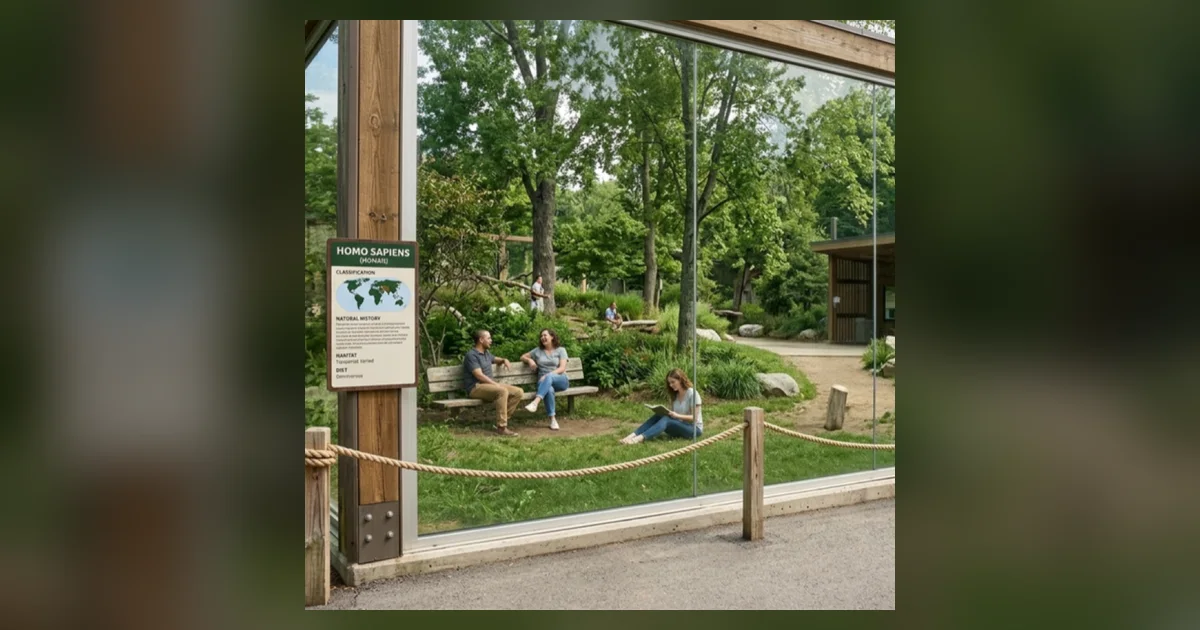
Cover of The Human Enclosure (Omxus Press)
In 1994, visitors to the Central Park Zoo in New York noticed something about Gus, the polar bear. He swam in a figure eight, around and around, for up to 12 hours a day. People called him the "bipolar bear" and thought it was funny. His keepers didn't. They hired an animal behaviourist (Daily Beast, 2013; Untapped New York, 2022).
Gus was given Prozac, as it happens. He also got toys and puzzles and things to work at, and the question everyone asked was what was missing from his life. Nobody asked what was wrong with his character. Most of us have our own figure eight. Who has ever come to inspect the pool?
In 2003 Ros Clubb and Georgia Mason published a short paper in Nature on carnivores in zoos. They asked which species coped worst. The answer was the ones built to roam. The larger an animal's natural home range, the more it paced in captivity and the higher its infant mortality: the further an animal was built to roam, the worse it fares when confined (Clubb & Mason, 2003).
That's how zoo science reads behaviour. And hunter-gatherers range over large territories and walk many kilometres a day. By the zoo literature's own logic, we belong among the species most at risk from confinement.
The rule goes back to Heini Hediger, the Swiss biologist whose 1950 book founded zoo biology. His point was simple. An animal doesn't need "lots of space"; it needs the space its species evolved to use. It doesn't need "company"; it needs the group size its species lives in. Get those wrong and you get pacing, rocking, over-grooming and withdrawal, not because the animal is broken but because the enclosure is (Hediger, 1950).
Today's zoos turn that rule into a scorecard. The Five Domains Model, used by welfare scientists around the world, checks nutrition, the physical environment, health and social behaviour, and reads the animal's mental state from all four (Mellor et al., 2020). It asks a question worth sitting with: an animal that is fed, warm and free of disease, but has nothing to do and no say, is not well.
Every accredited zoo builds things for its great apes to climb. Now look for the climbing wall in an office tower, a school or a train station. The adult world has chairs.
Humans are social primates. We evolved to live in groups of around 150 people we actually know (Dunbar, 1992), to walk and carry and climb every day, to eat a varied diet that takes work to get, and to have a say in what our group does (Lieberman, 2013). So we took 18 measures from zoo welfare science and scored two places: a typical accredited zoo, and the offices, schools, commutes and flats where most working adults spend their days.
| Area | Human places | Typical zoo |
|---|---|---|
| Food (3 measures) | 3.33 | 7.33 |
| Physical environment (4) | 4.25 | 6.00 |
| Health (3) | 4.67 | 7.67 |
| Behaviour and social life (4) | 2.75 | 6.00 |
| Mental state (4) | 3.25 | 5.75 |
| All 18 (geometric mean) | 3.4 | 6.4 |
The human side lost on 17 measures and tied on one: thermal comfort. Heating and cooling serve people as well as they serve zoo animals. The behavioural needs fail worst: group size, social structure, choice and control, and variety. Food shows the widest gap.
These are our own scores, not independent raters', so be suspicious of them. We tried to break them. Moving every score at random by up to three points, ten thousand times, left the human environment below the zoo every time. What could close the gap is bias with a direction: a rater who raised every human score and lowered every zoo score by 1.42 points, on all 18. Independent zoo welfare experts scoring blind is the obvious next test.
Food is the widest gap. A zoo makes animals work for their food. In Australia, ultra-processed foods (factory formulations, mostly shelf-stable) make up 42.0% of the energy people eat (Machado et al., 2019). A zoo matches the diet to the animal. Sydney's koalas get eucalyptus; we get whatever lasts on a shelf. Movement is next. In 2022, 25.5% of Australian adults did not meet the World Health Organization's minimum for physical activity (Strain et al., 2024).
Then the mind. In Australia, 42.9% of people aged 16 to 85 have had a mental disorder at some point in their lives, and among 16 to 24-year-olds, 38.8% had one in the past year (Australian Bureau of Statistics, 2023). If a zoo found a quarter of its gorillas sitting motionless facing the wall, a vet might well reach for medicine, as Gus's did. But no keeper would stop there. The keeper would look at the habitat and say something is wrong with it. Ours has not been inspected.
When a captive animal paces, zoo science treats the behaviour as a symptom of the enclosure and changes the enclosure. When a human shows the equivalent, the reading flips: the person is diagnosed and treated, and the environment is not assessed. The table is a frame, not a claim that each human condition has only an environmental cause. Its point is the direction of the inquiry.
| Captive animal | Zoo reading | Human equivalent | Usual human reading |
|---|---|---|---|
| Pacing | Too little space or enrichment | Restlessness, fidgeting | Attention disorder |
| Bar-biting | Frustrated motivation | Nail-biting, skin-picking | Anxiety disorder |
| Over-grooming | Stress response | Compulsive behaviour | Obsessive-compulsive disorder |
| Excessive sleeping, inactivity | Apathy from deprivation | Withdrawal, hypersomnia | Depression |
| Social withdrawal | Enclosure fails social needs | Isolation | Social anxiety |
| Aggression toward enclosure mates | Crowding, competition | Road rage, violence at home | Anger problem, crime |
This is the hopeful part, and it is on the record. In the 1960s Britain replaced the poisonous coal gas piped into its homes with natural gas. Nobody set out to prevent suicide. The suicide rate fell by about a third anyway, because one common means had gone from every kitchen (Kreitman, 1976). In a university tea room, a picture of watching eyes above the honesty box nearly tripled what people paid compared with a picture of flowers (Bateson et al., 2006). In 343 Chicago neighbourhoods, residents' shared expectation that neighbours would step in predicted lower violence and carried much of the effect of concentrated disadvantage (Sampson et al., 1997).
None of these changed people. They changed the surroundings, the way a good keeper changes an enclosure.
"We're not animals in a cage." We choose our conditions, the objection runs. We do, the way a zoo-born wolf chooses which corner to sleep in. Nobody born into an industrialised society chose the mortgage, the commute, the curriculum, the food supply or the law. Choosing among the options they provide is not freedom; in zoo terms it is enrichment.
"Things are better than they used to be." True, and beside the point. A zoo that upgrades from a concrete pit to a slightly larger concrete pit has not achieved adequate welfare. The benchmark is whether the habitat meets the evolved needs of the species. On that benchmark the human environment scores 3.4 out of 10.
Something is wrong with a lot of us, and most of us have been told it's us. Some of it is. We're not saying nobody needs a diagnosis, or that medicine doesn't help. Gus needed something too. But a zookeeper wouldn't look at a tired site supervisor who hasn't seen his mates in six weeks and start with him. The zookeeper would start with the enclosure. The knowledge to redesign ours exists. What's missing is the decision to apply it to ourselves.
In 2008 Denmark began paying night workers with breast cancer. Sleep advice still blames your habits. In a US sample, the job predicts who sleeps too little.
Cover of The Stolen Night (Omxus Press)
Twenty years of American time diaries show young people's time with friends fell from 137 minutes a day to 51, and the hours went to being alone.
Art: Omxus Press
Upstream settlers took a river from the Pima, and their relatives over the border have a fifth of the diabetes. What we call ageing is partly a report on the feed.
Cover of Applebee's Report (Omxus Press)