Would a zookeeper pass the way we live?
When a polar bear swam in figure eights, the zoo inspected his life. Scored the same way, the places people live and work fail on 17 of 18 measures.
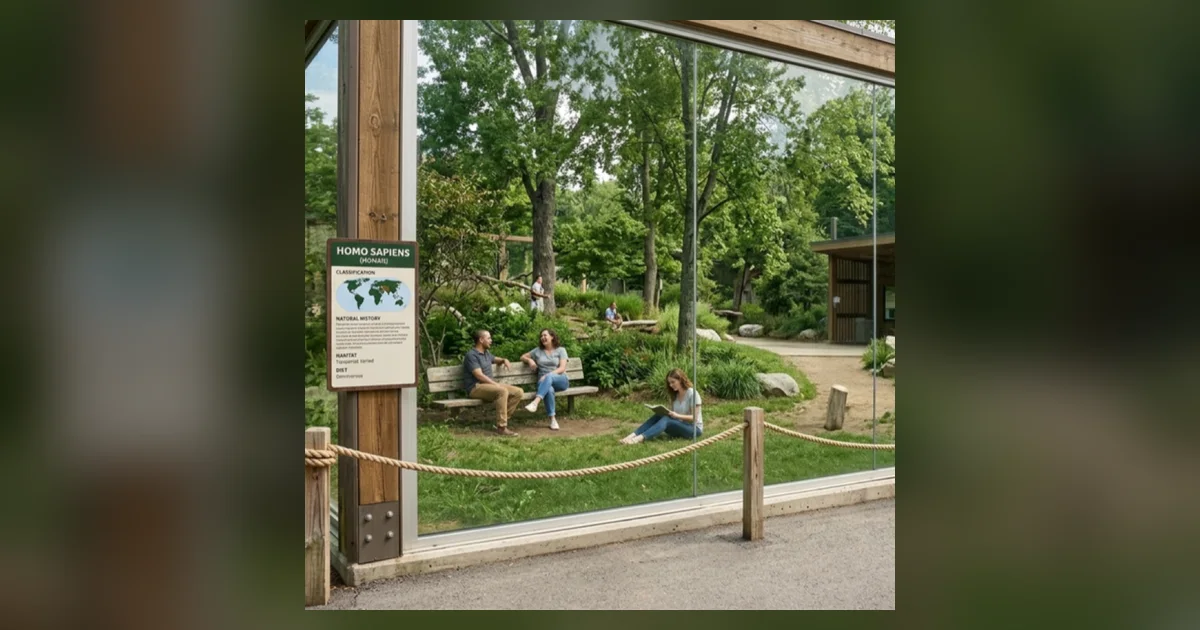
Cover of The Human Enclosure (Omxus Press)
8 min read
 articleworld4u
Cover of The Stolen Night (Omxus Press)
In 2008 Denmark's National Board of Industrial Injuries began paying compensation to women with breast cancer who had worked night shifts for at least 20 years. About 38 women got it, many of them nurses and flight attendants (Wise, 2009). The rest of us got a leaflet about coffee.
Denmark acted on a meeting. In October 2007 an international working group at the International Agency for Research on Cancer in Lyon weighed the evidence and put shift work that disrupts the body clock in Group 2A, "probably carcinogenic to humans" (Straif et al., 2007). A second group kept night shift work there in 2019 (Ward et al., 2019). That evidence isn't settled: Britain's advisers looked at the breast cancer studies and rated them limited (Industrial Injuries Advisory Council, n.d.). But the schedule people work to pay the rent sits in the same category as inorganic lead compounds and anabolic steroids. Nobody mentions it when you accept the job.
Meanwhile, if you sleep badly you're told: no coffee after lunch, no phone in bed, a cooler room, a regular bedtime. The advice assumes you control the conditions. Most of us wake when the alarm says, work when the roster says, and sit under the light the building provides.
How many hours humans need is a real fight. Matthew Walker's Why We Sleep made the case for eight (Walker, 2017), and an independent researcher, Alexey Guzey, then checked the book against its sources and found claims that went past the studies (Guzey, 2019). Researchers who put wrist monitors on the Hadza of Tanzania, the San of Namibia and the Tsimane of Bolivia, none with electricity, found actual sleep of just 5.7 to 7.1 hours (Yetish et al., 2015).
That's awkward for any simple story of modern sleep loss. But notice what those people had that you don't. They slept when their bodies and the cooling air said to, and woke without alarms.
The body's clock is set mainly by light, and it answers to better signals when it gets them. When researchers took people camping in summer with only natural light, their biological night moved to begin at sunset and end just after sunrise, and the night owls moved most (Wright et al., 2013). Nobody gave them a leaflet. The light did the work.
Whether you run early or late is partly inherited and changes across life: teenagers run late, older adults early (Roenneberg et al., 2003). A school bell or a shift start overrides all of that. People sleep short on workdays and catch up on days off, crossing a time zone every weekend without leaving home. Till Roenneberg's group named it "social jet lag" (Wittmann et al., 2006).
You can see it in the US national health survey of 2017–2018, which asks when people fall asleep and wake on workdays and free days (National Center for Health Statistics, 2020). Among 2,671 working adults aged 20 to 64, weighted to the workforce, about six in ten live with at least an hour of social jet lag. They sleep 7.3 hours on workdays and 8.3 on free days. If short workday sleep were simply preference, nobody would sleep an hour longer the moment the alarm's off. That hour is a debt, repaid every weekend.
If poor sleep came down to habits, it would spread evenly across jobs. It doesn't. In that survey, 43.9% of early-morning workers sleep under seven hours on workdays, against 21.3% of nine-to-five workers. At the same age, sex and hours worked, early starters have 2.73 times the odds. Nothing about their character makes them sleep less. The alarm goes off before their biological dawn.
Hours do the same thing. The share sleeping under seven hours climbs from 20.0% of people working under 35 hours a week, to 27.0% at 35 to 49, to 35.9% at 50 or more. The longer the week, the shorter the night. A survey like this is one snapshot and can't prove cause alone. Still, it points at the roster, and the roster's what the advice never mentions.
And what goes missing matters. In a trial on 164 volunteers given a cold virus, those sleeping five to six hours a night had 4.2 times the odds of catching it compared with those sleeping more than seven (Prather et al., 2015). Deep sleep may also be when the brain clears its waste. In mice, sleep doubles the clearance of beta-amyloid, the protein in Alzheimer's plaques (Xie et al., 2013), though that's still being tested in people.
So we sell the sleeper a pill, and judge it on whether the patient feels they slept. Almost nobody checks whether the brain did its maintenance. Benzodiazepines lengthen sleep but shift it into the lighter stages (Silva et al., 2023). In a matched study of 10,529 people prescribed hypnotics and 23,676 who weren't, the prescribed group died at several times the rate, even at fewer than 18 doses a year (Kripke et al., 2012). Sicker people get more pills, so that gap can't all be the drug, but it should worry anyone taking one nightly. Please don't stop one abruptly: ask your doctor how to come off it.
The one drug shown to deepen that stage is GHB, which doubled the first night-time pulse of growth hormone in healthy young men (Van Cauter et al., 1997). In 2000 the United States put street GHB in Schedule I, "no currently accepted medical use", and the same act put the same molecule, as an approved medicine, in Schedule III. One brings a felony, the other a prescription. GHB isn't harmless, as its effective dose sits close to its toxic one, and it's dangerous with alcohol. That's a case for honest labels and regulated supply, and for testing sleep medicines on sleep.
None of this needs new science. It needs the cost of lost sleep moved from the sleeper to whoever sets the clock. Shorter weeks, with hours people choose. Light as a building standard: bright by day, warm and dim after sunset. Shift work treated as an exposure, minimised where possible, paid for where not, and never imposed without people knowing what the evidence says. Apps designed to keep us scrolling into the biological night treated as the sleep hazard they are.
And later school. Paediatricians recommend secondary schools start no earlier than 8:30 (Adolescent Sleep Working Group et al., 2014). In 2016 Seattle moved its high schools from 7:50 to 8:45. Researchers put wrist monitors on students before and after. They slept 34 minutes more each night, and their grades in the biology class studied rose 4.5% (Dunster et al., 2018). Tired teenagers were never a character flaw. Someone just changed the bell.
Being tired all the time makes everything harder, and you've been told it's your fault. It mostly isn't.
You aren't short of discipline. The system that employs you was designed without reference to your biology. It can be redesigned, and the question is who gets to decide.
When a polar bear swam in figure eights, the zoo inspected his life. Scored the same way, the places people live and work fail on 17 of 18 measures.
Cover of The Human Enclosure (Omxus Press)
Twenty years of American time diaries show young people's time with friends fell from 137 minutes a day to 51, and the hours went to being alone.
Art: Omxus Press
Upstream settlers took a river from the Pima, and their relatives over the border have a fifth of the diabetes. What we call ageing is partly a report on the feed.
Cover of Applebee's Report (Omxus Press)