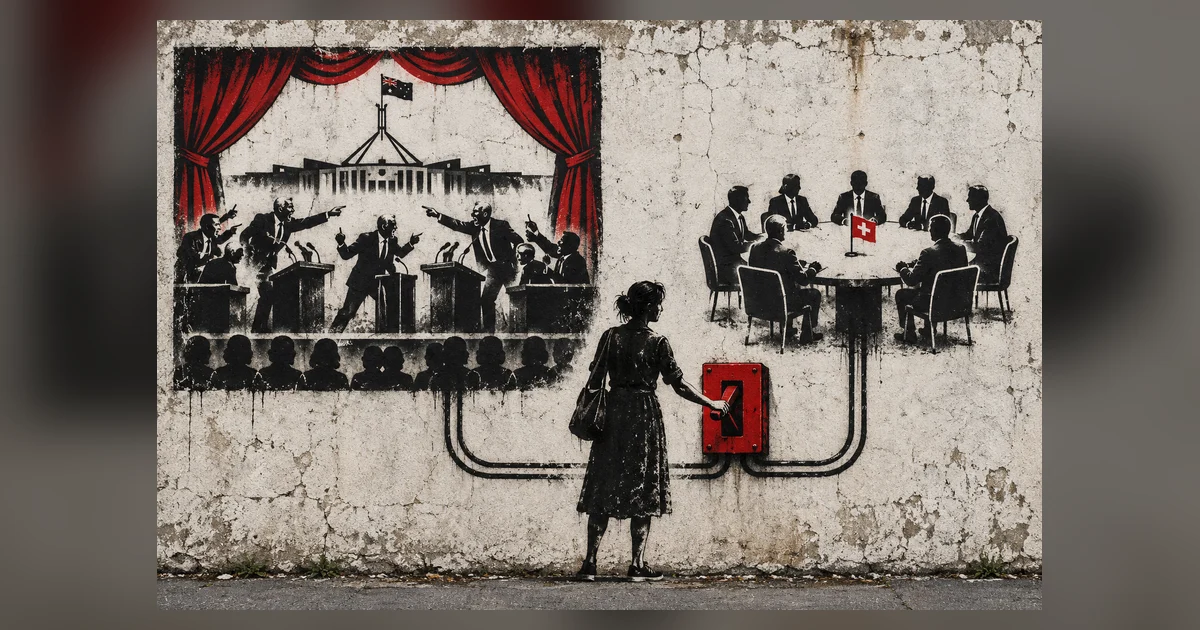
Why does Australia almost never change its Constitution?
Two Swiss farmers forced a national vote about cows' horns. Australians can't ask a question at all, and haven't said yes since 1977. Here's why.
Art: Omxus Press
8 min read
 articleworld4u

Art: Omxus Press
Judges asked to picture their own death set a bond nine times higher for the same woman on the same charge. In 2002 a whole country showed a pattern of its own: it rallied to its army and its president, and left its attitudes to ordinary crime alone.
Look up for a second. Now think about your own death. Your politics just moved.
A municipal court judge in Tucson reads a case brief. A woman has been arrested for prostitution. Set her bond. Minutes earlier the judge filled in a questionnaire; half of them were asked to describe what they think will happen to their body when they die. Those judges set an average bond of $455. The judges who were not asked set $50 (Rosenblatt et al., 1989).
Nothing about the woman changed. The judge's mind did.
The study was built to test an idea from a book. In The Denial of Death (1973), Ernest Becker argued that humans are the one animal that knows it will die, and that most of what we build, religion, nations, careers, monuments, is a way of not looking at that fact. Our cultures tell us we matter and that something of us will last. Becker called them hero systems.
Becker got to test it personally. Not long after the book came out, he lay in a Vancouver hospital room dying of colon cancer, aged 49, and let the writer Sam Keen turn on a tape recorder. "It's a test of everything I've written about death," he said. "How does one die? And I've got a chance of showing how one dies" (Keen, 1974). He died on 6 March 1974. The book won a Pulitzer two months later.
Three young psychologists turned his idea into experiments and called it Terror Management Theory. The design is always the same: remind one group of death, give another group something unpleasant but harmless to think about, then measure. People reminded of death judge rule-breakers more harshly, back their own group, prefer strong leaders and support military force. A review of 277 experiments found a solid average effect (Burke et al., 2010).
Science moved on, and so should the honest version of the story. A large replication in 17 laboratories could not reproduce one classic study (Klein et al., 2022), and a 2025 review that corrected for publication bias found the effect real in part but smaller and patchier than first thought (Chen et al., 2025). The direction has never flipped. The open question is how often, and how much.
So look outside the laboratory. The General Social Survey has asked a fresh random sample of Americans the same questions every two years since the 1970s. Its 2000 wave was the last before 11 September 2001; its 2002 wave went into the field five to nine months after.
In 2000, 41.0% of Americans had great confidence in the military, about where it had sat since 1996. In 2002, 56.7% did. Great confidence in the executive branch of the federal government doubled, from 14.1% to 27.8%. The share saying the country spent too little on defence rose from 24.6% to 31.6%. All three changes are far too big to be chance, and they held for two more years before fading.
Just as telling is what did not move. Support for the death penalty, for harsher courts, for free speech by communists and for legal marijuana stayed on the course they were already on. The attack did not make Americans harsher toward everyone. It made them rally, hard, to the institutions that stood for the nation under attack. That's what the theory means by defending the worldview. It also isn't proof: a real attack on a country gives people real reasons to rally, and no survey can pull the fear apart from the facts. But it's how the theory says a frightened nation would behave.
Here's the question underneath all this. Why do people defend systems that are hurting them? Why cheer the cuts to their own clinic, or wave the flag for the war that takes their kid? If the systems we live inside double as shelters from the fear of death, then attacking them isn't like correcting a fact. It's like pulling at a wall someone is hiding behind. People defend the familiar, rationalise its failures and turn on its critics, a pattern psychologists call system justification (Jost et al., 2004). You've probably watched it at a family dinner. More facts don't help, because the bottleneck isn't information. It's fear.
Here the story turns. In 2010 doctors in Boston randomly gave half of 151 people with advanced lung cancer early palliative care: help to face their illness and decide how they wanted to live. They had better quality of life and less depression, and fewer had aggressive treatment at the end. They also lived longer, a median of 11.6 months against 8.9 (Temel et al., 2010). A later trial of 207 patients found one-year survival of 63% for those who started palliative care at enrolment, against 48% for those who started three months later (Bakitas et al., 2015).
Psychologists find the same turn in the laboratory. A brief, glancing reminder of death makes materialistic people greedier. A slow, vivid reflection on their own death and their life as a whole makes them more generous (Cozzolino et al., 2004). Death pushed away drives defence. Death faced, with support, loosens the grip.
Plenty of cultures already know this. Día de los Muertos in Mexico, Sorry Business in Aboriginal communities and Buddhist meditation on impermanence all keep death inside ordinary life rather than locked in a hospital ward.
Arguing harder does not work, because an argument against the worldview is itself a threat that brings death closer to mind (Schimel et al., 2007). What works is giving people buffers that do not require obedience: real safety instead of symbolic safety. A community that responds when someone is in danger. A neighbourhood where people know each other. An income that does not vanish with a job. People who are safe can afford to let go of the symbols of safety.
The rest is the plain work of facing death in company. The systems we argue with may not be failing at all. They may be succeeding at a job they don't admit to.
We're all going to die, and that does suck. Pretending otherwise seems to make us meaner, and it costs other people: that woman's bond, for a start.
Talk about it, while it's only a conversation. Tell someone what you'd want, then write it down. Advance Care Planning Australia runs a free national line on 1300 208 582. If someone you love is seriously ill, ask early about palliative care. It doesn't mean giving up, and in those trials people lived longer.
And the next time someone's defending what's hurting them, or you are, try not to pull at the wall. Ask what they're afraid of. Make them safer if you can. Sit down next to them.
Becker spent his last weeks answering a stranger's questions about the thing he feared most, on tape, in a hospital room, so that the rest of us might do it better. How does one die? In company, if we can manage it.
Now you know it's happening. Look up again.
Two Swiss farmers forced a national vote about cows' horns. Australians can't ask a question at all, and haven't said yes since 1977. Here's why.
Art: Omxus Press
A small lottery lifted student turnout by 32%. Paying for blood drove women away. What moves us is rarely what we say it is, and somebody designs it either way.
Art: Omxus Press
A dead salmon lit up in a brain scanner because the method expected it to. When a clinician's belief decides the finding, what choice is always safe?
Cover of The Lonely Whisper of the Wind (Omxus Press)