Would a zookeeper pass the way we live?
When a polar bear swam in figure eights, the zoo inspected his life. Scored the same way, the places people live and work fail on 17 of 18 measures.
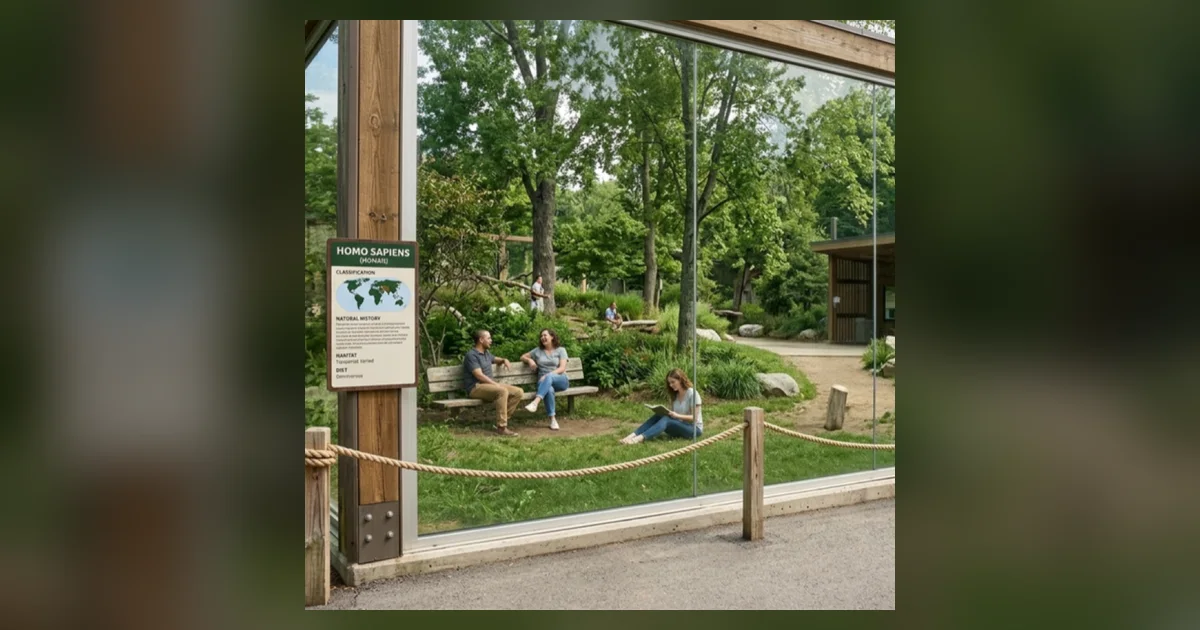
Cover of The Human Enclosure (Omxus Press)
8 min read
 articleworld4u

Art: Omxus Press
In early 2003 the remains of an elderly woman, Elsie Brown, turned up inside her home in suburban Melbourne. She had been dead for about two years. A Melbourne man who had never met her, Andrew Heslop, read about it and wrote a letter to the editor of The Age. He suggested a national "check on your neighbour" day (Relationships Australia, 2016).
Empty goalposts, a ball on the grass, nobody there. Hold that picture.
Elsie Brown's death is what the absence of something looks like. Your nan falls. Someone gets there in 60 seconds, because they live close and know her name. That used to come free with a street, along with the pub at the end of it, the cricket club, the church hall where the old blokes played cards on Wednesdays, and the front yard where kids stayed out until dark. No government funded any of it. It's what happens when people live near each other with time to spare.
Australians have a word for what it produced: mateship. Not the barbecue handshake. The ambient certainty that someone gives a damn about you, and that a teenager with a dark thought has three adults within earshot who aren't paid to listen.
You can't count certainty. But you can count the hours it's made from.
Every year, interviewers from the US Bureau of Labor Statistics phone thousands of people and ask them to walk through yesterday. Start at four in the morning. What were you doing? Who was with you? Then the next thing, and the next, until four the following morning. The survey has run this way since 2003: before the iPhone, through the years smartphones reached nearly every teenager, and through the pandemic (U.S. Bureau of Labor Statistics, 2025). Across 252,808 diary days from 2003 to 2024, weighted to the US population, here's what it shows.
In 2003 to 2007, Americans aged 15 to 24 spent 137 minutes a day with friends. By 2015 to 2019 it was 91. By 2022 to 2024 it was 51. That's a fall of 63%, in young women (124 to 43 minutes) and young men (150 to 59) alike. More than two hours a day with friends, then under one. The US Surgeon General's 2023 advisory, drawing on the same survey, sounded the same alarm (Office of the Surgeon General, 2023).
Maybe it was all the pandemic? No. A third of the fall came first, with no lockdown in sight, and it steepened after 2012, the year smartphones reached most American teenagers: 2.6 minutes a year before, 5.9 after.
Maybe they were working or studying harder? No. Their total time socialising, relaxing and at leisure barely moved, 270 minutes against 273. Leisure didn't shrink. It changed company. Time alone rose by 83 minutes a day, from 228 to 311, and it isn't only the young: across all Americans aged 15 and over, time with friends fell from 56 minutes to 25.
For ten years the public question has been whether phones make teenagers depressed. The share of US high-school students reporting persistent sadness rose from 26% in 2009 to 42% in 2021 (Centers for Disease Control and Prevention, 2023). Yet when researchers ran every defensible analysis of the big surveys, screen use explained at most 0.4% of the variation in teenagers' well-being, about as much as eating potatoes (Orben & Przybylski, 2019). The two sides have been stuck there since.
They may be asking the wrong question. You don't need to prove Instagram causes depression to see it replaced the cricket club. And friendship is made of hours: in one set of studies it took around 50 hours together to go from acquaintance to casual friend, and more than 200 to become close (Hall, 2019). Hours not spent together are friendships that never form, and nobody can miss a friend they never met.
Nobody set out to destroy mateship. A feed is paid for by advertisers, so every design choice gets tested against one measure: did people stay longer? Rewards that arrive unpredictably, like a slot machine, keep people checking (Ferster & Skinner, 1957). Posts about the political out-group draw far more engagement than posts about one's own side (Rathje et al., 2021). The isolation is a side effect, the way river pollution is a side effect of a factory: unintended, and still in the river.
And it feeds itself. The lonelier you are, the more you scroll. The more you scroll, the lonelier you become, and the more data you generate.
The machine didn't need to make anyone sad to do this. It only needed to be more rewarding, minute by minute, than the slow, effortful, unscripted business of being with people, and to get paid for every minute it won.
Go back to Elsie Brown. She died around 2001, six years before the iPhone. No feed emptied her street. Whatever left her alone was already under way, and the diaries agree: friend time was falling before 2012 as well.
The diaries also can't prove why. Within a single day, each extra hour of leisure on a screen went with only 3.9 fewer minutes with friends, which is small beside a fall of 86. Part of that may be measurement, because the survey records only what a person is mainly doing, so a phone at dinner goes uncounted. Part may be that this is a network effect: when your friends are all home on their phones, going out finds nobody to go out with, and one person's day can't show that. Other things changed in those years too. And this is American data. Nobody should assume Australia matches until someone runs the numbers.
Experiments fill some of the gap. Economists paid people to switch off Facebook for four weeks before the 2018 US midterms. They spent more time offline, including with family and friends, and reported higher well-being (Allcott et al., 2020). Students who limited social media to ten minutes per app per day for three weeks reported less loneliness (Hunt et al., 2018).
The fairest reading: we took apart the places where people met, and then something arrived to sell us the empty hours. Mateship is built from hours. The hours were sold.
Banning the screen would leave people with what they already had: an empty street. So don't fight the attention economy. Make it irrelevant. Build places worth putting the phone down for. Networks with no advertisers to sell your attention to. A way for neighbours to be called within a minute when someone falls. Public spaces where bodies move and people run into each other. Schools built around play and curiosity.
That can start small. Andrew Heslop's letter to the editor grew into Neighbour Day, and in 2014 he handed it to Relationships Australia, which now runs it across the country every March. One stranger read about one lonely death and refused to find it normal.
Life's hard, and it's harder alone. Friends don't come from wanting them. They come from hours.
Knock on the door before anyone has a reason to.
The ball is still on the grass. Somebody only has to turn up.
Allcott, H., Braghieri, L., Eichmeyer, S., & Gentzkow, M. (2020). The welfare effects of social
media. American Economic Review, 110(3), 629–676. https://doi.org/10.1257/aer.20190658
Centers for Disease Control and Prevention. (2023). Youth Risk Behavior Survey: Data summary and trends report,
2011–2021.
Ferster, C. B., & Skinner, B. F. (1957). Schedules of reinforcement. Appleton-Century-Crofts.
Hall, J. A. (2019). How many hours does it take to make a friend? Journal of Social and Personal Relationships,
36(4), 1278–1296. https://doi.org/10.1177/0265407518761225
Hunt, M. G., Marx, R., Lipson, C., & Young, J. (2018). No more FOMO: Limiting social media decreases loneliness and
depression. Journal of Social and Clinical Psychology, 37(10), 751–768.
https://doi.org/10.1521/jscp.2018.37.10.751
Office of the Surgeon General. (2023). Our epidemic of loneliness and isolation. U.S. Department of Health and Human Services.
Orben, A., & Przybylski, A. K. (2019). The association between adolescent well-being and digital technology use.
Nature Human Behaviour, 3(2), 173–182. https://doi.org/10.1038/s41562-018-0506-1
Rathje, S., Van Bavel, J. J., & van der Linden, S. (2021). Out-group animosity drives engagement on social media.
Proceedings of the National Academy of Sciences, 118(26), e2024292118. https://doi.org/10.1073/pnas.2024292118
Relationships Australia. (2016, February 25). Neighbour Day 2016 [Media release]. https://www.relationships.org.au/wp-content/uploads/MR-NeighbourDay-Launch_Feb2520166.pdf
U.S. Bureau of Labor Statistics. (2025). American Time Use Survey 2003–2024 multi-year microdata files
[Data set]. https://www.bls.gov/tus/
When a polar bear swam in figure eights, the zoo inspected his life. Scored the same way, the places people live and work fail on 17 of 18 measures.
Cover of The Human Enclosure (Omxus Press)
In 2008 Denmark began paying night workers with breast cancer. Sleep advice still blames your habits. In a US sample, the job predicts who sleeps too little.
Cover of The Stolen Night (Omxus Press)
Upstream settlers took a river from the Pima, and their relatives over the border have a fifth of the diabetes. What we call ageing is partly a report on the feed.
Cover of Applebee's Report (Omxus Press)