Why does Australia almost never change its Constitution?
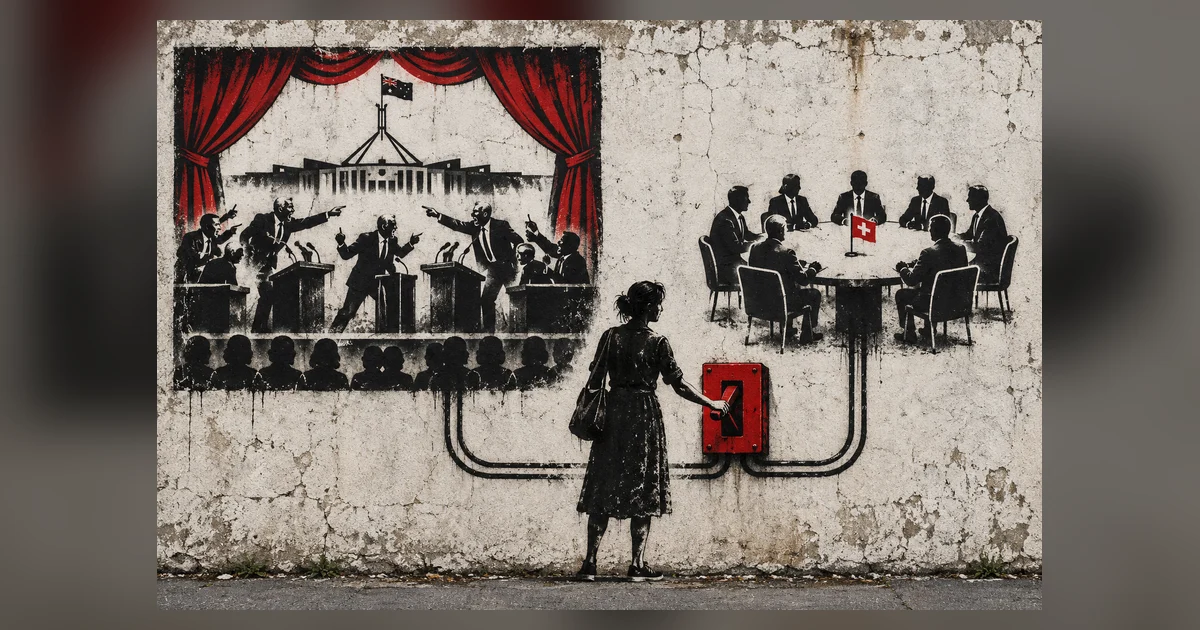
Two Swiss farmers forced a national vote about cows' horns. Australians can't ask a question at all, and haven't said yes since 1977. Here's why.
Art: Omxus Press
8 min read
 articleworld4u
Art: Omxus Press
Mary Hoodless was a community safety officer in Jingellic, up the Murray, when the fire came through in the summer of 2019–20. The town lost its phones. Hoodless told the local paper the month-long communication blackout across the Upper Murray caused "absolute chaos", and in June took it to the bushfire royal commission (Boyd, 2020).
You'd assume the fire burned the towers. Mostly it didn't. When Australia's communications regulator went through the season, it found 1,390 telecommunications facilities had been affected, and direct fire damage caused just one per cent of the outages. Most were power failures (Australian Communications and Media Authority, 2020). The towers stood there unburned and useless, because a line had come down somewhere far away.
That's what a network with a centre looks like when you can finally see it. Most days you can't. On 4 October 2021 a routine command disconnected every Facebook data centre, and for about six hours, billions of people who use WhatsApp as their phone line, family group and shop counter saw what their conversations rested on (Janardhan, 2021). Then it was fixed, and the dependency went back to being invisible.
Fires and typos are the gentle case. The human-rights group Access Now counts the times authorities switch the internet off on purpose. In 2016 it counted 78. In 2024 it counted 296, in 54 countries (Access Now, 2025). Over those nine years shutdowns grew about 13% a year, and the number of countries using them doubled, from 27 to 54. Four governments imposed seven in ten of 2024's.
Look at when they happen. In 2024, 103 came during conflict and 74 during protests. Seventy-two coincided with evidence of killings, torture or apparent war crimes that the blackout helped to hide. Sixteen came during school exams. The internet goes dark exactly when people most need to call for help and tell the world what's happening.
A fire, a typo and a dictator have one thing in common. A network with a centre has an off switch, and whoever or whatever reaches the centre holds it.
In 1964 an engineer named Paul Baran, working out how communications could survive a nuclear war, drew the answer: a network where every node passes messages on for its neighbours, with no centre whose loss takes everything down (Baran, 1964). The early internet took the lesson. The companies that run most of it now didn't.
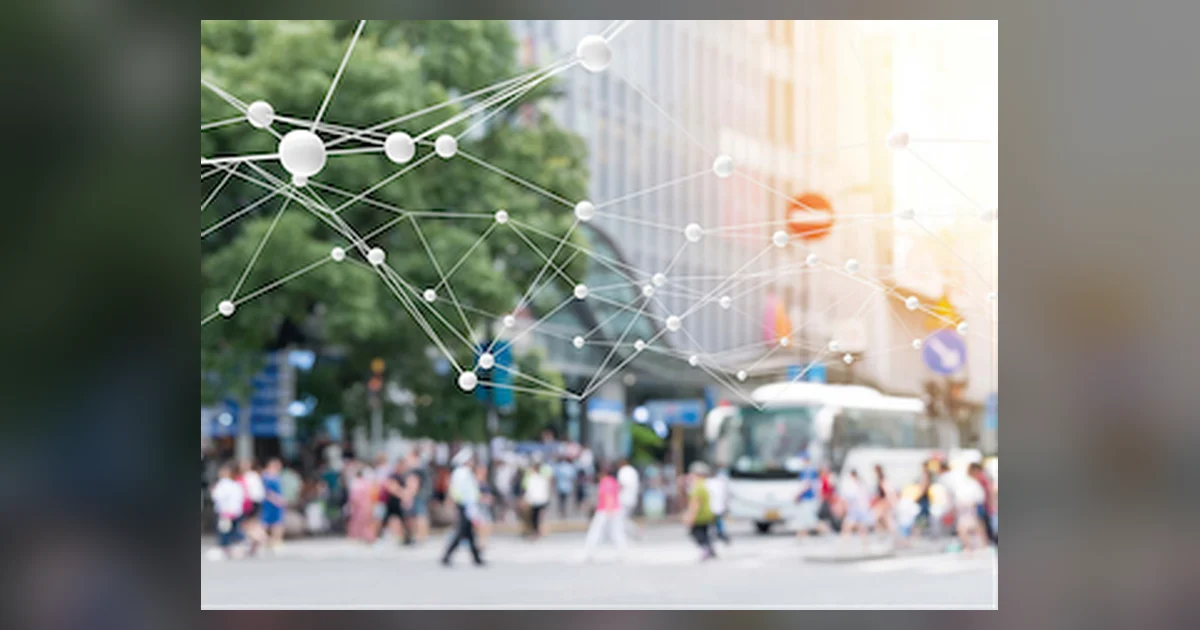
The idea has since turned cheap. Your phone has a Bluetooth radio, and so do close to seven billion others (Ericsson, 2023). Bluetooth has had a standard "mesh" mode since 2017, in which every device that hears a message passes it on (Bluetooth SIG, 2017). No tower. No server. No company. A small signed packet hops from phone to phone: someone nearby needs help, the road's cut at the bridge, the hall has water.
Would it work? Simulate thousands of towns of randomly placed phones and a pattern appears. A mesh connects once each phone has, on average, four or five others in range. Outdoors, with radios reaching about 120 metres, a hundred phones a square kilometre is enough. Indoors, where walls cut range to 30 or 50 metres, you need the crowd of a shopping centre or a stadium. So it suits a protest or a town under siege. A farm valley like Jingellic, with houses a kilometre apart, would need stronger radios or relay boxes on the fence posts.
It isn't magic, and it's been tried in anger. Protesters in Hong Kong reached for a mesh app called Bridgefy, and when cryptographers examined it they found they could track users and read messages (Albrecht et al., 2021). Researchers have also tracked supposedly anonymous Bluetooth devices (Becker et al., 2019). The idea needs proper engineering behind it, or it fails the very people it's for.
And remember the one per cent. If power's what took the towers down, messages alone won't do. So take the design one step further. A box in the garage holds a battery charged by the panels already on your roof. A pair of tuned copper coils, the big brother of your phone's wireless charger, passes power to the box next door. On your neighbour's cloudy morning, your surplus covers them. When you run the air conditioner, theirs covers you. A ledger keeps it fair.
Nikola Tesla dreamed of sending power around the world through the Earth itself, until his backer J. P. Morgan withdrew (Cheney, 1981). The planet's far too leaky for that (Nickolaenko & Hayakawa, 2002). But over a few metres, tuned coils do pass power through air (Kurs et al., 2007). Nobody has yet measured a multi-kilowatt hop between houses ten to twenty metres apart, and that's the number that matters. If each house draws from its nearest neighbour with spare power, almost every transfer is one hop long. So it isn't a long chain of losses. It's one hop, and one measurement. At $11,000 for a fully installed battery system and an $1,800 annual bill, a modelled node pays for itself in 6.3 years.
All of that's a model. Coil design, power electronics and Australian rules need expertise and approvals, and the design has been paused until it has them. Consider it a direction marker with a test attached: anyone with a bench, two coils and a meter can start on it.
There's something kind at the centre of this. Most "smart" systems turn where you are into data, then promise not to misuse it. A radio call doesn't work that way. It reaches the people near you and then it's gone. The people who hear your call for help are simply those closest to you, the way a surf lifesaver doesn't check who you are before pulling you out.
And people are already building towards it. After the Currowan fire left people stranded on the Shoalhaven's highways, with ATMs down and phones flat, a former naval aviator named Vince Di Pietro helped lead a council effort to fit 26 community hubs in existing buildings, running on solar and batteries, with satellite phones and screens that switch to local emergency instructions (The Cool Down, n.d.). No breakthrough. Just someone asking what happens when the line goes down, then doing something about it.
You can't stop the fire, the typo or the dictator. You can make sure they don't get to decide whether you reach your neighbours.
Two Swiss farmers forced a national vote about cows' horns. Australians can't ask a question at all, and haven't said yes since 1977. Here's why.
Art: Omxus Press
A small lottery lifted student turnout by 32%. Paying for blood drove women away. What moves us is rarely what we say it is, and somebody designs it either way.
Art: Omxus Press
A dead salmon lit up in a brain scanner because the method expected it to. When a clinician's belief decides the finding, what choice is always safe?
Cover of The Lonely Whisper of the Wind (Omxus Press)