Why does Australia almost never change its Constitution?
Two Swiss farmers forced a national vote about cows' horns. Australians can't ask a question at all, and haven't said yes since 1977. Here's why.
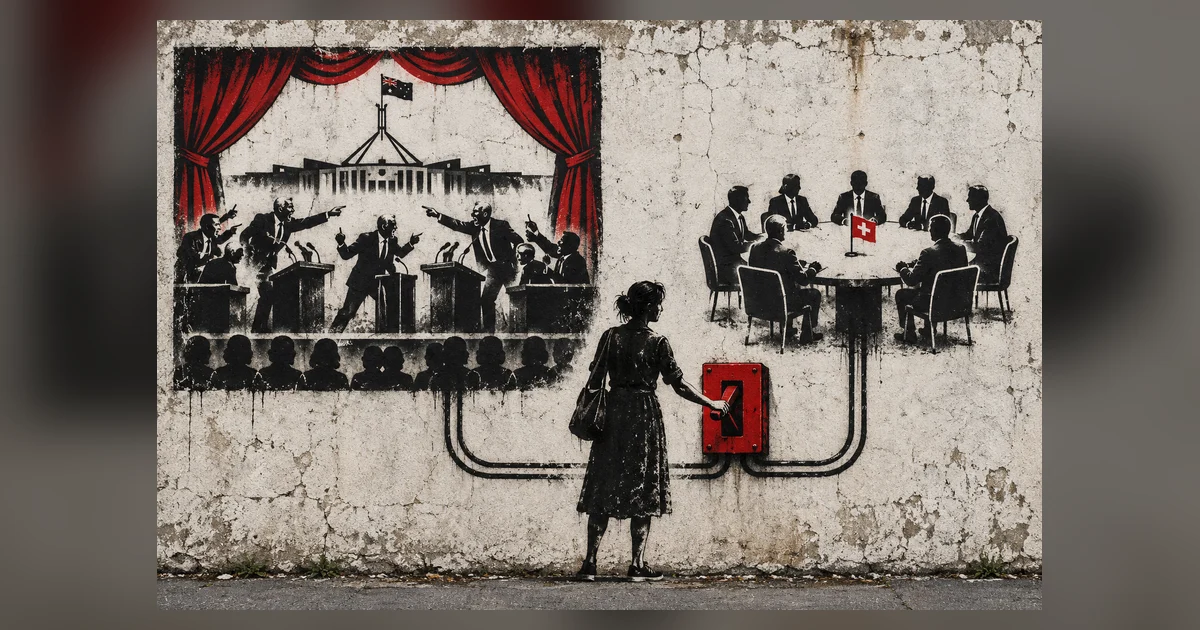
Art: Omxus Press
8 min read
 articleworld4u
Cover of Australian Democracy as Oligarchy (Omxus Press)
In 2006 Senator Eric Abetz sponsored a change to Australia's donation laws. Until then a party had to name anyone who gave it more than $1,500 in a year. The new law lifted the line to more than $10,000, rising with inflation (Electoral and Referendum Amendment Act 2006). Abetz said he hoped for "a return to the good old days when people used to donate to the Liberal Party via lawyers' trust accounts" (Tham, 2019, p. 3).
Read that again. A senator stood up and asked for donations that leave no trace, and got the law passed. Nobody broke a rule. So what did it do?
You can check. Every registered federal party lodges an annual return with the Australian Electoral Commission, listing its total income and itemising gifts above the line, and the Commission publishes the lot (Australian Electoral Commission, 2026a). From 1998–99 to 2024–25 that's 2,229 returns and 65,121 itemised receipts. Add them up and ask two plain questions. How much of the money has no named source? And of the named money, who gives it?
Across those 27 years, 33.4% of the money parties reported came with no named source. Every major party relies on it: 28% of Labor's income, 36% of the Nationals', 40% of the Liberals' and 40% of the Greens'.
Some of that's the $20 and $50 that keep a branch running. But watch what happened when the law changed. In the seven years the line sat at $1,500, unnamed money averaged 29% of party income. In the 19 years since it rose, it averaged 37%. Small donors didn't change their habits because of a law about large ones. The share grew by almost a third when Parliament raised the line below which names could be left off. Abetz got the good old days.
Of the money parties did declare as donations, the top 5% of donors gave more than half in 23 of the 27 years. In the last three federal election years they gave 85%, 86% and 80%. That matches the Grattan Institute's audit of the 2016 election, where "just 5 per cent of donors contributed more than 50 per cent" (Wood et al., 2018, p. 31).
The same report records a guest at a Victorian fundraising dinner saying what it bought: ten thousand dollars got you a seat next to the Premier (Wood et al., 2018, p. 39).
Most of what money buys in politics isn't a vote. It's a room. In a US experiment, congressional offices were three to four times more likely to give senior time to people introduced as donors than to the same people introduced as constituents (Kalla & Broockman, 2016).
Australia has its own version. Grattan counted at least 500 commercial lobbyists and another 1,755 people with sponsored passes to walk Parliament House unescorted. Where ministers' diaries are published, in Queensland and New South Wales, 62–63% of senior ministers' meetings were with businesses or industry groups (Wood et al., 2018). The High Court named the danger in 2015: not bribes, but a politician's "dependence on the financial support of a wealthy patron" (McCloy v New South Wales, 2015, as quoted in Tham, 2019, p. 4). People who meet every week come to like each other. That's human. It's also how a country ends up with policy a small number of donors would choose.
Grattan lists what the access bought. A casino licence granted without a tender. A carbon price with "overly-generous subsidies" for gas and coal "added in response to intense lobbying", then repealed. Mandatory pre-commitment for poker machines, blocked by clubs and hotels. Now picture who wasn't in the room: patients paying more for medicines, renters in cities where rezoning skews to the developer at the fundraiser, families in a pokie suburb. None of them are in the diary. They are, statistically, who Australia mostly is.
More than seven in ten Australians say the people in government look after themselves. It's easy to call that cynicism. The returns suggest it's closer to an accurate reading of a design that hears the well-resourced most clearly. And there's nobody to sack, because the people in the room are mostly doing their jobs as they understand them. The room isn't bad people. It's bad design.
In 2012 some people in the rural Victorian seat of Indi got sick of feeling taken for granted. They formed Voices for Indi and held kitchen table conversations: small groups in people's homes, more than 400 people across the electorate, on what they wanted from a member of Parliament. Those talks shaped a platform and chose a candidate. In 2013 Cathy McGowan, an independent, took one of the safest conservative seats in the country from a sitting frontbencher (Hendriks, 2017). Dozens of communities have since copied the model.
That's one seat, and independents can still end up with their own wealthy backers. But the table turned out to be a room anybody could get into.
In 2025 Parliament passed a law that lowers the line to $5,000, caps donations and spending, and speeds up disclosure, with its funding and disclosure changes starting 1 January 2027 (Australian Electoral Commission, 2026b). That makes Australia a test case: if raising the line hid more money, lowering it should show more. But those caps were written by the parties that'll live under them, and federal ministers' diaries still aren't published.
The other path takes the decision out of the room. Switzerland has put more than seven hundred federal questions to its voters since 1848, and 62% of Swiss people report high or moderately high trust in their federal government, against an OECD average of 39% (OECD, 2024). A review of the US evidence finds that ballot initiatives tend to move policy towards what majorities want, and that money is far better at blocking a measure than passing one (Matsusaka, 2005). It's hard to take a whole country to dinner.
Nothing here says Australia's an autocracy or that voting doesn't matter. It's a fortunate country, with institutions worth keeping and upgrading. We can keep the rule of law and the fair go, and still ask who's in the room.
Your life is shaped by decisions made in rooms you'll never enter. You've got more say than the odds suggest, because very few people bother.
Two Swiss farmers forced a national vote about cows' horns. Australians can't ask a question at all, and haven't said yes since 1977. Here's why.
Art: Omxus Press
A small lottery lifted student turnout by 32%. Paying for blood drove women away. What moves us is rarely what we say it is, and somebody designs it either way.
Art: Omxus Press
A dead salmon lit up in a brain scanner because the method expected it to. When a clinician's belief decides the finding, what choice is always safe?
Cover of The Lonely Whisper of the Wind (Omxus Press)