Why does Australia almost never change its Constitution?
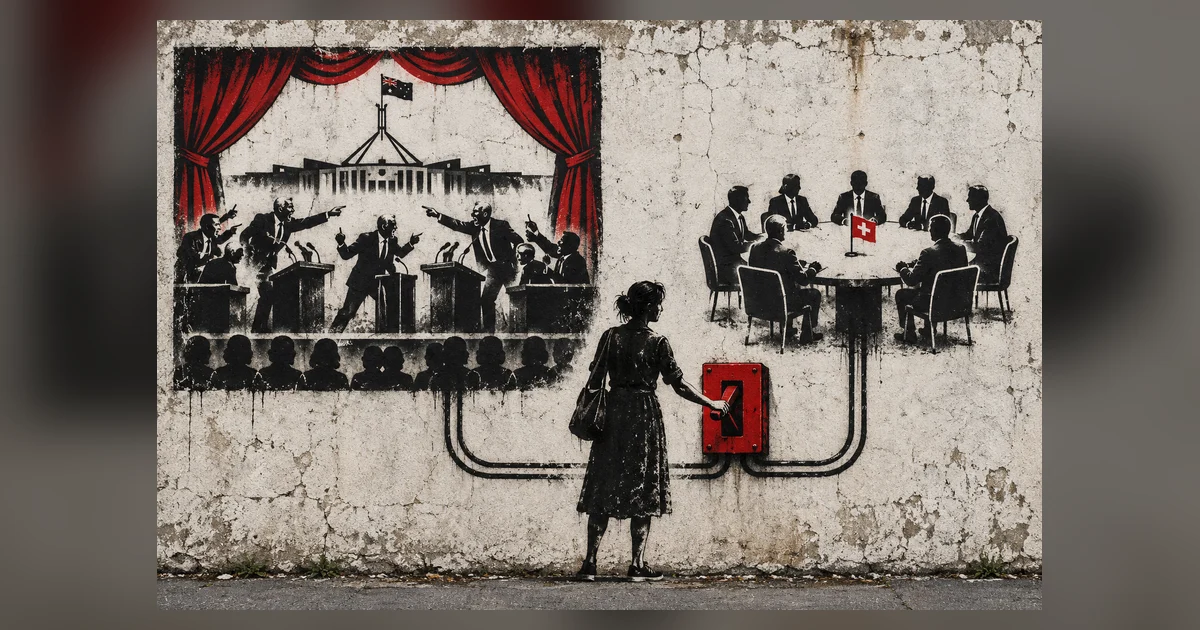
Two Swiss farmers forced a national vote about cows' horns. Australians can't ask a question at all, and haven't said yes since 1977. Here's why.
Art: Omxus Press
8 min read
 articleworld4u
Cover of Bread and Circuses (Omxus Press)
In 2017 a Melbourne woman named Shonica Guy, addicted to pokies for 14 years, took a casino and a machine maker to the Federal Court. She didn't ask for a cent in damages. She wanted a court to say the machines mislead people. It was, her lawyers said, like "playing a game of cards without knowing the deck has four aces of spades, three queen of hearts and seven tens of diamonds" (Clark, 2017).
In February 2018 Justice Mortimer dismissed the case: the allegations weren't proven (Guy v Crown Melbourne Limited (No 2), 2018). The machines are still there, with their lights and their sounds that celebrate when you win back less than you bet. Which raises a question that court was never asked. Where have they been put?
Victoria lets you check, because its gambling regulator publishes what each council area loses every year (Victorian Gambling and Casino Control Commission, 2024). In 2023–24 Victorians lost $3.03 billion on poker machines, $554 per adult. In Brimbank, in Melbourne's west, adults lost $1,076 each, more than anywhere else in the state.
Set all 70 council areas with pokies beside the Australian Bureau of Statistics' measure of disadvantage, and the pattern is plain.
| Fifth of Victorian council areas, by disadvantage | Share of adults | Share of pokies losses | Lost per adult, 2023–24 |
|---|---|---|---|
| Most disadvantaged | 14.0% | 20.6% | $814 |
| Second | 14.4% | 15.6% | $598 |
| Middle | 20.6% | 19.6% | $527 |
| Fourth | 23.0% | 22.2% | $536 |
| Least disadvantaged | 28.0% | 22.0% | $435 |
Each adult in the most disadvantaged fifth lost $814, nearly twice the $435 in the least disadvantaged fifth. (The fifths rank all 79 council areas with a disadvantage score, including those with no venues.) The same holds in every year from 2021–22 to 2023–24, and earlier work on Victorian data found the same (Rintoul et al., 2013). The more disadvantaged the area, the more machines per adult too. So machines aren't spread evenly and used unevenly. They're placed unevenly.
These are area figures, and some of that money comes from people who live elsewhere. But it isn't random, and it isn't because poor people are stupid. The Productivity Commission estimated that people with gambling problems supply around 40% of what pokies take (Productivity Commission, 2010). Put a machine designed to hold attention on the corner of a suburb with few other ways out, and you'll get what you've built.
None of this is new. The emperor Titus opened the Colosseum in 80 CE. It held around 50,000 people, and the shows, which were often fatal, were free (Hopkins & Beard, 2005). The city outside had hungry people, deep inequality and no real vote. Rome's rulers could have changed that. They handed out free grain instead; Augustus records giving grain and cash to "a little over two hundred thousand" people (Augustus, 14 CE), and feeding the city became a permanent duty of the emperor (Garnsey, 1988).
The poet Juvenal saw the trade. The people once "handed out military command, high civil office, legions, everything." Now they "anxiously hope for just two things: bread and circuses" (Juvenal, c. 100–127). His complaint was political, not moral. They'd had power, and they'd swapped it for a meal and a show.
Call that a lock: something that holds a bad condition in place by managing its consequences, at recurring cost, instead of removing its cause. Rome spent fortunes capturing, training and killing people on an industrial scale, and it made the city quieter, not stronger. It also didn't last. The Colosseum still stands. The empire doesn't.
The trick has a modern difference. Rome's games were free. Ours charge admission. Australians lost $31.5 billion gambling in 2022–23, about $1,527 an adult, the highest in two decades (Australian Institute of Health and Welfare, 2025). A person feeding a machine at 11 on a Tuesday night isn't a moral failure. They're someone with a hard life and a bright thing built to hold them. And governments that collect the tax on it have little reason to ask why they're there.
There's another way. In July 2007 Norway banned its slot machines outright. Later it brought in a few state-run terminals that need a player card (Parliamentary Library, 2011). Gambling and gambling problems fell, and so did calls to the national helpline. Some people moved to foreign websites, but far fewer than had left the machines (Engebø et al., 2021). Online gambling has since grown, and nobody should pretend the fight ended there. But a country looked at a lock and took it off, and the sky didn't fall.
Life's hard enough in Brimbank without a machine on the corner taking $1,076 a head. That's a choice somebody made, and somebody can unmake it.
Shonica Guy lost her case and asked for nothing for herself. What she wanted was for someone to look. Now you've looked.
Two Swiss farmers forced a national vote about cows' horns. Australians can't ask a question at all, and haven't said yes since 1977. Here's why.
Art: Omxus Press
A small lottery lifted student turnout by 32%. Paying for blood drove women away. What moves us is rarely what we say it is, and somebody designs it either way.
Art: Omxus Press
A dead salmon lit up in a brain scanner because the method expected it to. When a clinician's belief decides the finding, what choice is always safe?
Cover of The Lonely Whisper of the Wind (Omxus Press)