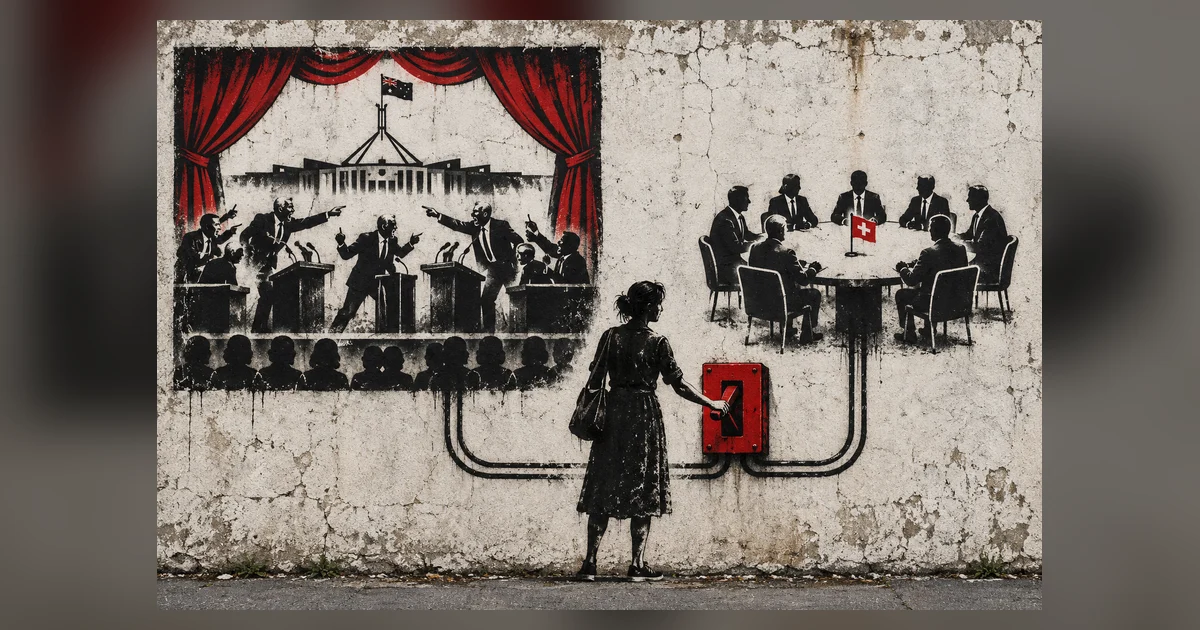
Why does Australia almost never change its Constitution?
Two Swiss farmers forced a national vote about cows' horns. Australians can't ask a question at all, and haven't said yes since 1977. Here's why.
Art: Omxus Press
8 min read
 articleworld4u
Art: Omxus Press
In the spring of 2019, students at a large public university in the United States got an email about their student government election. Some got a plain one: "Vote in SGA elections." And 3,779 got a subject line with six more words in it: "for a chance to win $300." Five voters would be drawn at random. The whole prize pool cost US$1,500 (La Raja & Schaffner, 2022).
Among students who opened the plain email, 20.3% voted. Among those who opened the lottery email, 26.8% did. That's a rise of almost a third. First-generation students moved most: 7.6 points, against 2.8 for everyone else. Each extra voter cost US$1.58.
Nobody in that study needed $300 to care about student government. Ask any of them why they voted and you'll hear about the issues. Nobody says "a small chance at a prize." The chance did the work anyway.
Australians should recognise this. We vote because democracy matters, we'll tell you, with a straight face and a sausage in one hand.
Psychologists have known for decades that people carry two kinds of motive. One kind they can name: the reasons they give. The other runs underneath, the pull of belonging, of being recognised, of not missing out, and it barely lines up with the first (McClelland et al., 1989).
The underneath kind doesn't even need you to see the reward. In laboratory experiments, coins flashed on a screen too fast to notice still made people try harder (Pessiglione et al., 2007; Zedelius et al., 2012). The prize in that email was printed in plain sight, but the motive it reached wasn't. A flicker of "what if my name gets drawn and I didn't vote?" isn't something anyone reports as a reason.
The same machinery runs backwards. In Sweden, researchers invited students to become blood donors. Some were offered nothing. Some were offered about US$7. Some could take the money or give it to charity. Women offered the money signed up at almost half the rate of women offered nothing. When the money could go to charity, they came back (Mellström & Johannesson, 2008).
No one said "money insults me." The money turned a gift into a job, and a motive nobody had mentioned quietly left. The same thing happened at day-care centres that started fining parents for late pick-up. Late pick-ups went up, because a fine is a price, and a price is something you can decide to pay (Gneezy & Rustichini, 2000).
Rewards also just shuffle things around. The American Red Cross gave randomly assigned donors gift cards of up to US$15. Donation rose from 0.53% to 1.33%, but donors moved from neighbouring drives and brought donations forward, offsetting roughly 31% to 45% of the gain (Lacetera et al., 2014). So count the whole system, not only the place the incentive sits.
Small things can last, though. Give schoolchildren a small reward for eating fruit or vegetables at lunch, for three or five weeks, and uptake doubles from a 39% baseline. Two months after the rewards stopped, it was still 21% to 44% above baseline (Loewenstein et al., 2016). Nobody grows up saying they eat vegetables because of a sticker. New editors on German Wikipedia who got a purely symbolic award on their profile, worth nothing outside the site, stayed active at higher rates for a year (Gallus, 2017).
Then there's the buzz. Mark Wilson, a London neurosurgeon and air ambulance doctor, kept flying to emergencies where someone nearby could have done something in those first minutes. Most people would help. They just didn't know. So in 2013 he and two colleagues started GoodSAM, a phone app that alerts trained volunteers near someone in cardiac arrest (Stanford Social Innovation Review, n.d.).
In London and the East Midlands, when a volunteer accepted an alert, the odds of the patient leaving hospital alive were about three times higher (Smith et al., 2022). Volunteers who accept may differ from those who don't, so don't lean too hard on that figure. But here's the catch: they accepted the alert in only 1 to 5 of every 100 arrests. The willingness to help was there. The system rarely reached it. Lift acceptance from 1.3% to 10% and, taking the odds at face value, that's about 13 more survivors per 1,000 arrests.
Don't get carried away. In May 2021 Ohio offered five US$1 million draws for vaccinated adults. First doses ran 10.7% above the trend in other states afterwards, which sounds great until you see that fifteen states moved more over the same weeks, for their own reasons. It can't be told from chance. The randomised experiments carry this argument, and a state lottery is too noisy to add to it.
Every system that asks people to take part already has an incentive design: a ballot, a blood service, a volunteer roster, a neighbourhood that might respond when someone collapses. Nobody gets to have none. They only choose whether to notice it.
The evidence points one way. Pair recognition with purpose, not price: symbolic awards keep volunteers. A small chance can beat a reminder. Money attached to a gift can drive givers off, unless it can go back to the cause. And an alert addressed to a named, nearby, trained person is the cleanest answer to a crowd that waits for someone else.
This can be used on you, of course, and it is, by every app on your phone. That's the reason to learn it. Life's hard enough without the helpful thing being the awkward thing. People who want to help you are everywhere, and most of what stops them is design.
The students who voted would tell you they voted because student government matters. They were right, and they were moved by something else as well. That something else belongs to whoever builds the system. It might as well be us.
Two Swiss farmers forced a national vote about cows' horns. Australians can't ask a question at all, and haven't said yes since 1977. Here's why.
Art: Omxus Press
A dead salmon lit up in a brain scanner because the method expected it to. When a clinician's belief decides the finding, what choice is always safe?
Cover of The Lonely Whisper of the Wind (Omxus Press)
Australia cut its road toll by 84% and young children's drowning by 87%. Harsher punishment didn't do it. People who refused to call the deaths accidents did.

Art: Omxus Press