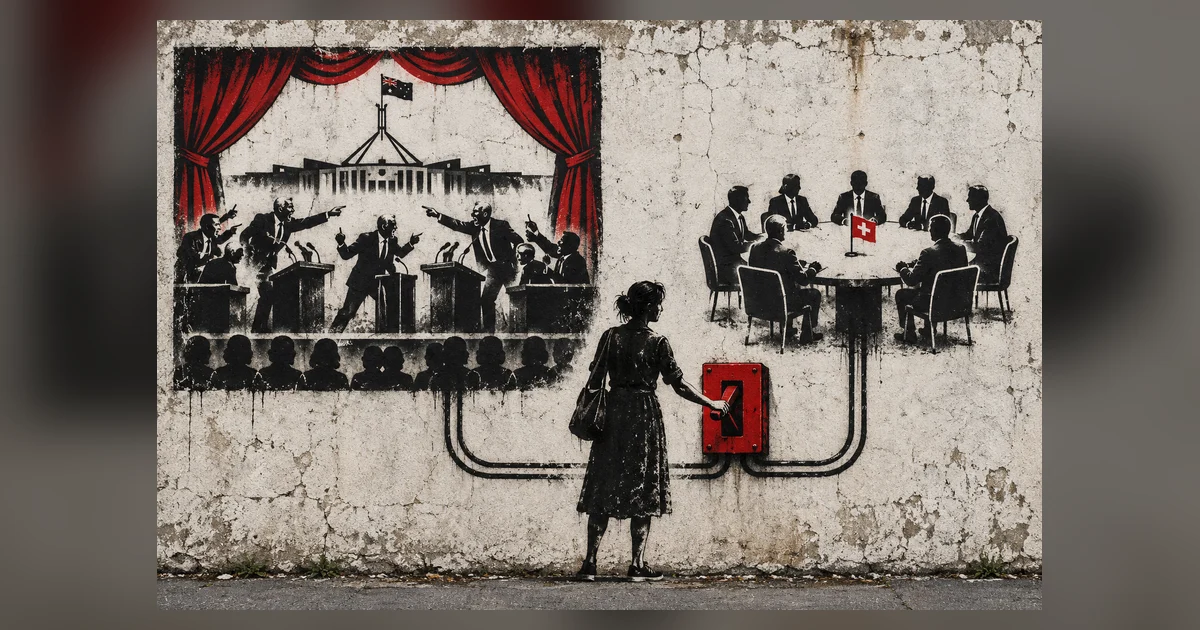
Why does Australia almost never change its Constitution?
Two Swiss farmers forced a national vote about cows' horns. Australians can't ask a question at all, and haven't said yes since 1977. Here's why.
Art: Omxus Press
8 min read
 articleworld4u
Art: Omxus Press
On 3 May 1980 Cari Lightner, thirteen, was walking to a church carnival in Fair Oaks, California, when a drunk driver hit her and drove on. The man was a repeat offender, out on bail from another drunk driving arrest. Police told her mother, Candy Lightner, he'd probably get little punishment (HISTORY.com Editors, n.d.). She wouldn't call it an accident.
Candy Lightner started Mothers Against Drunk Driving that year. Bereaved parents sat down together and went through it step by step, and they knew exactly where the system had let the driver through. They weren't scientists. Twenty-five years later, alcohol-related road deaths in the United States had fallen from an estimated 30,000 a year to 16,694 (Fell & Voas, 2006). They couldn't claim all of that, since cars and roads were changing too. But they'd helped change what everyone thought a drunk driver was.
Look at what they did with their anger. It would've been natural to aim all of it at one man. They aimed it at the holes he came through.
In 1970, land transport crashes killed 4,092 people in Australia, 32.7 for every 100,000 of us. In 2024 they killed 1,397, or 5.1 per 100,000, in a population more than twice the size (Australian Institute of Health and Welfare, 2026).
| Harm | Worst year | 2024 | Fall |
|---|---|---|---|
| Road deaths, per 100,000 people | 32.7 (1970) | 5.1 | 84.4% |
| Drowning deaths of children aged 0 to 4, per 100,000 children | 8.6 (1983) | 1.1 | 87.2% |
Had the 1970 road rate held, 8,957 people would have died on Australian roads in 2024. Across 1971 to 2024 the difference is about 211,000 people. Think of a city nearly the size of Geelong, walking around, none of whom know it. Had the 1983 drowning rate held, 133 young children would have drowned in 2024 instead of 17. Across 1984 to 2024 that's about 3,000 children.
Victoria made seatbelts compulsory in December 1970, and the other states followed (Foldvary & Lane, 1974). New South Wales began random breath testing in December 1982 (Homel, 1983). Roads and cars were rebuilt around the fact that people make mistakes. Pool fencing helped, especially fences separating the pool from the house (Thompson & Rivara, 1998), along with supervision, swimming lessons, resuscitation skills and faster emergency response. Those national figures show how far the harm fell, not which change did how much, and people's exposure changed too.
Nobody made drivers better people. The system changed, and the deaths followed it down.
Punishment arrives after the harm, by definition. The road toll didn't come down because we punished drivers harder after crashes. It came down because belts, breath tests, roads and cars changed the conditions under which people make mistakes.
Underneath that sits a plain belief: people are good, systems are broken, and we can fix the systems. Trace a preventable death backwards and you rarely find an evil person at the root. You find conditions set by designers, managers and lawmakers far from the event, waiting for an ordinary error to complete them (Reason, 2000). The word "accident" hides all of that. It tells you to stop looking.
The person closest to the failure often sees those holes most clearly. Yet institutions tend to hear grief rather than evidence. Philosophers call that a credibility deficit, handed to a speaker because of who they are and not what they know (Fricker, 2007). A grieving parent gets a kind voice and a pamphlet.
What would it look like to take them seriously? Try five questions, for anyone who has lived through a preventable harm:
Bruce and Denise Morcombe lived those questions in public. Their son Daniel was abducted and murdered on the Sunshine Coast in 2003. In 2005 they set up a foundation that teaches children personal safety. Queensland now has a Daniel Morcombe Child Safety Curriculum, and more than two million people took part in Day for Daniel in 2024 (Daniel Morcombe Foundation, n.d.). Punishment dealt with one man. The lessons reach kids nobody will ever know were saved.
Grief isn't neutral, and anyone building on it should say so. It's why the method needs rules. Every high-stakes decision should get a memo that writes down, before looking at the evidence, how likely each explanation was.
That matters most when institutions turn on grieving people. Say something's rare, 1 in 100, and a piece of evidence is ten times likelier when it's true. Of 1,000 such cases, the evidence turns up in all 10 true ones and in 99 of the 990 false ones, so about nine in ten flagged cases are false. The honest answer is about 9.2%. A reviewer who never wrote the rate down reads the same evidence as 90.9% likely (Gigerenzer & Hoffrage, 1995). That's the gap between a family supported and a family accused.
The method has limits too. Applied to one family's loss, it can yield a long list of requirements that fit that loss, and someone else answering the same questions will produce a different list. A local pilot can measure whether more adults know CPR or more pool gates latch. It can't measure child drowning deaths: a neighbourhood of 2,000 has about 114 children under five and would expect one such death every 800 years. So measure the layers, and leave the death count to the national figures.
Terrible things will keep happening to us. But some of them have holes in them that someone could have closed, and you might be the person who can see them.
The only justice that doesn't ask for a tragedy first is prevention.
Two Swiss farmers forced a national vote about cows' horns. Australians can't ask a question at all, and haven't said yes since 1977. Here's why.
Art: Omxus Press
A small lottery lifted student turnout by 32%. Paying for blood drove women away. What moves us is rarely what we say it is, and somebody designs it either way.

Art: Omxus Press
A dead salmon lit up in a brain scanner because the method expected it to. When a clinician's belief decides the finding, what choice is always safe?
Cover of The Lonely Whisper of the Wind (Omxus Press)