Why does Australia almost never change its Constitution?
Two Swiss farmers forced a national vote about cows' horns. Australians can't ask a question at all, and haven't said yes since 1977. Here's why.
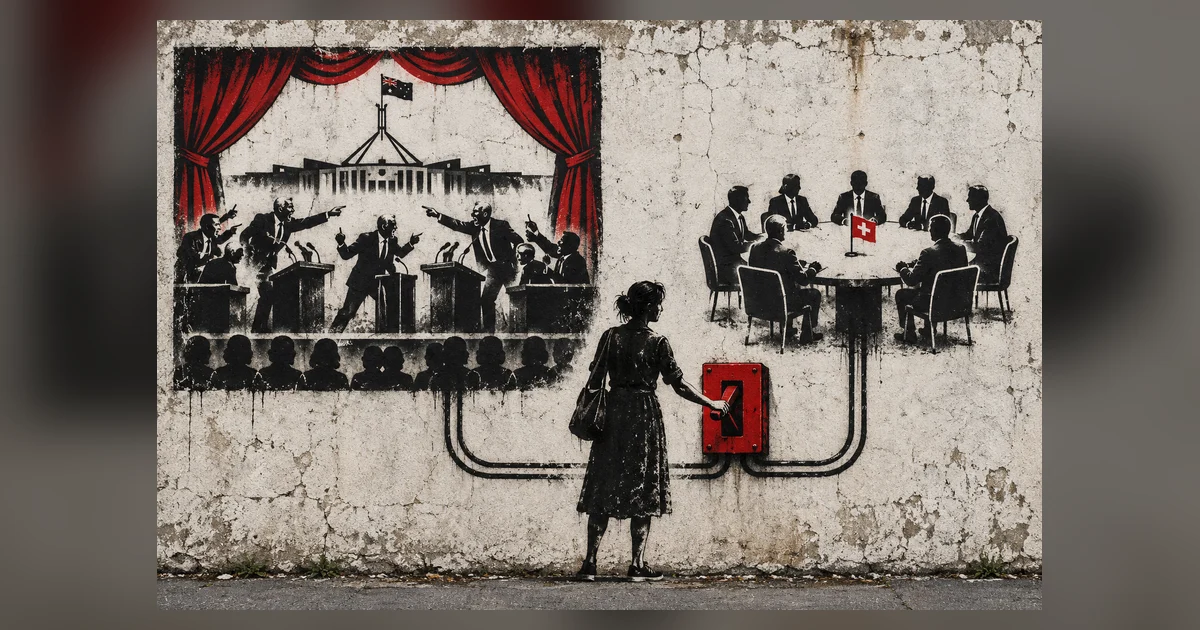
Art: Omxus Press
8 min read
 articleworld4u
Art: Omxus Press
In December 2025 Paris Buttfield-Addison, an Australian who writes technical books on Apple's programming languages, tried to pay for iCloud storage with a $500 Apple gift card from a major store. The card didn't work. Then the Apple ID stopped working too, one held for about 25 years, with "terabytes of family photos" and an entire message history behind it. The phones, tablets and laptops turned, as the author put it, somewhat to completely useless (Buttfield-Addison, 2025).
Support offered no explanation and no way back. So Buttfield-Addison did what few of us could do: published the story, as someone well known in those circles. Daring Fireball picked it up, then Apple Insider, then The Register. Hundreds of people wrote in. Someone from Apple's Executive Relations began to call, and five days after the post the account came back. The card, it seems, had been tampered with before anyone sold it. A customer of 25 years lost a whole digital life over a card that someone else had interfered with.
And the outcome rested on an audience. Ask what happens to a nurse in Launceston with the same bad card and no readers.
We know something about the answer. In February 2021 a father in San Francisco photographed his toddler's swollen groin because a nurse asked for pictures before a video consultation. Google's systems flagged the photos as abuse and shut the account, with more than ten years of email, contacts, photos and his phone number. Police investigated and cleared him. Google didn't restore the account, even after The New York Times called (Hill, 2022). From December 2023 Google began deleting personal accounts left inactive for two years, with all their email and photos (NPR, 2023). In July 2019 GitHub restricted developers in Iran, Syria and Crimea without notice (Dillet, 2019), for where they lived.
Nobody in these stories faced a judge. That's the point. A court can be asked why. A terms-of-service department can't.
This isn't about one cruel company. Your email resets every other password. Your phone holds the second factor. "Sign in with" buttons send the rest through the same few providers. So whoever runs those has become an identity office, unelected, with no due process.
And there aren't many of them. Regulators call a market "highly concentrated" when an index of concentration passes 1,800 (U.S. Department of Justice & Federal Trade Commission, 2023). Run StatCounter's public market data from 2012 to 2025 through that index, for phone systems, computer systems, browsers, search and social media, and every one of those markets passes it, in Australia and worldwide, in every year (StatCounter, 2025). In Australia in 2025, Google's owner handled 92% of searches. Four companies, Alphabet, Apple, Microsoft and Meta, held between 92% and 99% of four of the five markets. StatCounter counts page views rather than people, so treat those as rough. But Australia's own competition regulator reached the same conclusion in 2019: a few platforms act as gateways that others must pass through (Australian Competition and Consumer Commission, 2019).
Free email with lots of storage in 2004. A phone that needed an account in 2007. "Sign in with Google", because it beat another password. The standards underneath made that easy (Hardt, 2012; Sakimura et al., 2014). Each step made sense. Nobody ever sat down and handed over their identity. It went one convenient click at a time, and the total is captivity.
People have tried to fix this for a long time, and the best try looks almost quaint. In the 1990s, users of the encryption program PGP held key-signing parties: strangers met in a room, checked each other's ID, and vouched for each other's keys. No company involved. It's a lovely idea, and ordinary people never came. In 1999 two researchers gave twelve educated, email-literate people 90 minutes with PGP to sign and encrypt one message. Only a third managed it, and a quarter accidentally sent out the secret they were meant to protect (Whitten & Tygar, 1999).
Today's standards for identifiers you hold yourself are sound, too (Sporny et al., 2022). Few people use them. Network effects protect the big providers, and asking people to guard a cryptographic key is asking them to be their own bank.
So picture a design that keeps the room and loses the homework. Your device builds your key from things you know: your name, your birthday and a few random words it gives you. Nothing's stored on a server, so there's nothing for anyone to delete. To show you're a person, a small group meets in the same room. Their devices confirm they're together by short-range radio, and each signs that the others were there. A bot can't stand in a room.
Is a key you can remember safe? That's arithmetic. Name and birthday are public, so the words carry all the secrecy. If the device picks them at random, five words hold out against a laptop for tens of thousands of years but fall to a large cracking farm in about 208 days. Six take that farm more than a thousand years. Eight are beyond any attacker we can describe. Words people pick themselves are far weaker, with five falling to a laptop in about half an hour, so the device must choose and the key-making must be deliberately slow.
Nobody's tested the room part at scale. It raises hard questions: what about someone who can't get to a room, or forgets their words? Platforms also catch real abuse, and nothing here argues against that. But if the arithmetic works, why does your whole life still hang on a company's fraud filter? Mostly because it was never in anyone's interest to build the alternative.
Most of us will never read a terms-of-service page, and losing your photos of your kids shouldn't depend on it.
Australian Competition and Consumer Commission. (2019). Digital platforms inquiry: Final report. ACCC.
Buttfield-Addison, P. (2025). 20 years of digital life, gone in an instant, thanks to Apple. hey.paris. https://hey.paris/posts/appleid/
Dillet, R. (2019, July 29). GitHub confirms it has blocked developers in Iran, Syria and Crimea. TechCrunch. https://techcrunch.com/2019/07/29/github-ban-sanctioned-countries/
Hardt, D. (2012). The OAuth 2.0 authorization framework (RFC 6749). Internet Engineering Task Force. https://doi.org/10.17487/RFC6749
Hill, K. (2022, August 21). A dad took photos of his naked toddler for the doctor. Google flagged him as a criminal. The New York Times.
NPR. (2023, December 2). Google starts deleting Gmail accounts that have been inactive for over two years. https://www.npr.org/2023/12/02/1216716083/google-starts-deleting-gmail-accounts-that-have-been-inactive-for-over-two-years
Sakimura, N., Bradley, J., Jones, M., de Medeiros, B., & Mortimore, C. (2014). OpenID Connect core 1.0. OpenID Foundation. https://openid.net/specs/openid-connect-core-1_0.html
Sporny, M., Longley, D., Sabadello, M., Reed, D., Steele, O., & Allen, C. (2022). Decentralized identifiers (DIDs) v1.0. World Wide Web Consortium. https://www.w3.org/TR/did-core/
StatCounter. (2025). StatCounter Global Stats [Data set]. https://gs.statcounter.com/
U.S. Department of Justice & Federal Trade Commission. (2023). Merger guidelines.
Whitten, A., & Tygar, J. D. (1999). Why Johnny can't encrypt: A usability evaluation of PGP 5.0. In Proceedings of the 8th USENIX Security Symposium. USENIX. https://people.eecs.berkeley.edu/~tygar/papers/Why_Johnny_Cant_Encrypt/USENIX.pdf
Two Swiss farmers forced a national vote about cows' horns. Australians can't ask a question at all, and haven't said yes since 1977. Here's why.
Art: Omxus Press
A small lottery lifted student turnout by 32%. Paying for blood drove women away. What moves us is rarely what we say it is, and somebody designs it either way.
Art: Omxus Press
A dead salmon lit up in a brain scanner because the method expected it to. When a clinician's belief decides the finding, what choice is always safe?
Cover of The Lonely Whisper of the Wind (Omxus Press)