Why does Australia almost never change its Constitution?
Two Swiss farmers forced a national vote about cows' horns. Australians can't ask a question at all, and haven't said yes since 1977. Here's why.
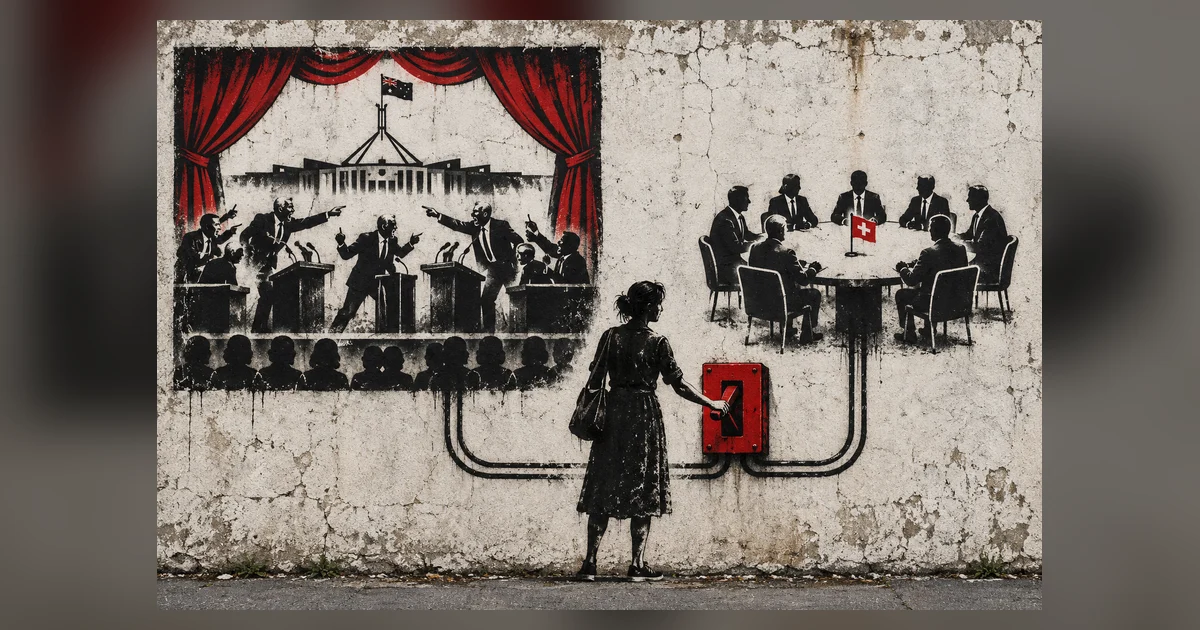
Art: Omxus Press
8 min read
 articleworld4u
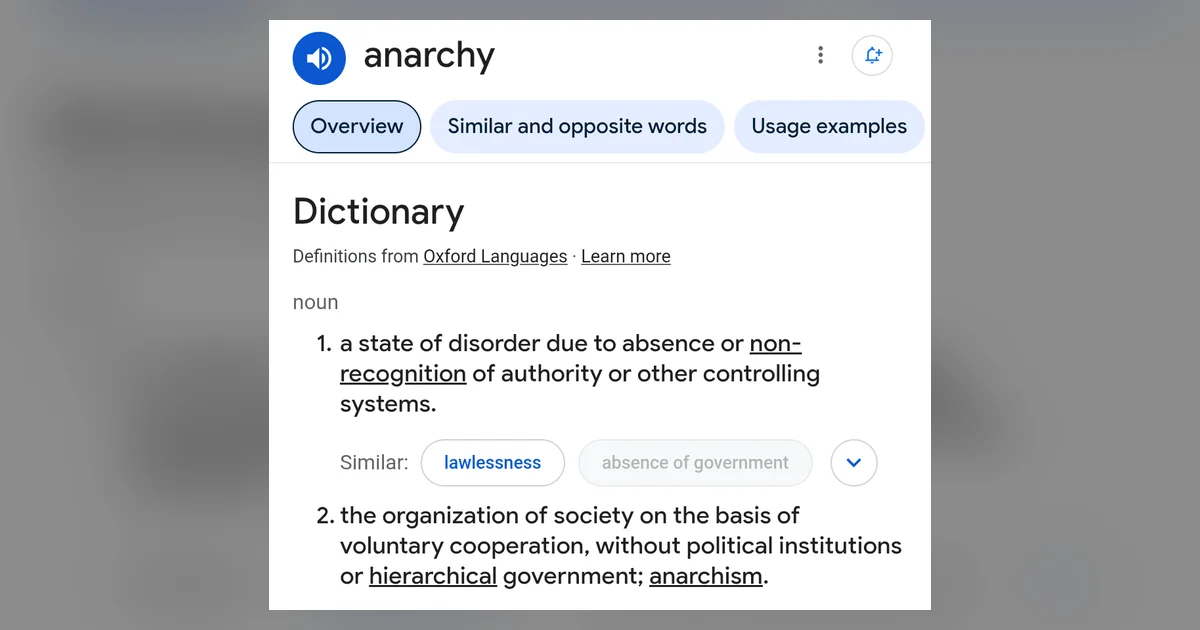
Art: Omxus Press
In 1483 the farmers of Törbel, a village on a Swiss mountainside, signed a contract on how to share their water and pasture. Nobody owned the alp. Nobody from outside ran it. An old rule of the place held that you couldn't send more cows up in summer than you could feed through the winter (Netting, 1981; Ostrom, 1990). Five centuries on, it's why scholars call Törbel "the over-researched village" (von Wyl, 2025).
Look the word up and you get two meanings: disorder, and a society run on voluntary cooperation. Most arguments only ever use the first.
Economists long assumed that a shared field had to be ruined by overgrazing unless a government ran it or a private owner fenced it. Elinor Ostrom spent a career showing farmers and fishers doing neither, for centuries, and won the 2009 Nobel Prize in economics for it. What happened next is the funny part. Open-source advocates at the Mozilla Foundation study those principles. So does the global alliance of workers' cooperatives. And in May 2025 Switzerland's environment minister, Albert Rösti, of the right-wing Swiss People's Party, called Ostrom's principles "pillars of Switzerland" (von Wyl, 2025).
Think about how odd that is. For a century, half the planet's politics has rested on one fight: who should hold the lever, the owner or the state? People died of that argument. Yet here's an alp that a conservative minister and a socialist co-op can both point to with pride.
Why? Each side's best argument is aimed at the other side's controller. Markets distrust planners, because no planner can know what millions of people know (Hayek, 1945). Socialists distrust owners, because owners take what workers make (Marx, 1867). Both assume someone must hold the lever. Take away the planner and the owner, and neither objection has a target.
Could that work on purpose, for something new? A small experiment tried it, using digital identity. It wrote three short descriptions, matched in length and tone, with no names.
The readers were two language models, DeepSeek (trained in China) and Gemini (trained in the United States), which carry the values of the writing that trained them (Tao et al., 2024). Each answered in fresh conversations as a committed free-market advocate, as a committed Marxist, and as itself, scoring each system from 1 (strongly oppose) to 7 (strongly endorse). Models also lean towards agreeing with whatever they're shown (Sharma et al., 2023), and that's why B and C are in the test. A flatterer would have endorsed them too.
It didn't. The models weren't being polite: 57% of all replies scored a system 1 or 2. The state registry got 1 or 2 in all 51 of its replies. The corporate platform split the room, with DeepSeek's free-market reader giving it 6.3 and its Marxist reader 1.0.
Now score each system by its less friendly reader, since that's the one you'd need to win over. DeepSeek's result: System A 3.80, the other two 1.00 each, and A beat both in all ten conversations. That isn't love. It falls short of the 5 set beforehand as strong support, because the Marxist reader endorsed A in four conversations and gave a mild 3 in the other six.
The objection tells you more than the score. The Marxist reader praised the equal shares, the commons and the mutual aid in every reply, and objected, 11 times in 14, to the per-check fee: the one feature that uses the market's tool. Gemini's free allowance ran out after 48 of 90 replies, so its answers are only a hint, but they point the same way.
Here's the argument underneath. Systems designed from a theory carry one side's constraint. System A started somewhere else: what would have to be true for the failures one person lived through, at the hands of companies, agencies and silent neighbours, never to happen to anyone else? Build against every failure you've seen and both camps recognise it, because both have seen those failures, and each blames the other side.
Törbel works the same way. Nobody there was building an ideology. They were trying not to starve in February.
A chatbot's reply isn't a government's endorsement, or a person's. The people behind this experiment are connected with System A, and they wrote all three descriptions, so treat it as a first look. One design can't prove the idea travels; that takes many designs and human readers from the left and the right. And being recognised isn't being adopted. Someone still writes the code and runs the servers. Törbel also had something no app has: people who'd see each other at church on Sunday.
Most of what's gone wrong in our lives has an owner or an office behind it, and we've been told those are the only two choices. They aren't.
Törbel never needed the word. It had the rule about the cows.
Two Swiss farmers forced a national vote about cows' horns. Australians can't ask a question at all, and haven't said yes since 1977. Here's why.
Art: Omxus Press
A small lottery lifted student turnout by 32%. Paying for blood drove women away. What moves us is rarely what we say it is, and somebody designs it either way.
Art: Omxus Press
A dead salmon lit up in a brain scanner because the method expected it to. When a clinician's belief decides the finding, what choice is always safe?
Cover of The Lonely Whisper of the Wind (Omxus Press)