Why does Australia almost never change its Constitution?
Two Swiss farmers forced a national vote about cows' horns. Australians can't ask a question at all, and haven't said yes since 1977. Here's why.
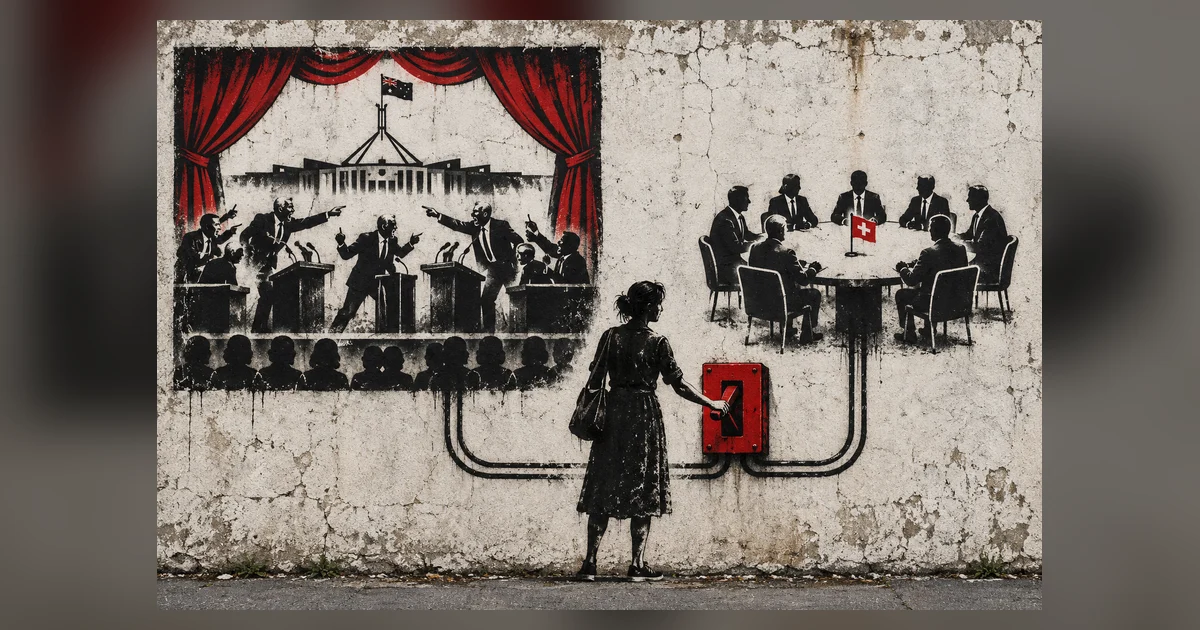
Art: Omxus Press
8 min read
 articleworld4u

Philosophers Club sign
In January 2006, housing officers in north London broke into a bedsit over unpaid rent and found Joyce Vincent's body on the sofa, the television still on. She had been dead for more than two years. Her direct debits had kept paying the bills (Morley, 2011). As far as every system was concerned, she still existed.
A club with a neon sign and one rule nobody wrote down: you have to turn up.
Our machines are good at confirming accounts and hopeless at confirming people. They now need to do the second, and badly. And the answer happens to involve somebody coming to your door.
In 2002 John Douceur named it. Where identity is cheap, one person can create as many identities as they like and outvote everyone else, and no system can stop it without a trusted authority to certify who's real (Douceur, 2002). He called it the Sybil attack. It's why any vote on the internet starts with a question nobody can quite answer: how many real people are here?
Two decades of defences followed. Scan the iris with a company's hardware (Worldcoin Foundation, 2023). Map who knows whom (Yu et al., 2006). Film your face and let a decentralised court challenge it (Proof of Humanity, 2021). Each moves the trust to a new place, an orb, a graph, a jury, and inherits its weaknesses (Siddarth et al., 2020). All of them try to prove a physical fact through a non-physical channel: to prove matter exists using only information.
Fred can't be "Fred" in Sydney and "Frederick" in Brisbane during the same sixty minutes. He has one body. Count every human in the same hour and physics does the rest.
So here is the whole design. Four times a year, on a pre-announced Saturday, in one sixty-minute window set the same everywhere on Earth, you stand with at least three other people and stay the hour. Your phones record each other by Bluetooth. When the hour closes, everyone confirms the head count and signs it. Miss the count and your token goes dormant. Vouch for a fake and you lose your own.
If you're sick, your neighbours come to you: press the button, three people come to your door, and the count happens at your kitchen table. If nobody will visit a sick neighbour for an hour, that isn't a system failure. It's the community failure the system exists to fix.
Researchers saw the core of this in 2008 and called it a "pseudonym party" (Ford & Strauss, 2008). The additions here are a count anyone can hold at a kitchen table, groups of four who share liability, and a rule that stops one small circle vouching for itself year after year.
If counts could happen at any hour, one busy person could attend 10 groups a day and show a different token at each: about 910 fake identities a quarter, on our modelling. One synchronised hour cuts that to one.
After that, a fake needs a room where every other head lies. A thousand fakes need 3,000 colluders, in person, at the same hour, every quarter, each staking their own token. Every extra liar is one more person who can talk. And because you can only repeat a partner so often, you meet at least ten different people a year, so even one lone fake needs ten accomplices.
The hole is real, and it's better said first. Phones aren't heads. A radio check counts devices, and a room in which everyone lies passes it. That's a social problem, not a physical one. The rotation rule makes such circles large and easy to spot, and adding one random stranger from nearby to each count makes them far harder still. But honest neighbours are what it finally rests on, as most things do.
We took the Bureau of Statistics' population and land area for all 2,454 small areas of Australia (Australian Bureau of Statistics, 2026) and scattered people evenly through each, which makes every distance longer than the real one. Even so, 94.1% of Australians have three others within 400 metres, about five minutes' walk. The 2% in truly remote country are who the remote rules are for: visitors come to you, and uploads can wait until there's signal. Each count writes one small record to a public ledger, with nothing personal on it, for about the cost of a coffee on real fee data (mempool.space, 2026). A street could pay for it from a tin.
In 2024 an estimated 15% of Australians were experiencing loneliness (Australian Institute of Health and Welfare, 2026). Across 148 studies, people with stronger social relationships had about 50% greater odds of survival (Holt-Lunstad et al., 2010). We live in apartments without knowing our neighbours' names, order food without speaking to anyone, and die without anyone noticing for days. Or for two years.
The count doesn't cure loneliness as a side effect. It makes total isolation structurally impossible. People will complain about this, right up until they realise it is the first time in years someone checked whether they were alive.
And once neighbours know each other's tokens, something else becomes possible. Hold a button for three seconds and everyone within a kilometre sees that help is needed. In Stockholm, a randomised trial texted trained volunteers near a cardiac arrest, and bystander CPR rose from 48% to 62% (Ringh et al., 2015). That's 14 more people in every 100 with someone's hands on their chest.
"People won't do it." Maybe. Australians have turned up to vote at more than 90% for a century, for a $20 fine (Australian Electoral Commission, 2023, 2025), and the count asks less: no ballot, no politics. Whether we'd turn up for each other is what nobody can show from a desk. It has never been piloted, the first holders can't be vouched for by earlier ones, and it may fail in ways nobody has thought of. One hundred people in one suburb would tell us.
You can test the only part that matters this Saturday, with no phones and no tokens. Knock on three doors in your street. Say you're trying something odd: one hour, four people, tea at your place, same time every three months. Write down who came. Then notice who you'd now miss if they stopped opening the door.
Be in the same room at the same time. That's the whole thing.
The sign is on. Somebody has to walk in.
Two Swiss farmers forced a national vote about cows' horns. Australians can't ask a question at all, and haven't said yes since 1977. Here's why.
Art: Omxus Press
A small lottery lifted student turnout by 32%. Paying for blood drove women away. What moves us is rarely what we say it is, and somebody designs it either way.
Art: Omxus Press
A dead salmon lit up in a brain scanner because the method expected it to. When a clinician's belief decides the finding, what choice is always safe?
Cover of The Lonely Whisper of the Wind (Omxus Press)