Would a zookeeper pass the way we live?
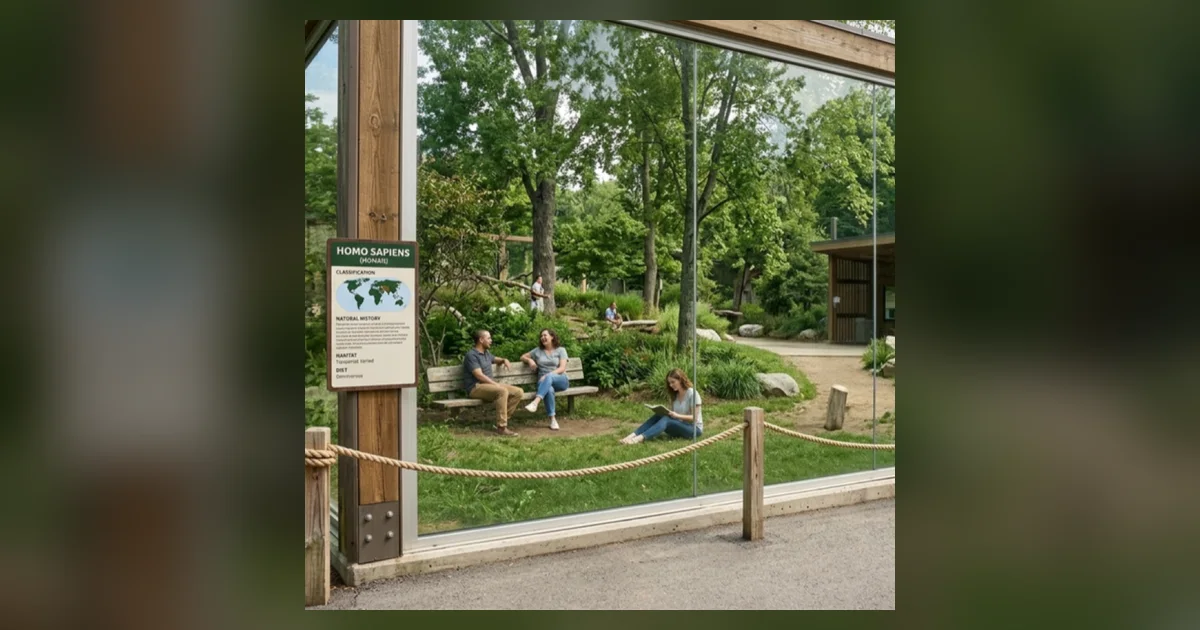
When a polar bear swam in figure eights, the zoo inspected his life. Scored the same way, the places people live and work fail on 17 of 18 measures.
Cover of The Human Enclosure (Omxus Press)
8 min read
 articleworld4u

Art: Omxus Press
Try this, beside a wall, with someone close. Take off your shoes, feet together, arms folded, eyes shut, and count to thirty. Now do it on a couch cushion. Past 40, one person in three can't. Past 80, three in four. Your feet have been holding you up, and we have spent fifty years muffling them.
Close your eyes. Something like this, maybe, until you start to wobble.
That isn't a party trick. Falls are the leading cause of injury in hospital in Australia, and they land hardest on older people (Australian Institute of Health and Welfare, 2024). A fall is how many people lose their house, their car keys and the rest of their independence in about a second.
Between 2001 and 2004, examiners for the United States national health survey ran that test on thousands of adults over 40, with a block of foam (National Center for Health Statistics, 2005). On the hard floor, 98% stood still. On the foam, 63% did. Among people in their forties, one in six wobbled off. Over 80, three in four.
The sole of your foot is packed with touch sensors of four kinds, densest at the toes and the ball of the foot (Kennedy & Inglis, 2002). They tell your brain where your weight is, which way the ground tilts and when you start to sway. Close your eyes and they do most of the work. Foam blurs them, leaving the balance organ in your inner ear, and for most older people that isn't enough (Agrawal et al., 2009).
The same survey tested the feeling in people's soles with a fine nylon filament. One adult in eight had a patch that couldn't feel it. Those people wobbled off even the hard floor three times as often, and reported trouble with falling two and a half times as often, as people of the same age and sex whose feet could feel.
A thick, soft running shoe isn't a foam pad, but it does the same kind of thing: two to four centimetres of foam between your most sensitive standing surface and the ground. Older men walking a beam kept their balance worst in thick, soft soles and best in thin, hard ones (Robbins et al., 1992). As eyes and inner ear decline, older people lean more on their feet. So the people most at risk of falling lose most from losing ground feel, and they're the ones most often advised into thick, soft, "comfortable" shoes.
Cushioning weakens the foot as well. Men in northern Mexico who wear thin sandals have stiffer arches and bigger foot muscles than American men in ordinary shoes (Holowka et al., 2018). Indian children who wore shoes had about three times the flat feet of children who went barefoot (Rao & Joseph, 1992).
Then the loop closes. Supportive shoes do the work of the foot's muscles, which shrink. Weak muscles support the arch less. Low arches and sore feet get treated with more support: orthotics, motion-control shoes. No one in that chain needs bad intent. It only needs nobody to ask whether the product causes the problem it's sold to solve.
For about 300,000 years human feet went bare or nearly bare. When shoes came, they were thin, flat and flexible: the Roman sandal, the medieval turnshoe, the Mexican huarache. The thick-soled, heel-raised running shoe arrived in the 1970s and became the default within a generation. No trials of injury prevention came first. It sold because it felt nice in the shop.
And the modern floor, flat concrete, smooth tile and uniform carpet, gives even a bare foot almost nothing to read. A zookeeper wouldn't accept that enclosure for a chimpanzee. Every modern zoo gives its primates grass, bark, earth, rock and branches, and changes them to keep things interesting. We give ours a car park.
The weakness is disuse, not damage. In a randomised trial, runners who simply walked in minimalist shoes, a little more each week for eight weeks, built foot muscle as fast as runners doing daily foot exercises (Ridge et al., 2019). Faint vibrations in a shoe insole, too gentle to notice, helped older people sway less by waking up the sensors in their soles (Priplata et al., 2003). And exercise that trains balance cuts the rate of falls in older people by about a quarter (Sherrington et al., 2019). Few things in medicine that simple work that well.
Don't throw away your shoes. Older people who wander the house in socks or bare feet fall indoors more often (Menz et al., 2006), and runners who swap shoes overnight get stress fractures (Salzler et al., 2012). A foot kept in foam for decades needs rebuilding slowly. If you have diabetes or numb feet, see a podiatrist first, because a cut you can't feel is dangerous.
What the evidence supports is thin, firm, flexible soles with room for the toes, floors with some texture, and practice.
Start this week, holding the kitchen bench. Stand on one foot while the kettle boils. Spend five minutes a day barefoot on grass, sand or a pebbly path. Next time you buy shoes, bend them, press the sole with your thumb, and choose the thin firm pair for walking around home. If you're looking after a parent, ask their GP about a balance class before you ask about a walker.
Then ask for better ground. Councils build paths, and aged care homes choose floors. Ask yours for pebble paths, timber boardwalks, sand, gentle slopes and low beams, alongside the smooth routes wheelchairs need. A zookeeper assessing a human city would note uniform substrate, nothing to feel underfoot, devices muffling the main sense organ for touching the ground, and a falling older population. The keeper wouldn't prescribe better restraints. The keeper would redesign the enclosure.
Open your eyes. Take your shoes off.
When a polar bear swam in figure eights, the zoo inspected his life. Scored the same way, the places people live and work fail on 17 of 18 measures.
Cover of The Human Enclosure (Omxus Press)
In 2008 Denmark began paying night workers with breast cancer. Sleep advice still blames your habits. In a US sample, the job predicts who sleeps too little.
Cover of The Stolen Night (Omxus Press)
Twenty years of American time diaries show young people's time with friends fell from 137 minutes a day to 51, and the hours went to being alone.
Art: Omxus Press