When unarmed health workers take the mental health and welfare calls, police rarely need to come, and minor crime reports fall. It works for a slice of calls, about one in five, not for most of them.
The mismatch
Police answer a large share of calls that involve no crime: a person in distress, someone sleeping rough, a welfare check. Officers train mostly for threat, and the person they meet in a mental health crisis is often frightened, confused or unwell.
That mismatch costs lives. A 2015 report from the Treatment Advocacy Center estimated that at least one in four people killed by police in the United States had a serious mental illness. It put their risk of being killed during a police encounter at about 16 times that of other civilians.
CAHOOTS: two people and a van
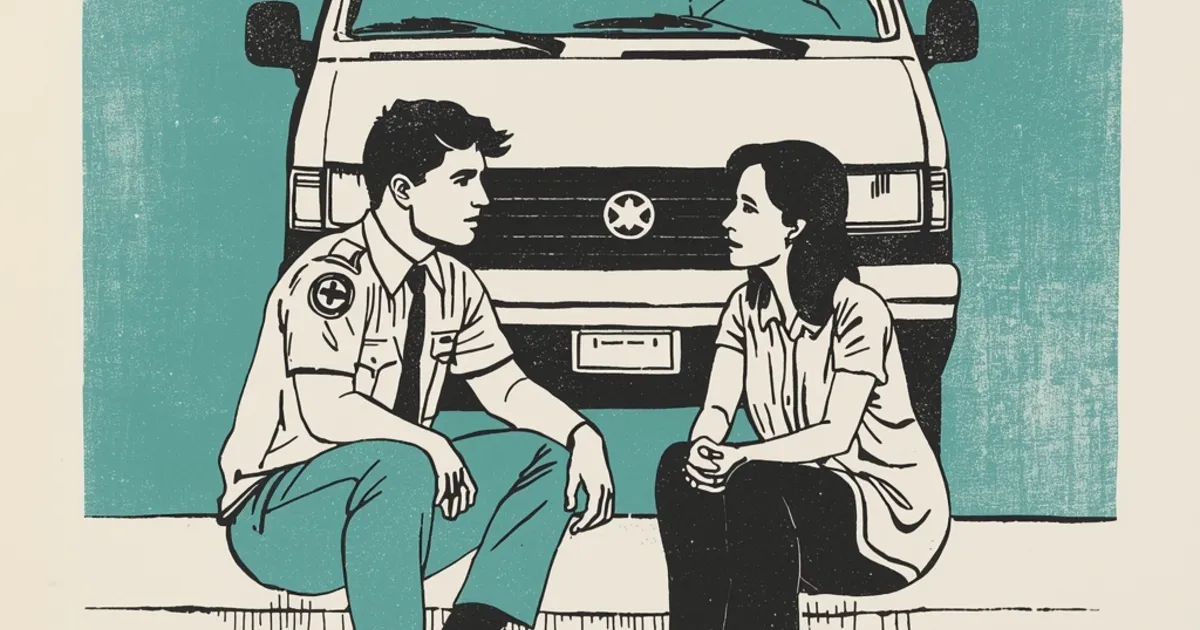
Since 1989, the White Bird Clinic in Eugene, Oregon, has run CAHOOTS. A medic and a crisis worker ride in a van. They carry no weapons and cannot arrest anyone. Dispatchers send them calls about mental health, drugs, homelessness and welfare checks.
The clinic reports that its teams take about a fifth of the calls sent out through 911, and call police for backup a few hundred times a year out of tens of thousands of calls. The program runs on roughly US$2 million a year, a small fraction of the city's police budget, according to the Vera Institute of Justice.
Two cautions. The clinic's own publications supply most of these figures, and outside auditors have not checked them. And the Eugene police department's analysis found most CAHOOTS calls were welfare checks, transport and public assistance, work police would not normally do. So CAHOOTS mostly adds help rather than replacing police on dangerous calls.
Denver: the first careful test
In 2020 Denver launched STAR (Support Team Assisted Response), a clinician and a paramedic in a van, in eight downtown precincts. Economists Thomas Dee and Jaymes Pyne compared crime in those precincts with similar areas the van did not serve.
Reports of less serious crimes, such as trespassing, public disorder and resisting arrest, fell by 34% where STAR worked. They estimated about 1,400 fewer offences in six months. Serious crime showed no change either way.
Part of that drop is simple: a nurse who helps someone off a doorstep writes no crime report. A police officer who moves the same person on may end up charging them with resisting arrest. The situation stays the same; the response decides whether it becomes a crime.
How many calls could go to health workers?
Some advocates claim most police calls could go to civilians. The data does not support that. The Vera Institute studied 911 calls in nine US cities and found that, on average, about 19% could be answered by unarmed crisis responders alone.
One in five is still a lot. It is thousands of calls a year in any large city where an armed response adds risk and nothing else.
What reform inside policing has shown
Body-worn cameras were meant to change police behaviour. In a randomised trial with 2,224 Washington DC officers, cameras made no meaningful difference to use of force or complaints. A review of 70 studies by Cynthia Lum and colleagues found much the same: no consistent effect on officer behaviour.
A camera records the encounter but does not change who turns up. The crisis-team programs change who turns up.
What Australia does
Australia has mostly chosen co-response: a mental health clinician rides with police, and in some places a paramedic too. Victoria, New South Wales and the ACT run PACER (Police, Ambulance and Clinician Early Response). Western Australia runs a Mental Health Co-Response program with clinicians in Perth police districts, the Police Operations Centre and the Perth Watch House, and in some regional towns.
A 2026 review of PACER in Australia and New Zealand found more problems settled at the scene, fewer trips to emergency departments, and care that people found more person-centred. But in these models a police officer still attends. That differs from Eugene and Denver, where the health team goes alone.
What to check where you live
- Ask your state police or health department whether a co-response or clinician-led team covers your area, and what days and hours it runs.
- Ask whether triple zero can dispatch a clinician without police, or only alongside them.
- If you are putting a case to a local member, lead with the Denver study. It is peer reviewed, it compared like areas, and it measured crime, not just satisfaction.
Sources
- Dee, T. S., & Pyne, J. (2022). A community response approach to mental health and substance abuse crises reduced crime. Science Advances, 8(23), eabm2106. doi.org/10.1126/sciadv.abm2106
- White Bird Clinic. (2020). CAHOOTS media guide. whitebirdclinic.org
- Eugene Police Department Crime Analysis Unit. (2020). CAHOOTS program analysis. City of Eugene. eugene-or.gov
- Vera Institute of Justice. (n.d.). Case study: CAHOOTS. vera.org
- Vera Institute of Justice. (2022). 911 analysis: How civilian crisis responders can divert behavioral health calls from police. vera.org
- Fuller, D. A., Lamb, H. R., Biasotti, M., & Snook, J. (2015). Overlooked in the undercounted: The role of mental illness in fatal law enforcement encounters. Treatment Advocacy Center. tac.org
- Yokum, D., Ravishankar, A., & Coppock, A. (2019). A randomized control trial evaluating the effects of police body-worn cameras. Proceedings of the National Academy of Sciences, 116(21), 10329–10332. doi.org/10.1073/pnas.1814773116
- Lum, C., Stoltz, M., Koper, C. S., & Scherer, J. A. (2019). Research on body-worn cameras. Criminology & Public Policy, 18(1), 93–118. doi.org/10.1111/1745-9133.12412
- Skopek, M. A., & Khan, S. (2026). Police, ambulance and mental-health clinician early response (PACER) models in Australia and New Zealand: A narrative review. Australasian Psychiatry. doi.org/10.1177/10398562261445808
- Western Australia Police Force. (n.d.). Mental Health Co-Response evaluation report. Tabled in the Parliament of Western Australia. parliament.wa.gov.au