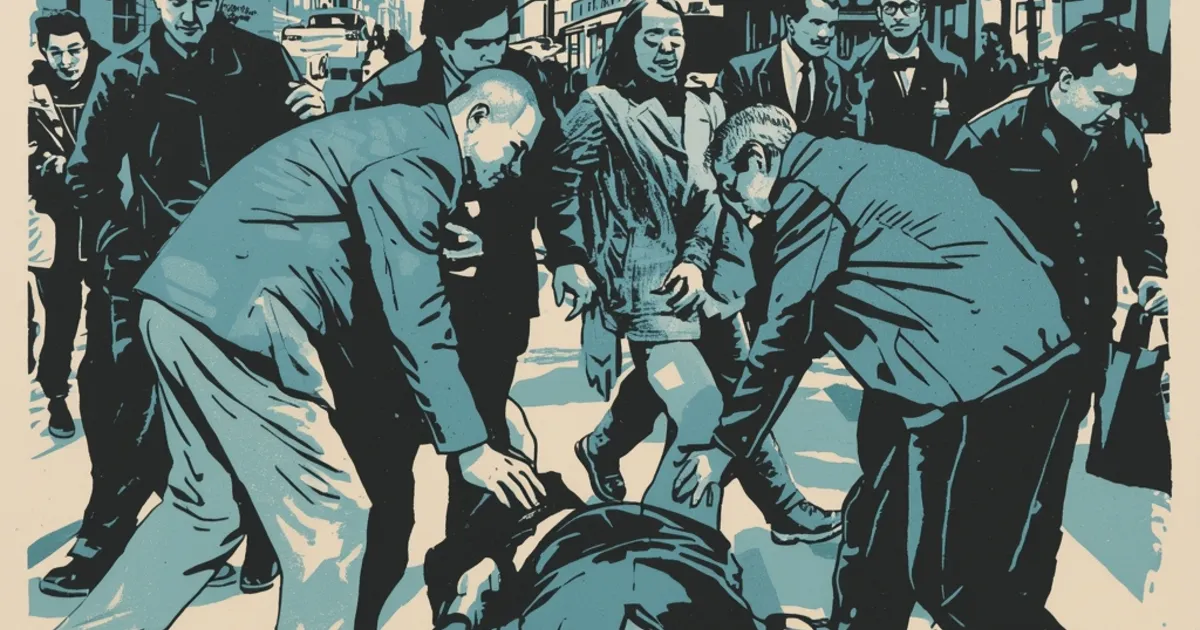
Mostly, they help. When researchers watched real CCTV footage of public fights, at least one bystander stepped in nine times out of ten, and more people present meant more help, not less.
The story everyone learned
In 1964 Kitty Genovese was murdered in Queens, New York. The New York Times reported that 38 neighbours watched and did nothing. The story became the textbook example of the "bystander effect": the more people who see an emergency, the less likely anyone is to help.
The story is false. Rachel Manning, Mark Levine and Alan Collins went back to the trial record and police files. They found no evidence of 38 witnesses, no evidence that witnesses watched the murder, and no evidence that they did nothing. The attack happened in two parts, the second in a stairwell almost no one could see. At least two neighbours called police, one shouted and scared the attacker off, and a friend held Genovese as she died.
The authors argue the myth did its own damage. Retold in textbooks for decades, it taught people to expect crowds to do nothing, and steered research towards why people fail to help instead of how they succeed.
What the lab found, and its limits
The murder prompted real experiments. In 1968 John Darley and Bibb Latané had students overhear what sounded like another student having a seizure. Students who believed they were the only listener went for help far more often than those who believed others could hear it too. The researchers called it diffusion of responsibility: when everyone could help, each person feels less need to.
A year later Latané and Judith Rodin staged a woman falling in the next room. Seventy per cent of people waiting alone called out or went to help. With a passive stranger in the room, only 40% did. Other people's calm can read as a sign that nothing is wrong.
The effect is real, but narrower than the legend. A 2011 meta-analysis by Peter Fischer and colleagues, covering studies from the 1960s to 2010, found the bystander effect shows up mostly in emergencies that are not dangerous. In clearly dangerous emergencies it largely disappeared. Competent bystanders, such as people with first aid training, were also less affected.
What cameras show
Lab studies use staged events. Richard Philpot and colleagues used real ones: 219 fights and arguments caught on CCTV in Lancaster, Amsterdam and Cape Town.
In 91% of them, at least one bystander intervened: gesturing to calm the aggressor, stepping between people, pulling someone away, or comforting the victim. The rate was about the same in all three cities, although Cape Town is thought of as less safe. The researchers concluded that perceived danger does not set how often people help. What matters is a clear signal that a conflict is happening and needs someone. And the more bystanders there were, the more likely the victim got help. Each person may feel slightly less responsible in a crowd, but a crowd holds more people willing to act.
Stepping in early works at scale too
The same idea, that people close to trouble can defuse it, drives violence-interruption programs. Cure Violence hires trusted local people to step into disputes before they turn into shootings. John Jay College researchers compared two New York neighbourhoods running it with similar areas that were not. In East New York, gun injuries fell 50%, against 5% in the comparison area. In the South Bronx, shooting victimisations fell 63%, against 17%: from 35 in the four years before the program to 13 in its first four years.
Those are two neighbourhoods in one city, not proof it works everywhere. But they point the same way as the CCTV: early, local, personal intervention works.
How to help without getting hurt
- Make it clear it's an emergency. People act when a situation is clearly serious. Say it out loud: "This isn't okay, someone call triple zero."
- Name a person. Diffusion of responsibility fades when the job belongs to someone: "You in the blue shirt, call 000."
- Act with others. The CCTV found help came more often where more people stood. Catch someone's eye and move together.
- Use the least risky kind of help. A calm word, standing nearby, or checking on the victim afterwards all count. You don't need to fight anyone.
- Learn first aid. Trained bystanders freeze less.
Sources
- Manning, R., Levine, M., & Collins, A. (2007). The Kitty Genovese murder and the social psychology of helping: The parable of the 38 witnesses. American Psychologist, 62(6), 555–562. pubmed.ncbi.nlm.nih.gov/17874896
- Darley, J. M., & Latané, B. (1968). Bystander intervention in emergencies: Diffusion of responsibility. Journal of Personality and Social Psychology, 8(4), 377–383.
- Fischer, P., Krueger, J. I., Greitemeyer, T., et al. (2011). The bystander-effect: A meta-analytic review on bystander intervention in dangerous and non-dangerous emergencies. Psychological Bulletin, 137(4), 517–537. pubmed.ncbi.nlm.nih.gov/21534650
- Latané, B., & Rodin, J. (1969). A lady in distress: Inhibiting effects of friends and strangers on bystander intervention. Journal of Experimental Social Psychology, 5(2), 189–202.
- Philpot, R., Liebst, L. S., Levine, M., Bernasco, W., & Lindegaard, M. R. (2020). Would I be helped? Cross-national CCTV footage shows that intervention is the norm in public conflicts. American Psychologist, 75(1), 66–75. research.vu.nl
- Delgado, S. A., Alsabahi, L., Wolff, K., Alexander, N., Cobar, P., & Butts, J. A. (2017). The effects of Cure Violence in the South Bronx and East New York, Brooklyn. John Jay College Research and Evaluation Center. johnjayrec.nyc