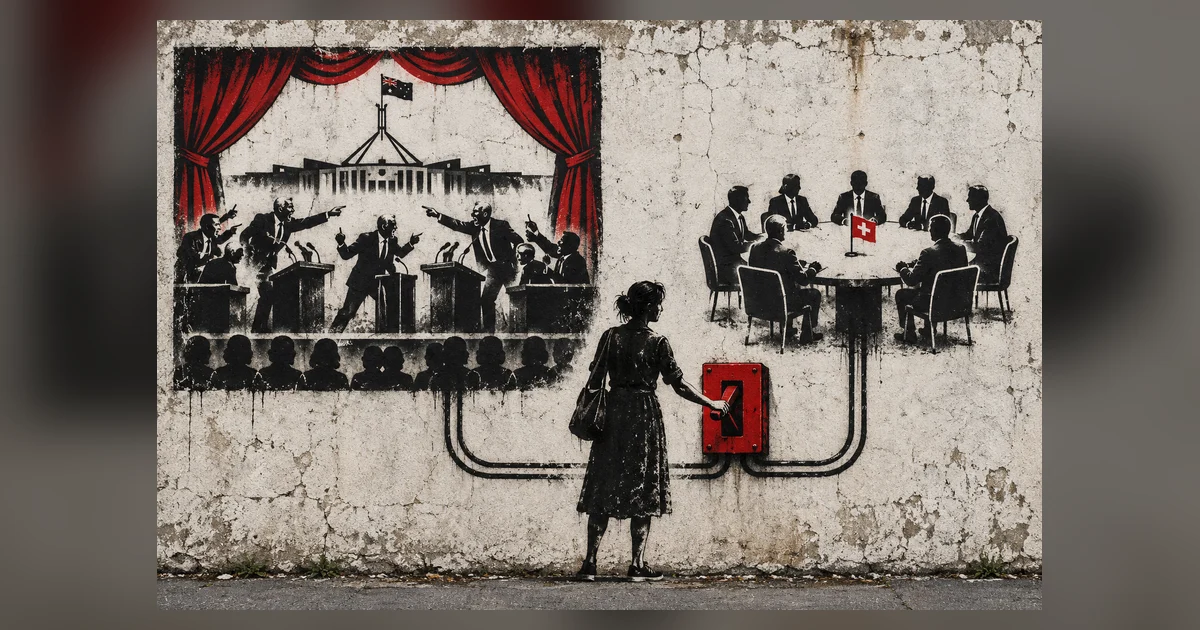
Why does Australia almost never change its Constitution?
Two Swiss farmers forced a national vote about cows' horns. Australians can't ask a question at all, and haven't said yes since 1977. Here's why.
Art: Omxus Press
8 min read
 articleworld4u
Cover of Learning Distillation (Omxus Press)
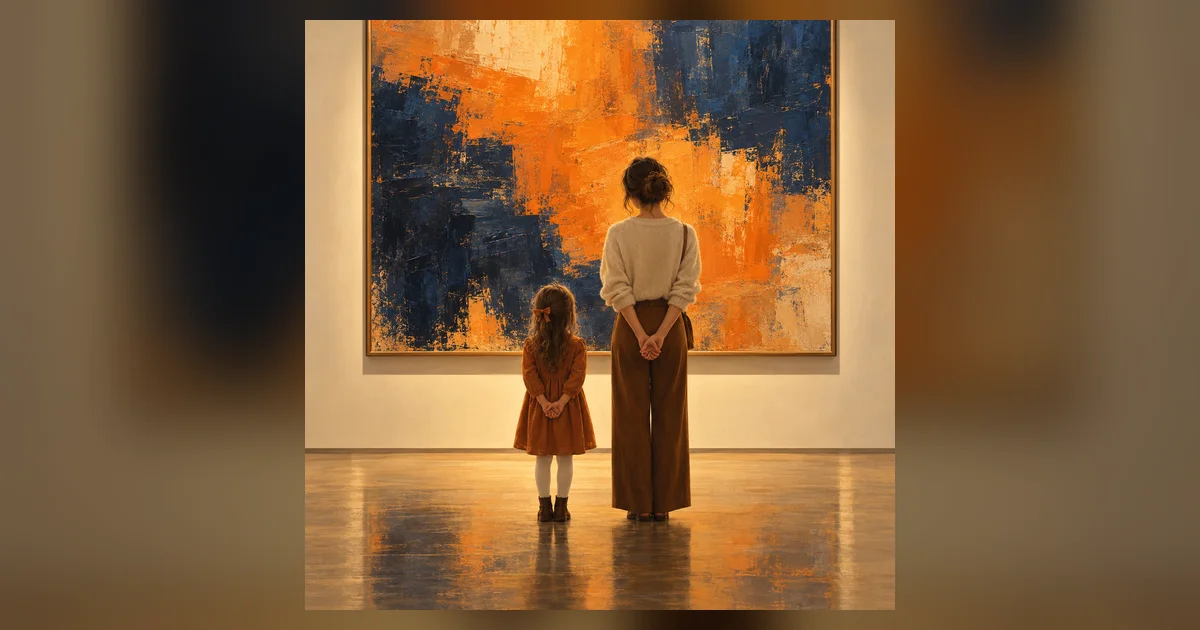
One of our writers remembers being taken to galleries as a child by a mother who would stand in front of a single painting for twenty minutes. "She did not tell me what it meant. She did not tell me what to feel. She stood there, looking, and I stood next to her." Decades later, that child knows how to look. Nobody ever taught it.
Now run the same scene with a father who hits things when the bills come. The child stands next to that too.
In the early 1960s, psychologist Albert Bandura and his colleagues brought preschool children one at a time into a playroom. In the corner, an adult attacked an inflatable doll: punching it, hitting it with a mallet, kicking it, shouting. Nobody told the children to watch. Nobody rewarded them. Then each child was left with toys, including the doll (Bandura et al., 1961).
Many of the children who had watched the aggressive adult did what the adult had done, down to the specific acts and words. Behaviour moved from one person to another by watching alone.
Artificial intelligence has a technique called knowledge distillation. A large model, the teacher, does a job well. A smaller model, the student, must do the same. Nobody teaches the student the teacher's reasoning, which is buried in millions of parameters no one can read. The student simply sees what the teacher does across thousands of examples, including how confident it is, and learns to produce the same outputs (Hinton et al., 2015). The student never learns why. It learns that.
Read that with a child in mind. A child can't see inside a parent's reasoning. The child sees the output: the face, the tone, what happens when a stranger knocks or a bill arrives. Thousands of examples, across years. The child absorbs how much as well as what: the slammed door versus the sigh. Children aren't gradient descent, and the comparison is only a comparison. But it puts its finger on something we keep missing. Nobody decides.
We tested a small version of this. The 2018 General Social Survey asked 1,119 Americans how often their mother attended religious services when they were a child, which religion they were raised in, and how often they attend now (Smith et al., 2019).
| Mother went to services when respondent was a child | Respondent goes nearly every week or more now |
|---|---|
| Weekly or more (n = 552) | 38.2% |
| Less than weekly (n = 408) | 21.1% |
| Never (n = 159) | 15.1% |
The habit carried over even after we allowed for the religion people were raised in, and their age, sex and education. Among the 135 people who moved to a different religion, the mother's frequency still carried over. The name of the faith changed. How often they turned up didn't. The picture is mixed: among everyone who changed, including those who left religion altogether, the link disappears. And this is one behaviour, remembered by adults, in families who share genes as well as homes.
Harder things travel the same road. Researchers following three generations of Iowa families found parents' angry and aggressive behaviour predicted their children's, and those children's parenting predicted the same in the third generation (Conger et al., 2003). Most children of violent homes don't become violent. It's probabilistic, which is what learning from one teacher among many looks like.
A child who grows up with anger as the normal answer to frustration learns that answer well. The grown person now does exactly what they were trained to do. By the only standard the learning process recognises, that's a success. We punish people for being good students of bad teachers.
Punishment assumes a free, deliberate choice the person could have made differently. If the response was a trained output running below conscious control, that choice may never have existed in the form we imagine. That doesn't mean anything goes, and the people harmed are still harmed. It means the honest response is retraining: new environments, new examples, new people to stand next to. Prevention isn't the soft option. It's the one that fits how learning works.
"Humans have free will." Perhaps. Libet's experiments suggested the brain prepares a movement before we report deciding; later work argues that signal may be background noise (Libet, 1985; Schurger et al., 2012). The argument doesn't need either. Even genuine choice runs on trained tendencies that narrow what feels possible. Free will, if it's there, isn't free of its training data.
"I changed. I chose to." People do, and it deserves credit. Look at how: a therapist offered a new model to watch, a crisis shook the old pattern, a group supplied new scripts, and the change held while that support held. That relocates the credit. It doesn't reduce it.
If cruelty distills, so does care. The mechanism is neutral. A child who can absorb rage by standing next to it can absorb twenty patient minutes in front of a painting the same way. That's the good news in all this: no lecture is required.
You're running this experiment today, whether you mean to or not. Pick one thing you'd hate a child to copy, and do the other thing out loud once this week, where they can see: "I'm furious, so I'm going to walk around the block." Pick one thing you love and let a child stand next to you while you do it, without explaining it. And when you next meet an adult doing harm, ask what was in their room. Then ask what we could put in the next one.
People aren't broken. They learned exactly what was in the room. So let's change what's in the room.
Two Swiss farmers forced a national vote about cows' horns. Australians can't ask a question at all, and haven't said yes since 1977. Here's why.
Art: Omxus Press
A small lottery lifted student turnout by 32%. Paying for blood drove women away. What moves us is rarely what we say it is, and somebody designs it either way.
Art: Omxus Press
A dead salmon lit up in a brain scanner because the method expected it to. When a clinician's belief decides the finding, what choice is always safe?
Cover of The Lonely Whisper of the Wind (Omxus Press)