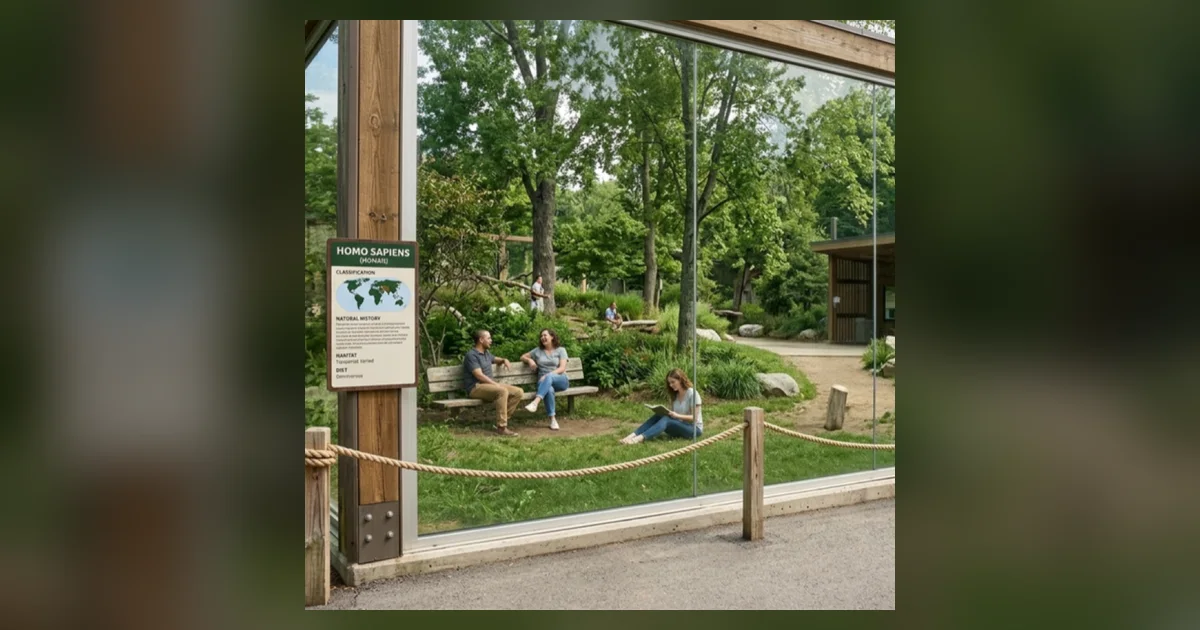
Would a zookeeper pass the way we live?
When a polar bear swam in figure eights, the zoo inspected his life. Scored the same way, the places people live and work fail on 17 of 18 measures.
Cover of The Human Enclosure (Omxus Press)
8 min read
 articleworld4u

Art: Omxus Press
In 2025 an Australian court sent a woman to prison for life for serving her guests a lunch laced with death cap mushrooms. Nobody argued about whether that was a crime. That same week we walked past shelves of processed meat, which the International Agency for Research on Cancer puts in the same carcinogen group as tobacco smoke (Bouvard et al., 2015). Nobody went to prison for that.
A group isn't a dose, and a sausage is no death cap. But bodies end up in the same place, and speed is what differs. Fast harm gets a verdict. Slow harm gets a shelf.
In Glasgow in the 2000s, a boy born in Calton could expect to live to 54. A boy born in Lenzie, a few kilometres away, could expect 82 (Commission on Social Determinants of Health, 2008). Twenty-eight years, same city, same weather, same health system.
We usually explain that with cigarettes and chips, and they do matter. The World Health Organization says 30 to 50 per cent of cancers are preventable with what we already know (World Health Organization, n.d.). In Australia in 2024, 36 per cent of all healthy years lost to illness and early death came from risks we can change (Australian Institute of Health and Welfare, 2024). The usual list is tobacco, diet, alcohol and inactivity. It leaves out what a life does to the immune system.
In 1995 Janice Kiecolt-Glaser and colleagues gave women a small standard wound on the forearm. Women caring for a relative with dementia healed in 48.7 days. Matched women caring for no one healed in 39.3 (Kiecolt-Glaser et al., 1995). Nobody had told these women anything about their skin. Their lives had told it.
A review of 300 studies later found long-lasting stress weakens the immune system, and the longer it lasts the broader the damage (Segerstrom & Miller, 2004). Over six years, a marker of inflammation called IL-6 rose about four times faster in people caring for a spouse with dementia than in others the same age, and stayed high after the spouse died (Kiecolt-Glaser et al., 2003). Grief and exhaustion don't stay in the mind.
It turns the other way too. Purpose, safety and connection go with lower inflammation (Bower et al., 2019). Across four US surveys, social isolation in adolescence carried as much inflammatory risk as physical inactivity (Yang et al., 2016).
Poverty bundles threat, low control and instability. If a hard life reaches the body, poverty should show in the blood even after the usual lifestyle risks are counted. So we looked, in the US national health survey of 2017 to 2018: 4,273 adults with a blood test for C-reactive protein, a standard marker of inflammation.
| Household income | Adults with high inflammation (above 3 mg/L) |
|---|---|
| Below the poverty line | 43.6% |
| Two to four times the line | 36.2% |
| Four times or more | 29.8% |
The steps run one way. Allowing for age and sex, the poorest group's odds of high inflammation were 1.80 times the richest's. Allowing for smoking and weight as well, 1.58 times. So smoking and weight explain about a quarter of the excess, and most of it remains.
That's one survey at one moment, so it shows poverty and inflammation travelling together, not that one causes the other. Income could stand in for diet, housing, neighbourhood or health care. Those are social conditions too, so the point survives. The data are American, and Australian survey data could test the same gradient here.
A species that understands cause and effect wouldn't build a world like this on purpose. If we do it anyway, you could say there are only two explanations: we are insane, or we hate ourselves.
There's a third. Slow harm takes decades between exposure and diagnosis. It's statistical, so no single death can be pinned on it. It's spread across millions of people. And it's profitable: nutrition studies wholly funded by industry are several times more likely to favour the sponsor (Lesser et al., 2007). We aren't insane, and we don't hate ourselves. We live inside arrangements nobody designed for human health, and arrangements can be redesigned.
Five conditions each have a biological pathway behind them: connection, safety, purpose, control and time. None is a clinical service. Each is a decision about how we live together. A renter who can't be evicted without reason has more safety. A casual with a fixed roster has more control. A carer with a week of respite has more time. Those women with slow-healing wounds didn't need a better cream.
Don't buy a supplement. Don't blame yourself for your blood, either. If you're the one worn down, the science says being tired and sick isn't a personal failing, and asking for help counts as treatment. Carer Gateway offers respite, free, on 1800 422 737.
If you're doing all right, take one thing off someone else this week: an afternoon for a carer you know, a fixed roster for a worker you manage. Then ask your state MP where they stand on evictions without grounds. You may never have thought of that as a health question. Your immune system has.
Australian Institute of Health and Welfare. (2024). Australian burden of disease study 2024. AIHW. https://www.aihw.gov.au/reports/burden-of-disease/australian-burden-of-disease-study-2024/contents/summary
Bower, J. E., Kuhlman, K. R., Haydon, M. D., Boyle, C. C., & Radin, A. (2019). Cultivating a healthy neuro-immune network: A health psychology approach. Social and Personality Psychology Compass, 13(9). https://doi.org/10.1111/spc3.12498
Bouvard, V., Loomis, D., Guyton, K. Z., Grosse, Y., Ghissassi, F. E., Benbrahim-Tallaa, L., Guha, N., Mattock, H., & Straif, K. (2015). Carcinogenicity of consumption of red and processed meat. The Lancet Oncology, 16(16), 1599–1600. https://doi.org/10.1016/s1470-2045(15)00444-1
Kiecolt-Glaser, J. K., Marucha, P. T., Mercado, A. M., Malarkey, W. B., & Glaser, R. (1995). Slowing of wound healing by psychological stress. The Lancet, 346(8984), 1194–1196. https://doi.org/10.1016/s0140-6736(95)92899-5
Kiecolt-Glaser, J. K., Preacher, K. J., MacCallum, R. C., Atkinson, C., Malarkey, W. B., & Glaser, R. (2003). Chronic stress and age-related increases in the proinflammatory cytokine IL-6. Proceedings of the National Academy of Sciences, 100(15), 9090–9095. https://doi.org/10.1073/pnas.1531903100
Lesser, L. I., Ebbeling, C. B., Goozner, M., Wypij, D., & Ludwig, D. S. (2007). Relationship between funding source and conclusion among nutrition-related scientific articles. PLoS Medicine, 4(1), e5. https://doi.org/10.1371/journal.pmed.0040005
Commission on Social Determinants of Health. (2008). Closing the gap in a generation: Health equity through action on the social determinants of health. World Health Organization.
Segerstrom, S. C., & Miller, G. E. (2004). Psychological stress and the human immune system: A meta-analytic study of 30 years of inquiry. Psychological Bulletin, 130(4), 601–630. https://doi.org/10.1037/0033-2909.130.4.601
World Health Organization. (n.d.). Preventing cancer. https://www.who.int/activities/preventing-cancer
Yang, Y. C., Boen, C., Gerken, K., Li, T., Schorpp, K., & Harris, K. M. (2016). Social relationships and physiological determinants of longevity across the human life span. Proceedings of the National Academy of Sciences, 113(3), 578–583. https://doi.org/10.1073/pnas.1511085112
When a polar bear swam in figure eights, the zoo inspected his life. Scored the same way, the places people live and work fail on 17 of 18 measures.
Cover of The Human Enclosure (Omxus Press)
In 2008 Denmark began paying night workers with breast cancer. Sleep advice still blames your habits. In a US sample, the job predicts who sleeps too little.
Cover of The Stolen Night (Omxus Press)
Twenty years of American time diaries show young people's time with friends fell from 137 minutes a day to 51, and the hours went to being alone.

Art: Omxus Press