Why does Australia almost never change its Constitution?
Two Swiss farmers forced a national vote about cows' horns. Australians can't ask a question at all, and haven't said yes since 1977. Here's why.

Art: Omxus Press
8 min read
 articleworld4u
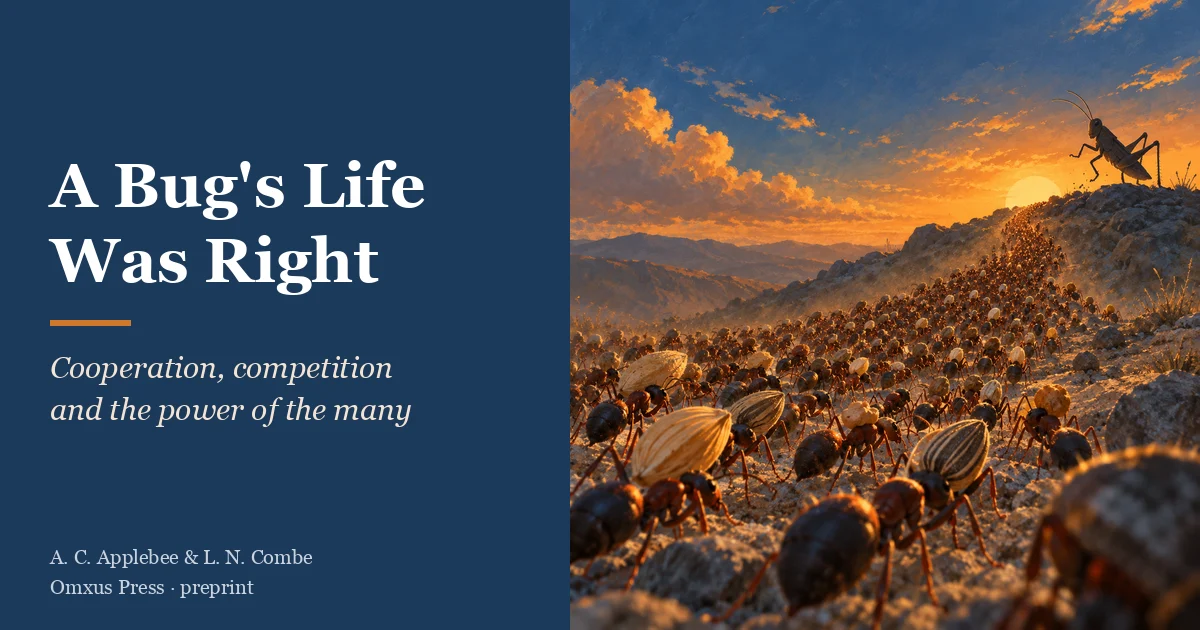
Cover of A Bug's Life Was Right (Omxus Press)
Right, stay with me here, because this uses a children's film to explain how power works. Most of us were told competition is the price of doing well, so we spend our lives ranked against the person beside us and call the exhaustion normal. The ants know better.
In Pixar's A Bug's Life (1998), a colony of ants spends every summer gathering food for a gang of grasshoppers. The grasshoppers arrive, take the offering and leave. It has gone on so long that the ants think it is simply how the world is. Then the offering falls short, and the grasshopper boss, Hopper, explains why his gang must go back:
"You let one ant stand up to us, then they all might stand up! Those puny little ants outnumber us a hundred to one. And if they ever figure that out... there goes our way of life!"
Hopper is not afraid of any single ant. He is afraid of arithmetic. His power depends on the ants never adding themselves up.
Is it true that people must compete to do well? A lab in Turin put it to the test.
At the University of Turin, researchers put 108 volunteers into virtual-reality headsets, attached heart-rate electrodes and gave them a deliberately annoying task. A word flashes up, say "purple", printed in green ink. Name the ink, not the word, as fast as you can (De Francesco et al., 2024).
Each volunteer first played alone. Then a virtual player joined them, secretly tuned to be a little better or a little worse than they were. Sometimes the volunteer worked with that player towards a shared score. Sometimes they played against it.
Which made people do better: a partner or a rival?
Both worked. Competing against a stronger rival lifted people's accuracy. So did cooperating with a weaker partner, by about the same amount. Over three long rounds, the two scores stayed level.
What changed was the body. Competing against the stronger rival raised people's heart rate and the stress they reported. Cooperating did not.
A sceptic will say "not significantly different" isn't the same as "the same". The researchers published their data, so we tested sameness directly. On both experiments the data rule out any meaningful advantage for competition, and the stress and heart-rate costs were medium to large every time. It's one lab and a colour-naming game, not a factory. But on this evidence, competition is a tax with no return.
The lab result is not a one-off. In 1981 a team at the University of Minnesota pooled 122 studies of how people achieve more: cooperating, competing or working alone. Cooperation won (Johnson et al., 1981). In 2008 the same group reviewed 148 studies covering more than 17,000 young teenagers in 11 countries. Cooperation went with higher achievement and better friendships, and under cooperation, doing well and being liked went together (Roseth et al., 2008).
So why does so much of life run on rivalry?
Hopper's arithmetic, in the United States in mid-2026: the richest 1% of households held 32.5% of all household wealth. The bottom half held 2.3%. One household for every fifty, holding fourteen times as much, and the top 1% has out-owned the bottom half in every quarter since 1989 (Board of Governors of the Federal Reserve System, 2026).
Every one of those fifty households works, rents, borrows, buys and votes. The one at the top depends on all of it.
Ants that compete with each other for rank don't count themselves. That is competition's quiet work, and it is why the grasshoppers prefer it.
If the arithmetic is that plain, why does nobody act on it? Four reasons, each with research behind it. Fear: standing up alone means pain, and in a large group each person's contribution is small, so each waits for someone else to go first (Olson, 1965). Normalisation: people born into an arrangement tend to defend it, even when it works against them (Jost et al., 2004). Division: ants ranked against each other are too busy jockeying to notice they are all being robbed. Myth: each ant assumes the others believe the story. Students who privately disliked campus drinking assumed everyone else liked it, and conformed to a norm almost nobody held (Prentice & Miller, 1993).
None of these is a real weakness. Each is a coordination problem, and a colony that ranks its members against each other has already taught them not to count together.
If rivalry buys no extra performance, why does it run so much of the economy? Think of two washing machines. One that lasts twenty years sells once. One that fails just after the warranty sells again and again. The logic is standard: a seller with market power can profit by making goods less durable than buyers would choose (Bulow, 1986). The documented case is the Phoebus cartel, formed in 1924, which limited bulb life to 1,000 hours and fined members whose bulbs lasted longer (Krajewski, 2014). Each move is rational for the seller and ruinous for the group, like antlers that help one bull elk win a fight and make every elk easier prey (Frank, 2011).
In the film, the turning point is almost silly. One ant stands up to Hopper, the others see it, and the spell breaks. The ants don't kill the grasshoppers. They stop being afraid, stand together, and Hopper, faced with a colony that has counted itself, has nothing.
It has happened with people. On 24 October 1975, about nine in ten women in Iceland stopped work: no cooking, no cleaning, no childcare, no shifts. Around 25,000 of them gathered in Reykjavík, in a country of about 220,000. Banks and factories struggled and fathers took children to work, and sausages sold out because they were easy to cook. Five years later Iceland elected the world's first woman chosen as president by a national vote (Brewer, 2015). Nobody got hurt. They just added themselves up, for a day.
The political scientist Gene Sharp argued that rulers don't own power; it is lent to them, every day, by soldiers, clerks and workers who keep cooperating (Sharp, 1973). Erica Chenoweth and Christopher Shay coded every major campaign to topple a regime, end an occupation or win independence from 1945 to 2013 (Chenoweth & Shay, 2019).
We ran the numbers on that record. Campaigns built on strikes, boycotts and mass refusal fully succeeded 57.3% of the time. Armed campaigns succeeded 29.8% of the time. The more people took part, the more often power gave way. Of the 17 campaigns that drew at least 3.5% of their country's population, 16 succeeded. When a regime's own security forces defected, campaigns succeeded 60.2% of the time, against 35.8% without defections; holding method constant, defection multiplied the odds of success by 2.64.
That last finding is Hopper's nightmare: the grasshoppers' own enforcers stop cooperating.
Cooperation can slide into everyone agreeing on the wrong thing; the psychologist Irving Janis called it groupthink (Janis, 1972). And Chenoweth has warned that mass campaigns have succeeded less often since 2010, as regimes learn too (Chenoweth, 2020). The answer in both cases isn't rivalry. It is cooperation with its eyes open, and organisation as well as numbers.
A colony that has learned to compete doesn't count itself. That's why the grasshoppers prefer it, and why cooperation, which looks like the soft option, is the dangerous one. Competition among the many costs them twice: once in their bodies, and once in their count.
So tomorrow, ask the person beside you at work what they think of the roster. That's step one, and it's how Iceland started too.
We outnumber them. We always have.
Two Swiss farmers forced a national vote about cows' horns. Australians can't ask a question at all, and haven't said yes since 1977. Here's why.
Art: Omxus Press
A small lottery lifted student turnout by 32%. Paying for blood drove women away. What moves us is rarely what we say it is, and somebody designs it either way.
Art: Omxus Press
A dead salmon lit up in a brain scanner because the method expected it to. When a clinician's belief decides the finding, what choice is always safe?
Cover of The Lonely Whisper of the Wind (Omxus Press)