In about 1960, David Weikart, who ran testing for the schools of Ypsilanti, Michigan, kept seeing the same thing: Black children from the poor side of town were failing, and nobody could say why. Instead of fixing older kids, he started with three- and four-year-olds. Forty years later, the crime figures for those children looked different (Schweinhart et al., 2005).
A classroom, not a cell
From 1962, 123 small children from low-income African American families were split at random: some went to a high-quality preschool, the rest to none. Researchers followed them all to age 40.
By then, 36% of the preschool group had been arrested five or more times, against 55% of the others. And 65% had finished high school, against 45%. Nobody punished them into it. It's one small program in one town, so nobody should promise those exact numbers elsewhere. But a later study of similar programs in North Carolina found a return of 13.7% a year and a benefit–cost ratio of 7.3 (García et al., 2020). Few things a government buys return that much, and almost none of it shows up in the budget that paid.
Where the people prison holds come from
The Adverse Childhood Experiences study surveyed 9,508 adults. Abuse, violence against a mother, and living with someone who used substances, was mentally ill or had been imprisoned each counted as one category. People with four or more had a four- to twelve-fold higher risk of alcoholism, drug abuse, depression and suicide attempts (Felitti et al., 1998).
Much of what we lock people up for sits downstream of harm done to them first. Punishing it without touching the source treats a symptom and calls the disease a crime.
Why stopping things doesn't work
Humans don't stop. We can start things, but stopping leaves a vacuum, and something fills it, usually something worse. That sounds like folk wisdom, but history keeps offering examples. Alcohol prohibition fed organised crime. Prison, the biggest attempt to stop anything, returns a large share of the people it holds: in Australia, 43% of adults released in 2021–22 were back inside within two years (Productivity Commission, 2025).
Researchers have long known where punishment's power lies. Being likely to get caught deters people. Making the sentence longer adds very little (Nagin, 2013). When studies compare people sent to prison with similar people given a community sentence, prison does no better, and sometimes worse (Nagin et al., 2009).
There's one big exception, and it tells you why. In Norway, cases go to judges at random, and some judges imprison more often than others. So researchers could compare people who went inside only because of the judge they drew. Prison cut their chance of reoffending within five years by 29 percentage points, mostly by getting them into jobs (Bhuller et al., 2016). Prison isn't one thing. What happens inside decides what comes out.
What Australia's numbers say
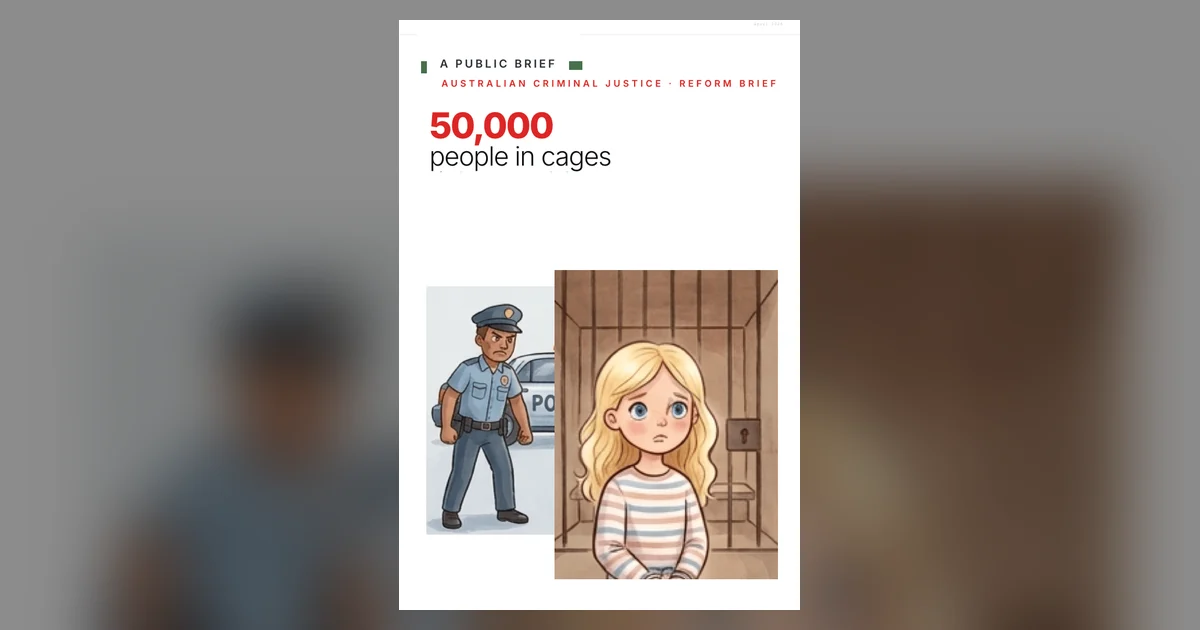
On an average day in 2024–25, Australia held 45,526 people in prison. A prison place cost $440.60 a day. Supervising someone in the community cost $32.17 (Productivity Commission, 2026). And the prison rate for Aboriginal and Torres Strait Islander adults rose 22.9% in seven years while everyone else's fell.
| 2017–18 | 2024–25 |
|---|
| Aboriginal and Torres Strait Islander adults in prison, per 100,000 | 1,718.9 | 2,112.6 |
| Non-Indigenous adults in prison, per 100,000 | 168.5 | 146.0 |
| Gap | 10.2 times | 14.5 times |
Does a less punishing day go with less violence? Across the eight states and territories, systems whose prisoners spend more hours out of their cells record fewer assaults: New South Wales averaged 8.1 hours and 24.8 assaults per 100 prisoners, Western Australia 10.3 hours and 7.9. But the states record assaults differently, and within each state the pattern fails, probably because short-run changes come from staffing and lockdowns. Regime design and violence travel together. Adding an hour isn't a magic lever.
Grow what we want
Here's the alternative in one line: grow what we want until what we don't want has nowhere to live. Fill the space first, with people who have your back, skills that travel and stories that make helpers into local heroes. Small, real examples are all over the research.
- A small reward for eating fruit or vegetables at lunch doubled how many children did it, in 40 schools. Two months after the rewards stopped, they were still eating 21% to 44% more (Loewenstein et al., 2016).
- When an app called nearby trained volunteers to someone in cardiac arrest, and a volunteer said yes, the patient's odds of leaving hospital alive were about three times higher (Smith et al., 2022).
- Fencing a backyard pool off from the house sharply lowers a small child's risk of drowning (Thompson & Rivara, 1998). Physical barriers prevent drownings in a way that punishment after the fact cannot.
- In 2001 Portugal stopped treating personal drug use as a crime. Selling is still a crime, but users go to health panels that can't imprison anyone. The surge critics predicted didn't come. Problematic use, drug harm and prison crowding fell (Hughes & Stevens, 2010).
Containment without cruelty
Some people are dangerous. Until that changes, others need protecting, and sometimes that means a locked door. The key move is separating containment from punishment. Containment is about safety. Punishment is about making a person suffer because suffering is deserved. You can do the first in humane conditions for as long as it takes.
The real obstacle is emotional. "What do offenders deserve?" has no empirical answer. "What produces fewer victims?" has one. If you've been hurt, you are owed safety and the truth and a say. The evidence says a longer sentence is unlikely to protect the next person.
What you can do
Next time your state announces more prison beds, write to your MP with two numbers, $440.60 and $32.17, and ask what a year of the difference would buy in your electorate's preschools. Ask your local council whether it funds a Men's Shed, a parent group or a free CPR day. Sign up as a volunteer responder on GoodSAM. Learn your neighbours' kids' names.
You can't stop humans being human. You can build places where the best of us has room. We start again, not from zero but from love: the love we already know how to give. And we build systems worthy of it.
Sources
- Bhuller, M., Dahl, G. B., Løken, K. V., & Mogstad, M. (2016). Incarceration, recidivism and employment (NBER Working Paper 22648). https://doi.org/10.3386/w22648
- Durose, M. R., Cooper, A. D., & Snyder, H. N. (2014). Recidivism of prisoners released in 30 states in 2005 (NCJ 244205). Bureau of Justice Statistics.
- Felitti, V. J., Anda, R. F., Nordenberg, D., Williamson, D. F., Spitz, A. M., Edwards, V., Koss, M. P., & Marks, J. S. (1998). Relationship of childhood abuse and household dysfunction to many of the leading causes of death in adults: The Adverse Childhood Experiences (ACE) study. American Journal of Preventive Medicine, 14(4), 245–258. https://doi.org/10.1016/S0749-3797(98)00017-8
- García, J. L., Heckman, J. J., Leaf, D. E., & Prados, M. J. (2020). Quantifying the life-cycle benefits of an influential early-childhood program. Journal of Political Economy, 128(7), 2502–2541. https://doi.org/10.1086/705718
- Hughes, C. E., & Stevens, A. (2010). What can we learn from the Portuguese decriminalization of illicit drugs? British Journal of Criminology, 50(6), 999–1022. https://doi.org/10.1093/bjc/azq038
- Loewenstein, G., Price, J., & Volpp, K. (2016). Habit formation in children: Evidence from incentives for healthy eating. Journal of Health Economics, 45, 47–54. https://doi.org/10.1016/j.jhealeco.2015.11.004
- Nagin, D. S. (2013). Deterrence in the twenty-first century. Crime and Justice, 42(1), 199–263. https://doi.org/10.1086/670398
- Nagin, D. S., Cullen, F. T., & Jonson, C. L. (2009). Imprisonment and reoffending. Crime and Justice, 38(1), 115–200. https://doi.org/10.1086/599202
- Productivity Commission. (2025). Report on Government Services 2025, Part C: Justice, Sector Overview, Table CA.4: Prisoners released who returned to prison within two years. Australian Government. https://www.pc.gov.au/ongoing/report-on-government-services
- Productivity Commission. (2026). Report on government services 2026, Part C, Section 8: Corrective services [Dataset].
- Schweinhart, L. J., Montie, J., Xiang, Z., Barnett, W. S., Belfield, C. R., & Nores, M. (2005). Lifetime effects: The High/Scope Perry Preschool study through age 40. High/Scope Press.
- Smith, C. M., Lall, R., Fothergill, R. T., Spaight, R., & Perkins, G. D. (2022). The effect of the GoodSAM volunteer first-responder app on survival to hospital discharge following out-of-hospital cardiac arrest. European Heart Journal: Acute Cardiovascular Care, 11(1), 20–31. https://doi.org/10.1093/ehjacc/zuab103
- Thompson, D. C., & Rivara, F. P. (1998). Pool fencing for preventing drowning of children. Cochrane Database of Systematic Reviews, CD001047. https://doi.org/10.1002/14651858.CD001047