Bourke, in far-west New South Wales, used to make the news as the most dangerous town in the state. In 2013 its Aboriginal community, led by Ngemba man Alistair Ferguson, sat down and asked what it was spending on its kids getting locked up, and what else that money could do. They called the project Maranguka, which means caring for others (KPMG, 2018).
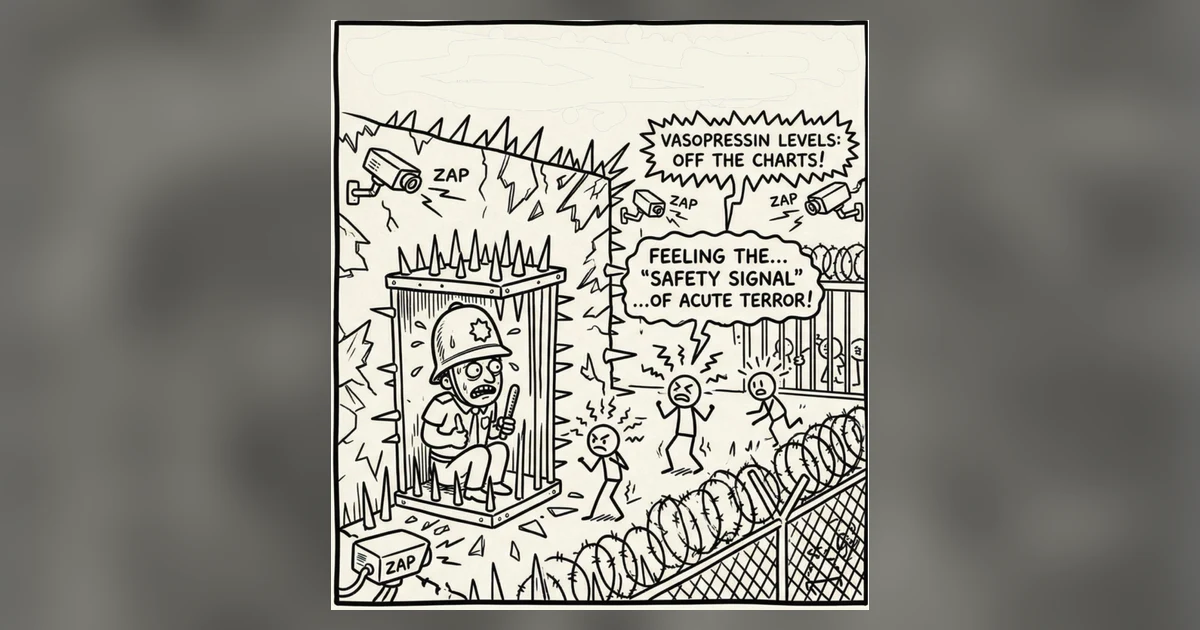
Everyone in this cartoon is frightened, the copper most of all. We're paying for the lot.
By 2017, police-recorded domestic violence was down 23% on the year before. Charges across the top juvenile offences fell 38%, and days adults spent in custody fell 42%. KPMG put the gross impact at $3.1 million against $0.6 million in cost (KPMG, 2018). One town and one assessment don't prove a national policy. But that's a small town getting more safety for less money, and it's worth seeing what the rest of us buy instead.
What $7.33 billion buys
On an average day in 2024–25, Australia held 45,526 people in prison. Prisons cost $7.33 billion that year, or $160,819 for each person. Supervising someone in the community cost $32.17 a day, against $440.60 for a prison bed (Productivity Commission, 2026). And 43% of people released in 2021–22 were back inside within two years (Productivity Commission, 2025). Few of us would keep paying for a product with that return rate.
The usual answer is more money for prisons. So we put each state's spending per prisoner beside the share of its released prisoners who came back.
| State or territory | Spent per prisoner per day | Back within two years |
|---|
| South Australia | $344.44 | 28.2% |
| Northern Territory | $373.76 | 60.3% |
| Queensland | $388.95 | 41.9% |
| Western Australia | $421.49 | 30.8% |
| New South Wales | $480.23 | 48.8% |
| Victoria | $610.83 | 39.3% |
| Tasmania | $637.32 | 51.3% |
| ACT | $773.86 | 34.2% |
There's no pattern. South Australia spends among the least and has the lowest return rate. Tasmania spends among the most and has the second highest. Eight jurisdictions can only reveal a strong relationship, and states differ in who they lock up, so this doesn't prove money never matters. It shows that how much isn't the question. What it buys is.
Price the gap against Norway, where about 20% are reconvicted within two years (Kristoffersen, 2013), and it comes to about 10,471 people and $1.68 billion a year. Norway measures reconviction and Australia reimprisonment, so that's a benchmark, not a forecast.
The instrument at the front door
If a forensic lab told a court its DNA test was right 54% of the time, the court would throw it out. Every day, police, prosecutors and juries decide who is telling the truth by watching how a person behaves. Across 206 studies and 24,483 judges, people get that right 54% of the time. A coin gets 50% (Bond & DePaulo, 2006). Nobody throws that out.
The signs we trust most, like looking away or hesitating, have almost no link to lying (DePaulo et al., 2003). They are, however, what trauma does to a person, and the people the system sees are the people most hurt. Of 64,329 young people in Florida's juvenile justice system, 97% reported at least one adverse childhood experience (Baglivio et al., 2014), against about 61% of adults in 25 US states (Merrick et al., 2019). So a frightened or grieving person who freezes or goes silent can be read as evasive or disrespectful, and charged.
Six changes, one rule
Each of these follows one rule: if the evidence says the current approach doesn't work, stop doing it.
- Train police to recognise trauma, grief and neurodivergence, and to calm a situation before judging anyone. We're not asking officers to be social workers. We're asking them to be accurate.
- Review any charge laid during a trauma response within 48 hours, by a senior officer who wasn't there. We already review use of force this way.
- Screen bail supervisors. No accused person released into the care of someone with a record of abusing them. We screen foster carers.
- Keep psychiatric diagnosis independent of any one person's uncorroborated word, when someone is locked in a ward.
- Send drug-affected people to treatment. NSW Drug Court participants were 17% less likely to be reconvicted of any offence and 30% less likely for a violent offence than a matched group (Weatherburn et al., 2008).
- Tell juries the accuracy rate of judging truth from demeanour.
The warning across the Tasman
New Zealand shows how reform gets lost. Its prison population fell by more than a quarter, from 10,645 in March 2018 to 7,669 in March 2022. Then a new government changed course, and by December 2025 it was back to 10,860 (Ara Poutama Aotearoa, 2025). Whatever you think of that choice, the reform lived in policy, so one election undid it. The lesson is to write changes into law: the Evidence Act, the Bail Act, the Mental Health Act. Law is harder to pass and harder to undo.
Why doesn't this already happen? Elections come every three to four years, and the benefits of prevention arrive in eight to twelve. Announcing a new prison wins votes now. Prevention's success is harm that never happens and never gets counted. That isn't corruption. The system is working as designed, and the design is the problem.
What you can do
Find your state in that table. Send your MP the row, and ask what the money buys and what Bourke did differently. Justice reinvestment now runs or is starting in other Australian towns, so ask whether yours could be one. If you ever sit on a jury, remember the 54%.
Nobody's asking the justice system to go soft on crime. We're asking it to be accurate, and to stop punishing people for grieving.
Bourke asked what else that money could do. Ask yours.
Sources
Ara Poutama Aotearoa, Department of Corrections. (2025). Prison facts and statistics: Quarterly snapshots. https://www.corrections.govt.nz/resources/statistics/quarterly_prison_statistics
Baglivio, M. T., Epps, N., Swartz, K., Huq, M. S., Sheer, A., & Hardt, N. S. (2014). The prevalence of adverse childhood experiences (ACE) in the lives of juvenile offenders. OJJDP Journal of Juvenile Justice, 3(2), 1–23.
Bond, C. F., Jr., & DePaulo, B. M. (2006). Accuracy of deception judgments. Personality and Social Psychology Review, 10(3), 214–234. https://doi.org/10.1207/s15327957pspr1003_2
DePaulo, B. M., Lindsay, J. J., Malone, B. E., Muhlenbruck, L., Charlton, K., & Cooper, H. (2003). Cues to deception. Psychological Bulletin, 129(1), 74–118. https://doi.org/10.1037/0033-2909.129.1.74
KPMG. (2018). Maranguka Justice Reinvestment Project: Impact assessment. https://www.indigenousjustice.gov.au/wp-content/uploads/mp/files/resources/files/maranguka-justice-reinvestment-project-kpmg-impact-assessment-final-report.pdf
Kristoffersen, R. (2013). Relapse study in the correctional services of the Nordic countries: Key results and perspectives. EuroVista, 2(3). https://hdl.handle.net/11250/195255
Merrick, M. T., Ford, D. C., Ports, K. A., Guinn, A. S., Chen, J., Klevens, J., Metzler, M., Jones, C. M., Simon, T. R., Daniel, V. M., Ottley, P., & Mercy, J. A. (2019). Vital signs: Estimated proportion of adult health problems attributable to adverse childhood experiences and implications for prevention, 25 states, 2015–2017. MMWR, 68(44), 999–1005. https://doi.org/10.15585/mmwr.mm6844e1
Productivity Commission. (2025). Report on Government Services 2025, Part C, Table CA.4. https://www.pc.gov.au/ongoing/report-on-government-services
Productivity Commission. (2026). Report on Government Services 2026, Part C, Section 8: Corrective services. https://www.pc.gov.au/ongoing/report-on-government-services
Weatherburn, D., Jones, C., Snowball, L., & Hua, J. (2008). The NSW Drug Court: A re-evaluation of its effectiveness (Crime and Justice Bulletin No. 121). NSW Bureau of Crime Statistics and Research.