Why does Australia almost never change its Constitution?
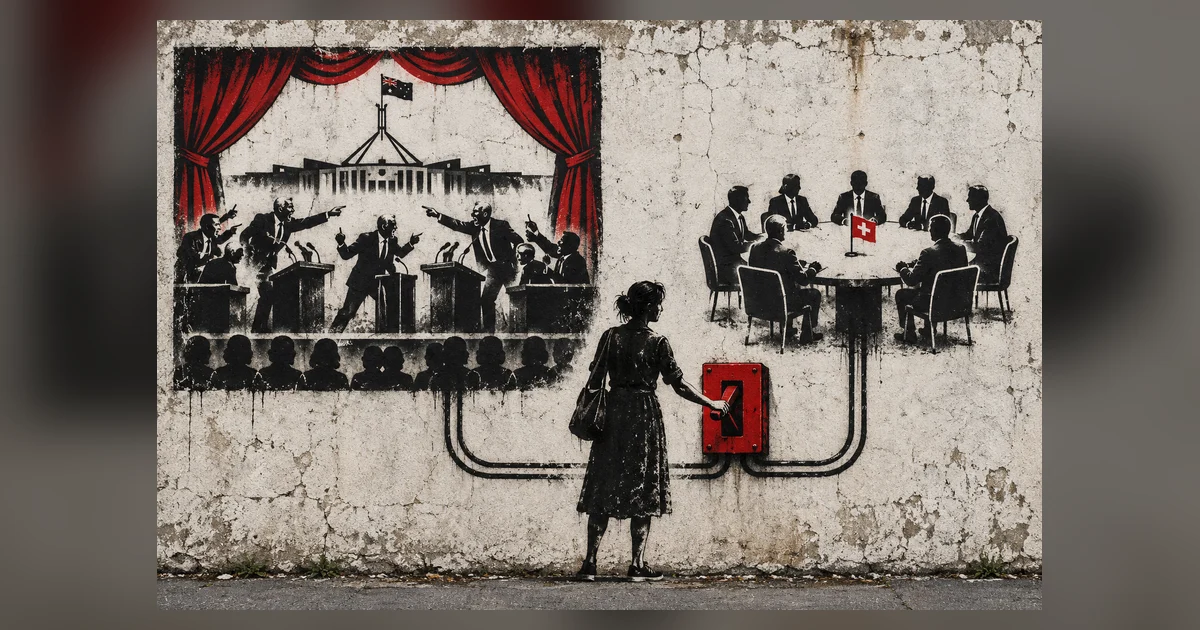
Two Swiss farmers forced a national vote about cows' horns. Australians can't ask a question at all, and haven't said yes since 1977. Here's why.
Art: Omxus Press
8 min read
 articleworld4u
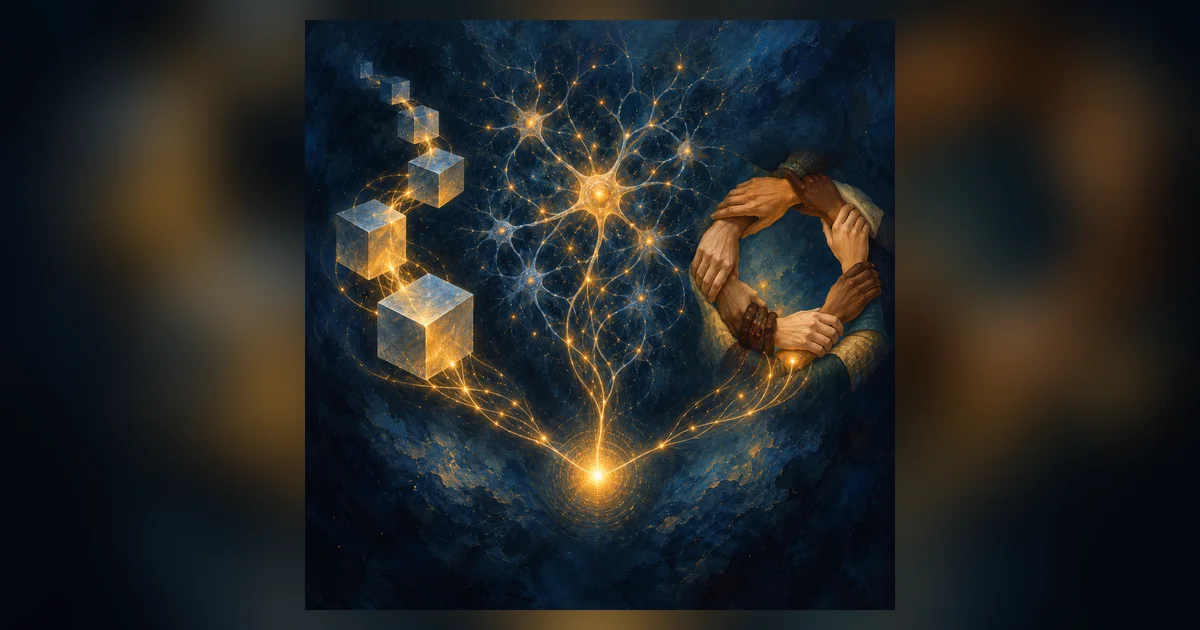
Cover of Consensus, Distillation, and Trust (Omxus Press)
On the Pacific island of Yap, money was once huge stone discs. Around 1900 a visitor heard about the richest family on the island. Its fortune was a giant stone that had sunk in a storm generations back, and nobody living had seen it. Everyone agreed it was still theirs, so it still bought things (Furness, 1910; Friedman, 1991).
We're told we need a boss for almost everything: someone to run the register, the bank, the court, the platform. Those people then get to charge us, and sometimes shut us out. But that family's wealth sat under the sea with no bank and no government, on nothing except a shared story. How does that hold together? And can we build more of it?
Lying on Yap was hard, because everybody knew everybody and your standing was all you had. Agreement among strangers holds when deviating costs something. Computers, children and communities all run on versions of that one idea. What differs is how precisely we can measure the cost.
Bitcoin, proposed in 2008, is Yap with strangers: a shared list of who owns what, with nobody in charge of it (Nakamoto, 2008). To add a page, a computer must win a lottery that burns real electricity. To rewrite an old page, a cheat must win that lottery faster than everyone else combined, over and over. The maths is exact: a cheat with one tenth of the world's mining power, facing six confirmed blocks, wins less than one time in a thousand (Grunspan & Pérez-Marco, 2018).
That maths assumes blocks arrive like raindrops on a roof, at random, with no memory of the last one. So we checked it on 4,032 real blocks from 2024. The median gap was 440 seconds; the model predicts 430. It holds. You may think Bitcoin itself is a wasteful gamble, and there's a case for that. The point here is narrower: strangers really can agree without a referee, if lying costs enough.
A toddler faces a quieter version of the same problem. Nobody hands over the rules of anger, patience or shame. The child watches, thousands of times, copies, and comes to agree with the people around them about how the world works (Bandura, 1977).
Machine learning has a name for something like this. In "knowledge distillation", a small model learns by copying a large model's answers, including how sure it is of each, without ever seeing its reasoning (Hinton et al., 2015). What passes from parent to child may be a spread in the same way: anger likely, silence possible, calm rare. Children aren't computers, and this is an analogy that needs testing. But the cost is real. Act differently from the room and the room pushes back, which is why patterns run through families far more than the "rational criminal" of economics would predict (Becker, 1968).
None of this dissolves responsibility. A pattern learned decades ago is now the person's own, landing on other people. What changes is the response: less punishing choices that may never have been made, more retraining through new rooms and new examples.
The third problem is counting people. If a community shares something equally, one vote or one share each, it must know that every member is real and counted once. Online, one person can pose as a thousand, and computer scientists have shown you can't stop this without some authority or some cost (Douceur, 2002).
One answer is old, and Yap would recognise it. People who know you vouch for you in person. Require three vouches per member, and faking a hundred people needs three hundred lies told face to face, each risking the liar's own standing. How strong that is depends on one number nobody has properly measured: what a false vouch really costs. That's the weak spot, and it's also hopeful, because it means this isn't a mystery. It's a thing someone can go and measure.
Bitcoin's guarantee is exact because electricity is easy to measure. A child's is fuzzy. A community's is only as good as what it costs to lie to the people around you, and in most of our lives that cost has collapsed, because we don't know each other.
You can raise it, cheaply. Become someone in your street whose word means something. Lend the ladder, and return the trailer. Say who you'd vouch for and mean it. Every time a place runs on that, it needs one less boss, and it gets one less bill.
Agreement isn't imposed from above. It emerges from cost, structure and repeated interaction, whether the agents are machines, neurons or people. On Yap, it held up a fortune at the bottom of the sea.
Two Swiss farmers forced a national vote about cows' horns. Australians can't ask a question at all, and haven't said yes since 1977. Here's why.
Art: Omxus Press
A small lottery lifted student turnout by 32%. Paying for blood drove women away. What moves us is rarely what we say it is, and somebody designs it either way.
Art: Omxus Press
A dead salmon lit up in a brain scanner because the method expected it to. When a clinician's belief decides the finding, what choice is always safe?
Cover of The Lonely Whisper of the Wind (Omxus Press)