In August 1980, nine-week-old Azaria Chamberlain vanished from a tent at Uluru. Her mother Lindy said a dingo took her. In 1982 Lindy Chamberlain was convicted of murder and sentenced to life with hard labour. She served more than three years. How does a whole country, with forensic scientists, police, lawyers and twelve careful jurors, get that wrong?
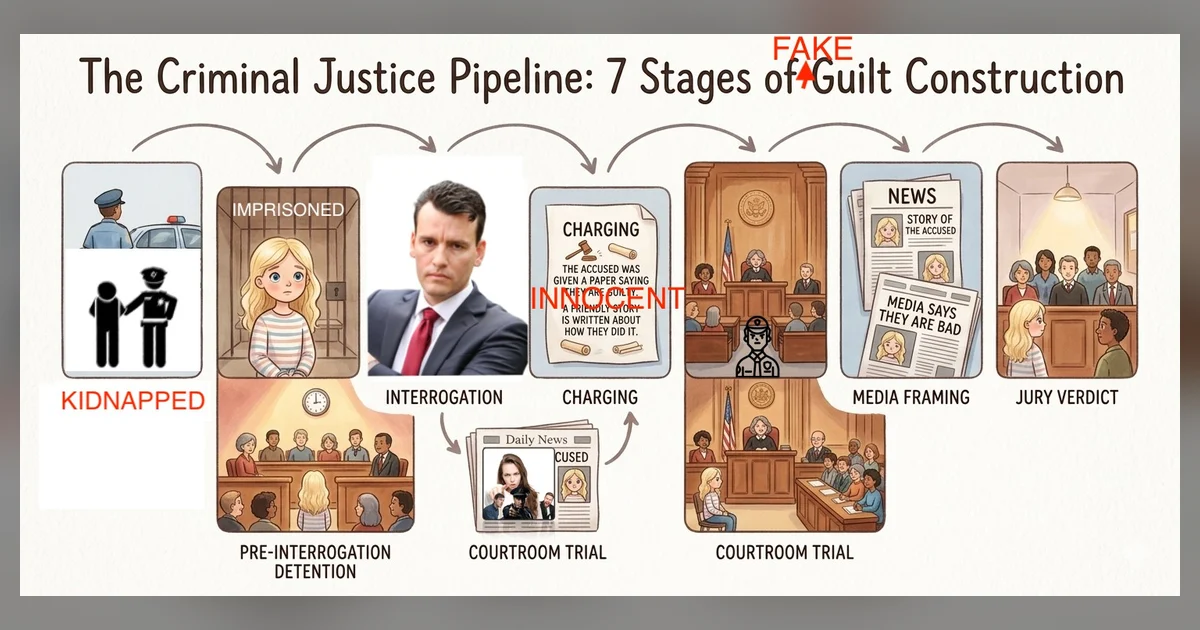
Not through one mistake. Nobody has to be a villain. Follow any person through the chain and you can watch each link weaken the next.
One verb
It starts with how a question gets asked. Fifty students were asked how fast cars were going when they "smashed" into each other. Fifty were asked about cars that "hit". Fifty were never asked about speed. A week later, 16 of the "smashed" students said they had seen broken glass, against 6 of those never asked (Loftus & Palmer, 1974). The film had none.
One verb, picked by the person asking, wrote a memory. The people carrying it couldn't tell.
The person who walks into the room
Now the arrest. A search. Phone, wallet and keys in a bag. A bare cell. Hours. The law calls this person innocent. Their body gets treated otherwise.
Stress like that turns down the part of the brain that holds a line of reasoning and resists a leading suggestion (Arnsten, 2009). Custody by itself makes people more likely to go along with what they're told (Gudjonsson, 2003). So the person who reaches the interview room is more suggestible than the person who was arrested, and no one measures by how much.
The room
Then the questions. Silence, composure, tears and looking away all get read as signs. We went through 23 behaviours the world believes betray a liar, and found 21 of them either unrelated to lying in high-stakes testimony or pointing the other way. In 121 real trial clips, the people telling the truth stumbled more than the people lying. Remembering is work, and work shows.
Of the first 250 people in the United States cleared by DNA evidence, 40 had confessed (Garrett, 2011). Read those confessions and the words give it away: "you" appears 7.6 times as often as in true ones, on our count. "You said." "Like you told me." The story came from across the table.
The court, the news, the jury
Cross-examination is the verb again, asked by people paid to win. The news tells the story before the trial. Twelve people who weren't there choose the story that hangs together, and the story told first has the advantage. At no stage does anything in the chain test whether the story is true.
Lindy Chamberlain's composed, factual manner was read by investigators, reporters and jurors as lack of distress, and so as guilt. A mother killing her baby was a story everyone knew. A wild animal taking a baby from a tent wasn't. The "foetal blood" found in the family car later proved to be a false positive for a sound-deadening compound. In 1986 Azaria's matinee jacket turned up near a dingo lair. A Royal Commission found the case unsafe (Morling, 1987), the convictions were quashed in 1988, and a coroner found in 2012 that a dingo took and killed Azaria. Every link had done its job.
Who the chain reads worst
The people who look "wrong" while telling the truth pay most: the traumatised, whose memories come out in pieces; autistic adults, judged more deceptive than other truthful people (Lim et al., 2022); people whose honest speech sounds different. We ran a lie detector trained on US writers over truthful writers from India. It called 55.6% of them liars, against 21.3% of the US writers. In Australia the imprisonment gap for Aboriginal and Torres Strait Islander adults is now 14.5 times, up from 10.2 in 2017–18 (Productivity Commission, 2026). Those figures have many causes, but a chain that reads difference as guilt is unlikely to be helping.
Most people in prison did what they're there for. But the system can't tell you which ones, because it counts convictions, not accuracy. Nothing in the chain is built to learn from its errors.
What works instead
This can change, and it has. England moved its police to an interview method built to gather information rather than extract a confession. Across the studies, such methods give fewer false confessions and no loss of true ones (Meissner et al., 2014). The rest isn't complicated. Give demeanour evidence no weight, and tell juries so. Record every custodial moment, not only the formal interview. Give people rest and legal advice before any question.
What you can do
If police ever want a chat, you or your kid: be polite, say "I'd like to speak to a lawyer first", and then stop talking, even if you did nothing wrong. Especially then. The innocent think the truth will protect them, and that's how they end up in the room. Teach your children this. If you're on a jury, ignore the face and test the facts. And ask your state's attorney-general whether police must record everything from the moment of arrest.
A person can be arrested without having done anything wrong. They can be convicted. The word on the verdict form will carry the full weight of the system, but it won't mean this person did the thing. It will mean this system processed this person and produced this output. It doesn't have to stay that way. The evidence has been presented. The choice is political.
Sources
Arnsten, A. F. T. (2009). Stress signalling pathways that impair prefrontal cortex structure and function. Nature Reviews Neuroscience, 10(6), 410–422. https://doi.org/10.1038/nrn2648
Garrett, B. L. (2011). Convicting the innocent: Where criminal prosecutions go wrong. Harvard University Press.
Gudjonsson, G. H. (2003). The psychology of interrogations and confessions: A handbook. Wiley.
Lim, A., Young, R. L., & Brewer, N. (2022). Autistic adults may be erroneously perceived as deceptive and lacking credibility. Journal of Autism and Developmental Disorders, 52(2), 490–507. https://doi.org/10.1007/s10803-021-04963-4
Loftus, E. F., & Palmer, J. C. (1974). Reconstruction of automobile destruction. Journal of Verbal Learning and Verbal Behavior, 13(5), 585–589. https://doi.org/10.1016/S0022-5371(74)80011-3
Meissner, C. A., Redlich, A. D., Michael, S. W., Evans, J. R., Camilletti, C. R., Bhatt, S., & Brandon, S. (2014). Accusatorial and information-gathering interrogation methods and their effects on true and false confessions: A meta-analytic review. Journal of Experimental Criminology, 10(4), 459–486. https://doi.org/10.1007/s11292-014-9207-6
Morling, T. R. (1987). Royal Commission of Inquiry into Chamberlain Convictions: Report. Government Printer of the Northern Territory.
Productivity Commission. (2026). Report on Government Services 2026, Part C, Section 8: Corrective services. Australian Government.