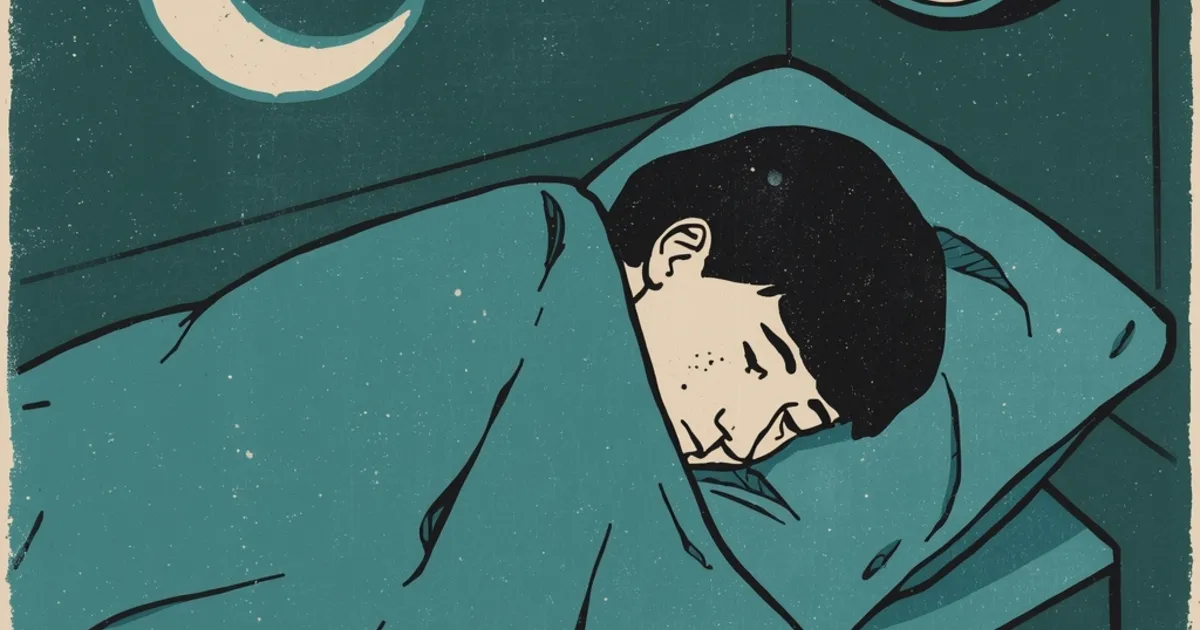
Adults need seven hours or more, most sleep scientists agree. The bigger modern problem may be when we sleep: evening light and early alarms push the body clock out of step with the day, and that does its own harm.
The official answer: seven hours or more
In 2015, fifteen experts from the American Academy of Sleep Medicine and the Sleep Research Society reviewed more than 5,300 studies. They concluded that healthy adults should sleep seven or more hours a night, and that six hours or fewer does not sustain health and safety.
That is a floor for most people, not a prescription for each person. Some people do well on less, and some need more.
People without electricity don't sleep eight hours either
A common story says we sleep far less than our ancestors did. A 2015 study tested it. Researchers put motion-tracking watches on people in three groups who live without electricity: the Hadza in Tanzania, the San in Namibia and the Tsimane in Bolivia.
They slept 5.7 to 7.1 hours a night, about 6.4 on average: no more than many office workers. They went to sleep about three hours after sunset, woke near dawn, and slept about an hour longer in winter than summer. Sleep began as the air cooled and ended at the coldest point before dawn.
So the claim that modern life has taken hours of sleep from everyone doesn't hold up. It doesn't prove six and a half hours is ideal, either. These groups live near the equator, and the watches measured stillness, not the depth of sleep.
What short sleep does
Lab studies leave little doubt that too little sleep harms the body.
| Study | What happened |
|---|
| Spiegel et al., 1999 | 11 young men spent six nights with four hours in bed. Their bodies handled sugar worse than after they caught up on sleep. |
| Prather et al., 2015 | 164 adults wore sleep trackers for a week, then had cold virus dropped into their noses. Those who slept six hours or less were about four times as likely to get a cold as those who slept more than seven. |
Timing matters as much as length
Your body runs on an internal clock of about 24 hours. Light sets it, through cells in the eye that don't help you see; they only measure brightness. Bright light in the evening tells the clock it's still day and holds back melatonin, the hormone that signals night.
A 2014 Harvard study had people read for four hours before bed, either from a light-emitting e-reader or a printed book, for five nights each. After the e-reader nights, people:
- made about half as much melatonin in the evening
- had body clocks running more than an hour and a half late
- took about ten minutes longer to fall asleep
- felt sleepier the next morning
Indoor light is also far dimmer than daylight. Days that are too dim and evenings that are too bright blur the signal the clock needs.
Social jet lag
Most people's body clocks don't match their alarm clocks. Late sleepers get up early for work or school on weekdays, then sleep late at weekends, as if flying across time zones every week. Researchers call this social jet lag. A large European study of social jet lag in 2012 linked it to higher body weight, beyond any effect of how long people slept.
Teenagers are the extreme case: their body clocks run later than children's or adults', and school still starts early.
Night shifts
Night work is the biggest mismatch of all. In 2019, the World Health Organization's cancer agency, IARC, again classed night shift work as probably causing cancer in humans (Group 2A). It based this on limited evidence in people for breast, prostate and bowel cancer, and stronger evidence from animal studies and from how the body clock controls cells.
What you can do
- Aim for seven hours or more of sleep a night.
- Get outside in daylight in the morning, even for ten or twenty minutes.
- Dim the lights in the last hours before bed, and keep screens down or off.
- Keep wake-up times within an hour or so between weekdays and weekends.
- Keep the bedroom cool; sleep in the study above began as the air cooled.
- If you work nights, darken the room completely for daytime sleep and talk to your doctor about regular health checks.
Sources
- Watson, N. F., Badr, M. S., Belenky, G., et al. (2015). Recommended amount of sleep for a healthy adult: A joint consensus statement of the American Academy of Sleep Medicine and Sleep Research Society. Journal of Clinical Sleep Medicine, 11(6), 591–592. https://doi.org/10.5664/jcsm.4758
- Yetish, G., Kaplan, H., Gurven, M., et al. (2015). Natural sleep and its seasonal variations in three pre-industrial societies. Current Biology, 25(21), 2862–2868. https://doi.org/10.1016/j.cub.2015.09.046
- Spiegel, K., Leproult, R., & Van Cauter, E. (1999). Impact of sleep debt on metabolic and endocrine function. The Lancet, 354(9188), 1435–1439. https://doi.org/10.1016/S0140-6736(99)01376-8
- Prather, A. A., Janicki-Deverts, D., Hall, M. H., & Cohen, S. (2015). Behaviorally assessed sleep and susceptibility to the common cold. Sleep, 38(9), 1353–1359. https://doi.org/10.5665/sleep.4968
- Chang, A.-M., Aeschbach, D., Duffy, J. F., & Czeisler, C. A. (2015). Evening use of light-emitting eReaders negatively affects sleep, circadian timing, and next-morning alertness. Proceedings of the National Academy of Sciences, 112(4), 1232–1237. https://doi.org/10.1073/pnas.1418490112
- Roenneberg, T., Allebrandt, K. V., Merrow, M., & Vetter, C. (2012). Social jetlag and obesity. Current Biology, 22(10), 939–943. https://doi.org/10.1016/j.cub.2012.03.038
- IARC Monographs Vol 124 Group. (2019). Carcinogenicity of night shift work. The Lancet Oncology, 20(8), 1058–1059. https://doi.org/10.1016/S1470-2045(19)30455-3



,_Mo_i_Rana,_Norway_2017-10-09_a.jpg)
