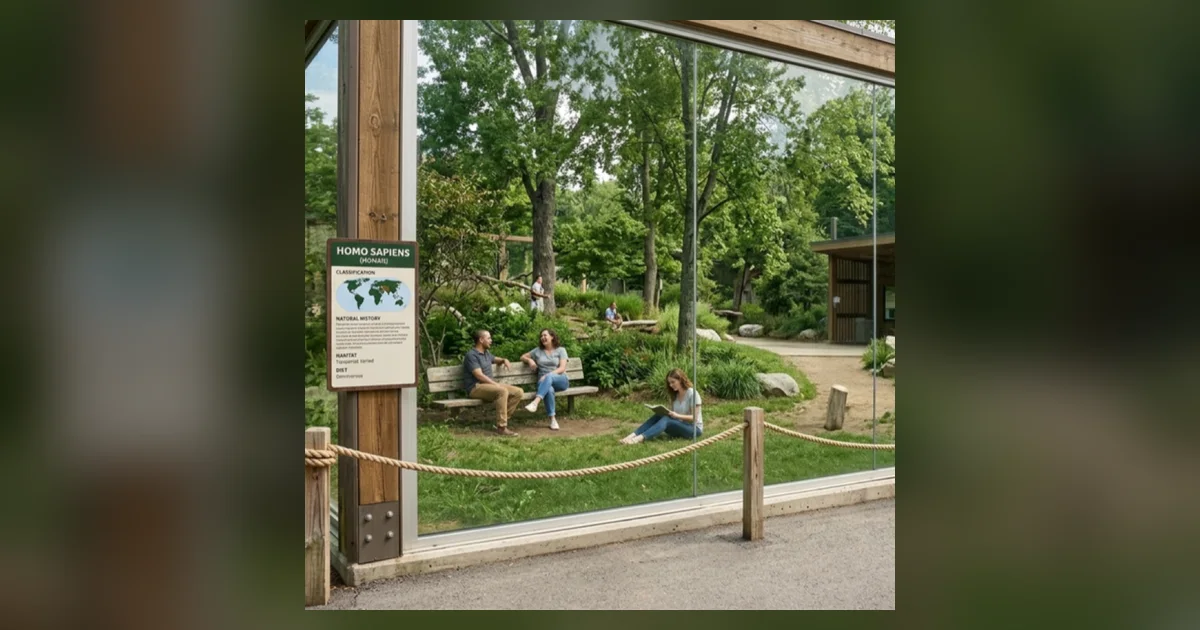
Would a zookeeper pass the way we live?
When a polar bear swam in figure eights, the zoo inspected his life. Scored the same way, the places people live and work fail on 17 of 18 measures.
Cover of The Human Enclosure (Omxus Press)
8 min read
 articleworld4u

Art: Omxus Press
In the late 1940s, Jerry Morris, a British doctor, looked at the men who ran London's double-decker buses. Same employer, same class, same city, same bus. The drivers sat all shift. The conductors climbed the stairs all shift, and they had far less heart disease, which struck them later and killed them less often (Morris et al., 1953).
Most of us are drivers now. We feel tired, stiff and low, and we tell ourselves we ought to go to the gym, then feel bad when we don't. It turns out the conductors never went to the gym.
Between 2007 and 2018, interviewers for the United States national health survey asked 34,770 adults how they spent a typical week: how much they moved at work and at home, whether they walked or cycled to get anywhere, whether they played any sport, and how long they sat (National Center for Health Statistics, 2020). Statisticians later linked each person to the national death register (National Center for Health Statistics, 2022).
The answers describe a modern day. The typical adult sat six hours. 36.2% sat eight hours or more. 47.0% did no exercise or sport at all. 76.7% never walked or cycled to get anywhere.
We followed the answers forward. Over a median 6.7 years, 3,102 of 30,857 adults died. People who sat eight hours or more and moved less than 150 minutes a week died at 2.34 times the rate of people who sat under four hours and moved an hour a day, comparing people of the same age, sex, income, education and smoking, with the same history of diabetes, heart disease and cancer.
Here's the turn. Among people who moved an hour a day, sitting longer made no clear difference. Eight hours in a chair, with an hour of movement, wasn't clearly riskier than four. Among people who barely moved, every extra hour of sitting added about 6.6% to the risk. A million-person analysis found the same thing in 2016 (Ekelund et al., 2016). So the chair isn't the villain. The missing movement is.
That makes sense once you look at the animal doing the sitting. A house cat can outrun us. We have no claws, no venom and no armour. What we can do, better than almost anything alive, is keep going: a springy Achilles tendon, a ligament that steadies the head when running, buttock muscles that fire in running and barely in walking (Bramble & Lieberman, 2004). Hadza hunter-gatherers in Tanzania spend 135 minutes a day in moderate-to-vigorous activity, more than 14 times the level in large US studies, and their cardiovascular biomarkers are optimal (Raichlen et al., 2017). They rest nearly ten hours a day too, but often squatting, which keeps the leg muscles working (Raichlen et al., 2020). A chair switches them off. Within hours, in rats kept from walking, muscle lost about 90 to 95% of the active form of the enzyme that pulls fat out of the blood (Bey & Hamilton, 2003); two minutes of light walking every twenty minutes lowers the sugar spike after a meal (Dunstan et al., 2012).
The finding that matters most came from people who never exercise. Among 16,286 adults who did no sport at all, those whose daily lives included 150 minutes a week of moving, at work, in chores, carrying, getting around, died at a 31% lower rate than those whose lives included none. Movement that came with the day did about as much as moderate exercise. Those are the bus conductors again, sixty years on. It's also how long-lived communities have been described: they don't go to the gym; they walk, garden and climb hills (Buettner, 2008).
That's very good news if you hate the gym, can't afford it, or are too tired to face it after a shift.
If movement used to come with the day, the question is who took it out. Escalators replaced stairs. Cars replaced walking. Across fourteen cities on five continents, people living in the most walkable neighbourhoods got 68 to 89 more minutes of moderate-to-vigorous activity a week than people in the least, 45 to 59% of the whole weekly recommendation from street layout alone, without anyone telling them to (Sallis et al., 2016). You do not fix that with willpower. You fix it with stairs that are easy to find, streets worth walking, and monkey bars at the bus stop.
This is observational, and people reported their own movement, once. Illness causes both inactivity and death, so some of the early gap is sickness already present. Morris's conductors may have differed from drivers too, and he checked uniforms to see whether conductors started out slimmer: partly they did. But the gap stayed near two after removing early deaths and people with major disease, and an unmeasured factor would need to be very strong to explain it all away.
Forget the membership. Break up your sitting: two minutes of walking every twenty or thirty. Take the stairs when you can find them. Do your chores and carry your own shopping, and count them, because your body does. If you're looking after someone who sits all day, a walk to the letterbox is medicine. And if you're sad, a walk works alongside therapy and medication and doesn't replace them.
Then ask who took the stairs away. Across fourteen cities, people in walkable neighbourhoods moved far more without anyone telling them to. You don't fix an environmental mismatch with willpower. So ask your council for streets worth walking, stairs before the lift, and monkey bars at the bus stop. Jerry Morris worked this out on the buses, walked for the rest of his life, and died at 99.
When a polar bear swam in figure eights, the zoo inspected his life. Scored the same way, the places people live and work fail on 17 of 18 measures.
Cover of The Human Enclosure (Omxus Press)
In 2008 Denmark began paying night workers with breast cancer. Sleep advice still blames your habits. In a US sample, the job predicts who sleeps too little.

Cover of The Stolen Night (Omxus Press)
Twenty years of American time diaries show young people's time with friends fell from 137 minutes a day to 51, and the hours went to being alone.

Art: Omxus Press