Why does Australia almost never change its Constitution?
Two Swiss farmers forced a national vote about cows' horns. Australians can't ask a question at all, and haven't said yes since 1977. Here's why.
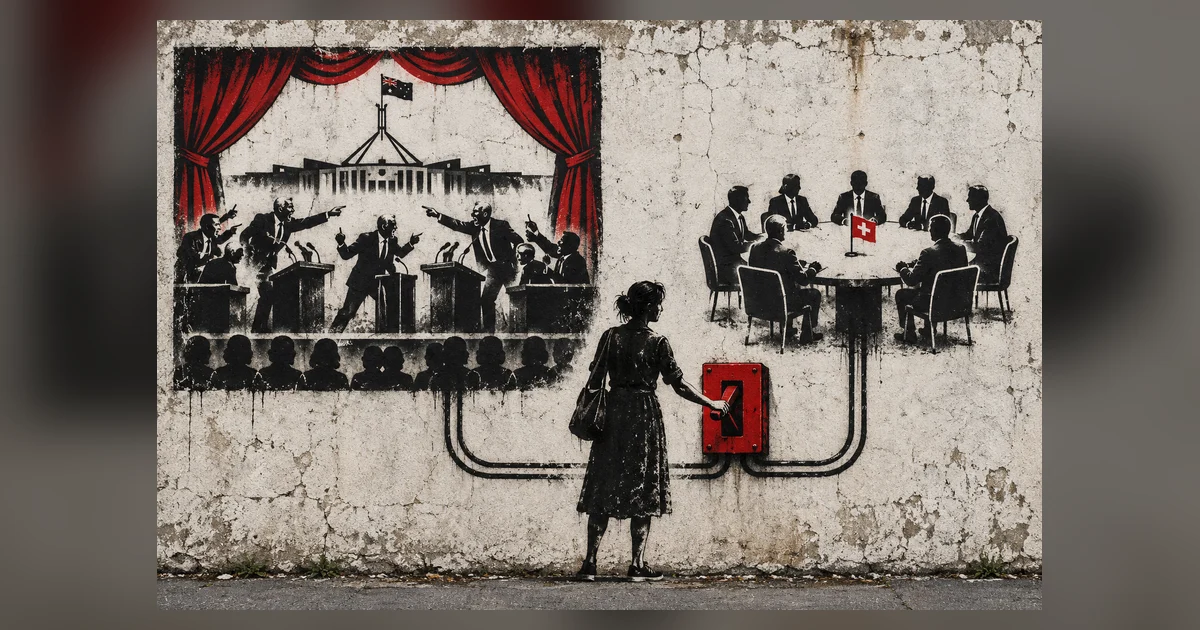
Art: Omxus Press
8 min read
 articleworld4u
Cover of Trust-First Governance (Omxus Press)
In 2016 Rhys Cauzzo, 28, of Melbourne, got a letter saying he owed the government about $28,000. A computer had decided that. Debt collectors followed. In January 2017 he took his own life, and his mother, Jennifer Miller, spent years asking how a nation had come to send those letters (Holmes, 2023).
The scheme, Robodebt, went after about 443,000 Australians and was found unlawful: a "crude and cruel mechanism, neither fair nor legal" (Holmes, 2023). It assumed people were cheats until they could prove otherwise. Science has tested that assumption. It used 17,000 wallets.
Between 2013 and 2016, a team of economists walked into banks, hotels, post offices and police stations in 355 cities across 40 countries and handed in more than 17,000 "lost" wallets. Each held a key, a shopping list and a business card with an email address. Some held cash. Some didn't (Cohn et al., 2019).
Then they waited to see who would email the owner.
Before the study, most people asked, including economists, predicted that cash would make people keep the wallet. The more money, the less honesty. The opposite happened. In country after country, wallets with money were more likely to come back than empty ones, and when the researchers raised the amount, more came back still (Cohn et al., 2019).
Nobody was watching the person at the counter. Nobody would ever have known.
Now look at how we build things. Passwords, ID checks, security guards, surveillance cameras, means tests, audits, courts. Every one of them starts from the idea that people will cheat unless they're stopped.
That idea costs a fortune, and Robodebt was only the cruellest bill. Worldwide spending on information security alone was forecast to pass US$124 billion in 2019 (Gartner, 2018). In one survey, employees spent about 12.6 minutes a week just typing and resetting passwords, worth an estimated US$5.2 million a year in lost time for an average organisation (Ponemon Institute, 2019). And the payoff is thinner than you'd think: a major review of public-area CCTV found a small drop in crime, mostly in car parks, and little effect on violence (Welsh & Farrington, 2009).
The honest majority pays that bill, every day, to guard against a minority. In the wallet study, that majority is the person at the counter.
What does trust buy a country? We took survey data from 91 countries, where people were asked whether "most people can be trusted", and set them against corruption, homicide and imprisonment rates for the same years.
The pattern is clear. Countries whose people trust each other have cleaner institutions and far less lethal violence. In the most trusting quarter of the world, the median homicide rate is 0.8 per 100,000 people. In the least trusting quarter it's 4.2. And at the same level of national wealth, every 10 points of trust goes with a 15.3% lower imprisonment rate. That's correlation, and trust and fair institutions likely build each other.
Denmark, Norway, Finland and Sweden sit where you'd expect: the median trust is 68.4% and the median imprisonment is 58 people per 100,000.
| Australia | Nordic median | Least trusting quarter of the world (median) | |
|---|---|---|---|
| "Most people can be trusted" | 48.5% | 68.4% | 8.4% |
| Prisoners per 100,000 | 163 | 58 | 165 |
(World Values Survey and World Prison Brief)
Australians trust each other about as much as Austrians do, which puts us in the most trusting fifth of the countries surveyed. Yet Australia locks people up at almost exactly the rate of countries where one person in eight, or fewer, trusts a stranger, and at nearly three times the Nordic rate. New Zealand shows the same gap.
The people already behave like a high-trust society. The institutions don't.
Nobody's saying remove the locks and hope. Some people do keep the wallet. This is an engineering idea. Software teams stopped trying to prevent every failure years ago. Instead they make failures easy to see, small in reach and quick to undo (Woods, 2015). Apply the same thinking to government and you get five rules:
None of this is fantasy. The web already runs on a public, tamper-evident log that catches security certificates issued in secret (Laurie et al., 2013).
There's Australian evidence for the core idea. Kristina Murphy, Tom Tyler and Amy Curtis surveyed taxpayers, welfare recipients and people who'd dealt with police. Being treated fairly shaped whether people complied, and it mattered most for those who doubted the law itself (Murphy et al., 2009). Trust given as fair treatment comes back as compliance.
And when the floor goes up, harm goes down. Alaska pays every resident a yearly dividend. In the four weeks after payday, property crime drops by 8%, with no rise in violent crime (Watson et al., 2020). Ireland handed one of its hardest political questions to 99 citizens picked at random. Their recommendation led to the 2018 referendum that changed the constitution (Farrell et al., 2019).
Strangers in 40 countries, handed a lost wallet, did the right thing more often when there was money in it. Nobody watched them. Nobody would ever know. Our institutions are built for a different species. They assume the wallet will be kept, so they lock, watch, credential and punish, and they charge the honest majority for it.
People aren't good uniformly or unfailingly, but they are as a robust statistical tendency, and design should build on that. Suspicion-first systems build walls and hope the good get through. Trust-first systems build windows and make sure the bad are visible. All of this can be tested in small pilots, and it should be.
Next time a government or company wants more proof from you, ask how many honest people it will trip up for each cheat it catches, and whether anyone counted. Ask your federal MP whether the Robodebt Royal Commission's recommendations have all been carried out, and where you can see the list. If you run anything at all, a club, a shop, a team, find one rule that exists for the worst 1% and see what happens if you drop it for a month.
And hand in the next wallet you find. The rest of us are already doing it.
If any of this hits close to home, Lifeline is on 13 11 14.
Two Swiss farmers forced a national vote about cows' horns. Australians can't ask a question at all, and haven't said yes since 1977. Here's why.
Art: Omxus Press
A small lottery lifted student turnout by 32%. Paying for blood drove women away. What moves us is rarely what we say it is, and somebody designs it either way.
Art: Omxus Press
A dead salmon lit up in a brain scanner because the method expected it to. When a clinician's belief decides the finding, what choice is always safe?
Cover of The Lonely Whisper of the Wind (Omxus Press)