It's in the same range as other major risks. Pooled studies of millions of people find that loneliness, social isolation and living alone each raise the risk of dying early by roughly 26 to 32%. The body treats being cut off as a threat, and the change shows up down to which genes switch on.
What the big studies found
In 2010, psychologist Julianne Holt-Lunstad and colleagues pooled 148 studies that followed 308,849 people over time. People with stronger social relationships were 50% more likely to be alive at the end of the studies than people with weaker ones. The result held across ages, sexes, starting health and causes of death. The authors concluded the effect is comparable to well-known risks for early death, such as smoking and drinking.
A second review in 2015 split the problem into three parts:
| Measure | What it means | Higher risk of early death |
|---|
| Social isolation | Few contacts, measured from outside | 29% |
| Loneliness | Feeling disconnected, whatever the number of contacts | 26% |
| Living alone | Household size | 32% |
Feeling alone mattered about as much as being alone. The link was stronger in people under 65, not weaker.
The kind of connection matters too. In the 2010 review, the strongest link came from measures of how woven into a network of people someone was: family, friends, groups, neighbours. Simply sharing a house showed the weakest link. Having people around is not the same as belonging among them.
These studies follow people; they don't assign loneliness at random. Some of the link may run the other way, since illness can isolate people. But the studies controlled for starting health, and the pattern held.
Lonely and alone are different
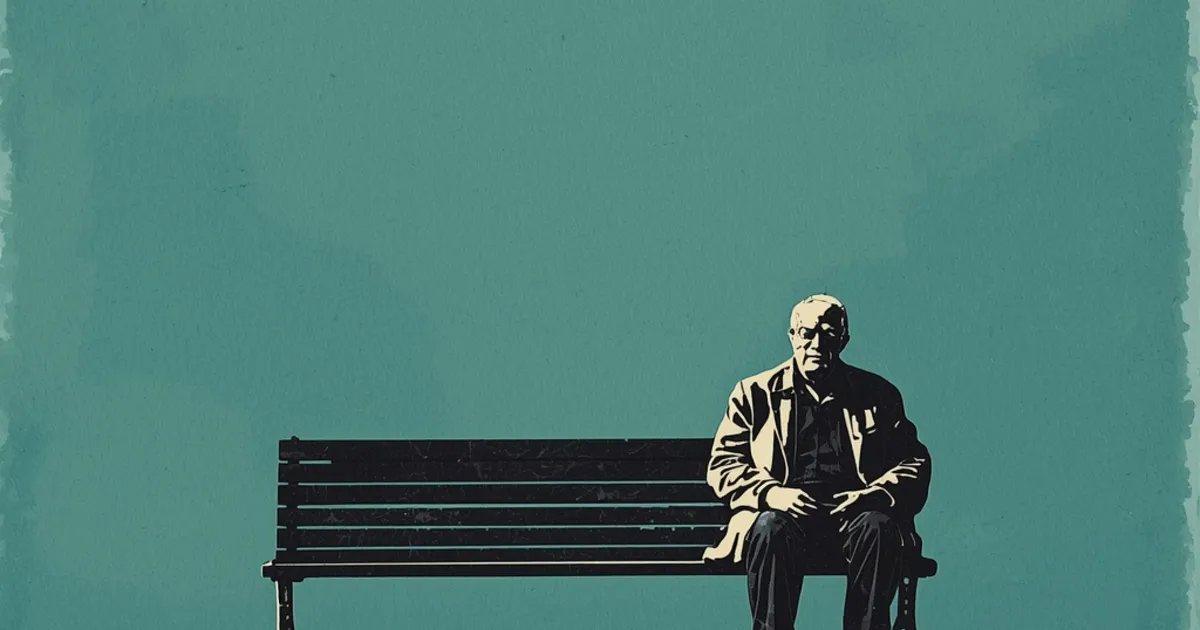
You can live alone and feel well connected, or sit in a full office and feel invisible. Researchers treat these as two things: isolation is the number of people around you, and loneliness is the gap between the contact you have and the contact you need. Both carry risk.
What loneliness does inside the body
In 2007, a team led by Steve Cole at UCLA and John Cacioppo at the University of Chicago compared white blood cells from people who had felt lonely for years with cells from people who hadn't. In the lonely group:
- genes that drive inflammation were more active
- genes for fighting viruses and making antibodies were less active
- the cells responded less to the body's own anti-inflammatory signals
The study was small, with 14 people, but later research built on it. One explanation is evolutionary: for a social animal alone, injury is the bigger danger, so the body primes for wounds rather than for the viruses that spread in groups. Kept up for years, that setting feeds the long-term inflammation behind heart disease and diabetes.
Why "just join a club" often fails
A 2011 review of loneliness programmes sorted them into four kinds: teaching social skills, adding support, creating more chances to meet people, and changing how lonely people read social situations. In the better-designed trials, only the last worked consistently.
The researchers' explanation: loneliness sharpens the mind's watch for rejection. Lonely people tend to read neutral faces and silences as unfriendly, then pull back first. More invitations don't help if every one feels like a risk. Changing that reading, often with talking therapy, gives the next invitation a chance.
A problem of how we live
In 2023, the US Surgeon General issued an advisory, Our Epidemic of Loneliness and Isolation, calling social connection an underrated part of public health. It asks governments and employers to build what it calls social infrastructure: parks, libraries and places where people meet, and policies that leave time for each other.
Trust between people grows from seeing the same faces again and again. Long commutes, unpredictable shifts and streets with nowhere to stop all get in the way.
What you can do
- Choose something regular over something big: the same class, walk or café at the same time each week.
- Notice when you expect rejection. Test it: send the message and see what actually comes back.
- If loneliness has lasted months, tell your GP. It's a health risk, and talking therapy helps.
- Check in on neighbours who live alone, especially after a death, a move or retirement.
- At work or in your community, argue for spaces and times where people can simply be around each other.
Sources
- Holt-Lunstad, J., Smith, T. B., & Layton, J. B. (2010). Social relationships and mortality risk: A meta-analytic review. PLoS Medicine, 7(7), e1000316. https://doi.org/10.1371/journal.pmed.1000316
- Holt-Lunstad, J., Smith, T. B., Baker, M., Harris, T., & Stephenson, D. (2015). Loneliness and social isolation as risk factors for mortality: A meta-analytic review. Perspectives on Psychological Science, 10(2), 227–237. https://doi.org/10.1177/1745691614568352
- Cole, S. W., Hawkley, L. C., Arevalo, J. M., Sung, C. Y., Rose, R. M., & Cacioppo, J. T. (2007). Social regulation of gene expression in human leukocytes. Genome Biology, 8(9), R189. https://doi.org/10.1186/gb-2007-8-9-r189
- Masi, C. M., Chen, H.-Y., Hawkley, L. C., & Cacioppo, J. T. (2011). A meta-analysis of interventions to reduce loneliness. Personality and Social Psychology Review, 15(3), 219–266. https://doi.org/10.1177/1088868310377394
- Office of the Surgeon General. (2023). Our epidemic of loneliness and isolation: The U.S. Surgeon General's advisory on the healing effects of social connection and community. US Department of Health and Human Services. https://www.ncbi.nlm.nih.gov/books/NBK595227/



,_Mo_i_Rana,_Norway_2017-10-09_a.jpg)
