Would a zookeeper pass the way we live?
When a polar bear swam in figure eights, the zoo inspected his life. Scored the same way, the places people live and work fail on 17 of 18 measures.
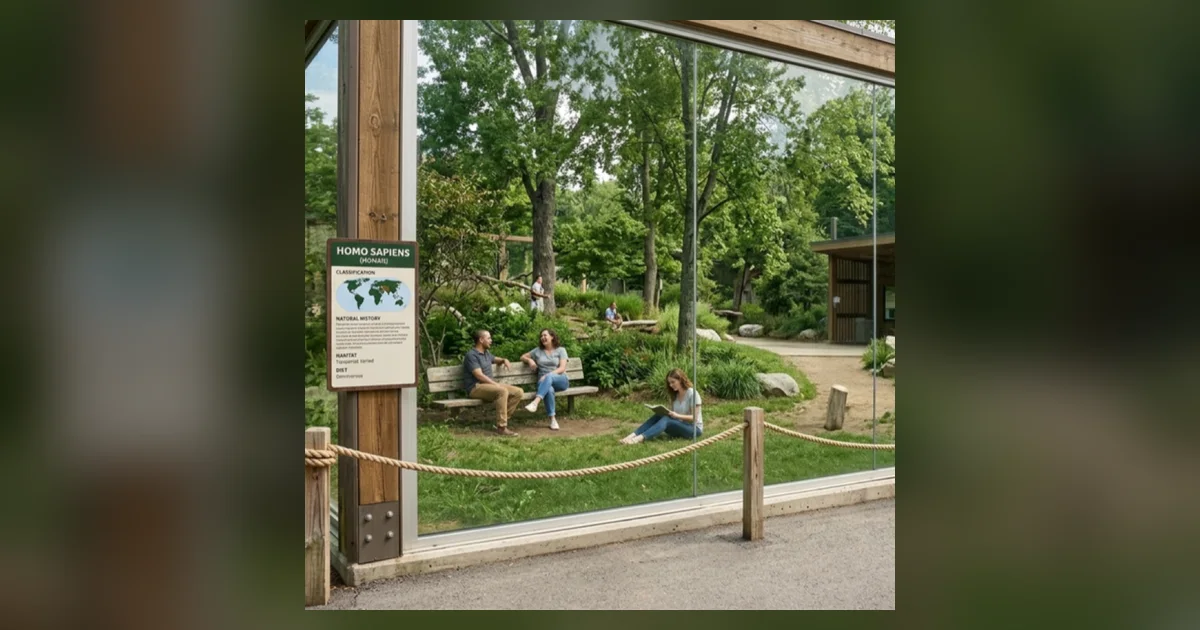
Cover of The Human Enclosure (Omxus Press)
8 min read
 articleworld4u

Photo: A. C. Applebee
Open the federal government's list of itself and scroll. A Slot Compliance Committee for Sydney Airport. A Registrar of Liner Shipping. An advisory committee for each marine park. "This is a Future Fund Board of Guardians investment holding entity", over and over. Now you're lonely, and it's Sunday. Which row do you ring?
Some alleys are shortcuts. Others, accidents of wonder. This one is in Subiaco, strung with light, beads and trinkets.
The Department of Finance publishes the Australian Government Organisations Register for anyone to download (Department of Finance, 2026). On 31 December 2025 it had 1,371 rows: departments, agencies, boards, tribunals, committees, companies and funds, each with a few lines on what it does, written by the government itself.
Researchers wrote the other list. Strip away every department, every form and every "service", and ask what a person needs, and you get twelve things: food, water, shelter, health, safety, learning, connection, purpose, justice, movement, information and identity. Eight published lists of human needs, from Maslow to the OECD's measures of a good life, cover them between them (Maslow, 1943; OECD, 2011). Seven of the eight name one item outright: other people.
We searched every row for words naming each need, then read 80 rows at random by hand to check the search. The two methods agreed on 86% of rows. Two in three bodies, 904 of 1,371, never name any of the twelve. Reading by hand gave 54 of 80. Among the 195 main agencies, the ones with their own budgets and staff, half still name none.
Health has 183 bodies, learning 120, safety 117. Movement has none. Purpose has none. Connection has two, and neither works on it: one advises on "social cohesion and integration policy", the other drives "social inclusion and productivity" in federal workplaces. No body in the register names loneliness or friendship. Meanwhile the register grows by about 13 bodies a year.
A government body is built to check whether you qualify, regulate, license, pay or advise. Health, schools and policing are full of things to check and license, so they fill with bodies. You cannot means-test a friendship, or license a walk, or assess someone's reason to get up in the morning.
Those are needs with some of the strongest evidence for survival. Across 148 studies and 308,849 people, those with stronger social relationships were 50% more likely to survive the follow-up period, an effect the researchers judged comparable with quitting smoking (Holt-Lunstad et al., 2010). About an hour a day of moderate movement removes the extra risk of death that comes with long sitting (Ekelund et al., 2016). People with a strong sense of purpose die early less often (Cohen et al., 2016). When the state's answer to loneliness is a mental health plan with ten subsidised sessions a year, it treats a gap in the street as a disease in the person.
Most public servants we've met got into this to help somebody. But look at the shape of the thing: much of what sits outside the twelve is gatekeeping a need, managing a problem another body made, or justifying its own existence. The usual defence is that services are complex because life is complex. The old answer comes from C. Northcote Parkinson, who counted the British Admiralty: between 1914 and 1928 its capital ships fell by 67% and its officials rose by 78% (Parkinson, 1957).
The price falls on the person asking. Researchers call it administrative burden: learning what exists, filling in forms, and the stress of being judged (Herd & Moynihan, 2018). People with the least time, money and health pay most, so many who qualify never receive what they are owed (Ko & Moffitt, 2022).
The twelve still need doing. What can go is the proof, the gatekeeper and the conditions between a person and the thing they need. In Stockholm, trained neighbours were alerted by phone to a nearby cardiac arrest. Bystanders started CPR in 62% of cases where neighbours were alerted, against 48% where they were not (Ringh et al., 2015). No new agency. Just people near each other, told when they are needed.
In June 2016 a British MP, Jo Cox, was murdered in the street outside a library in her own electorate. She had been setting up a commission on loneliness, because she'd knocked on doors in Yorkshire and heard it everywhere. Her colleagues finished it. In January 2018 Britain appointed the world's first minister for loneliness (Jo Cox Commission on Loneliness, 2017). Japan followed in 2021. One minister doesn't fix a street, and no one has yet shown what those posts have changed. But somebody finally wrote it down on the list.
A word search isn't a reading, which is why we checked it by hand. The register counts bodies, not money or staff, and many of its 602 joint ventures and investment vehicles cost the public little. States and councils do much of the local work, and it's one national government at one point in time. The list shows what the federal state is built around. It doesn't show what removing the layer would do.
Check it yourself: download the register from data.gov.au and search the descriptions for "loneliness". Then send your federal MP what you find.
And don't wait for a row. You can't means-test a friendship, and nobody needs a form to start one. Ring someone who's gone quiet. Say hello to the person you always nod at. Ask the older bloke next door to help you with something, because needing a hand is how it starts. If you're the one alone this Sunday, FriendLine is on 1800 424 287. It is free, for anyone over 18, and they would like to hear from you.
Beauty turns up in places that weren't meant for it. So do friends.
When a polar bear swam in figure eights, the zoo inspected his life. Scored the same way, the places people live and work fail on 17 of 18 measures.
Cover of The Human Enclosure (Omxus Press)
In 2008 Denmark began paying night workers with breast cancer. Sleep advice still blames your habits. In a US sample, the job predicts who sleeps too little.
Cover of The Stolen Night (Omxus Press)
Twenty years of American time diaries show young people's time with friends fell from 137 minutes a day to 51, and the hours went to being alone.
Art: Omxus Press