Would a zookeeper pass the way we live?
When a polar bear swam in figure eights, the zoo inspected his life. Scored the same way, the places people live and work fail on 17 of 18 measures.
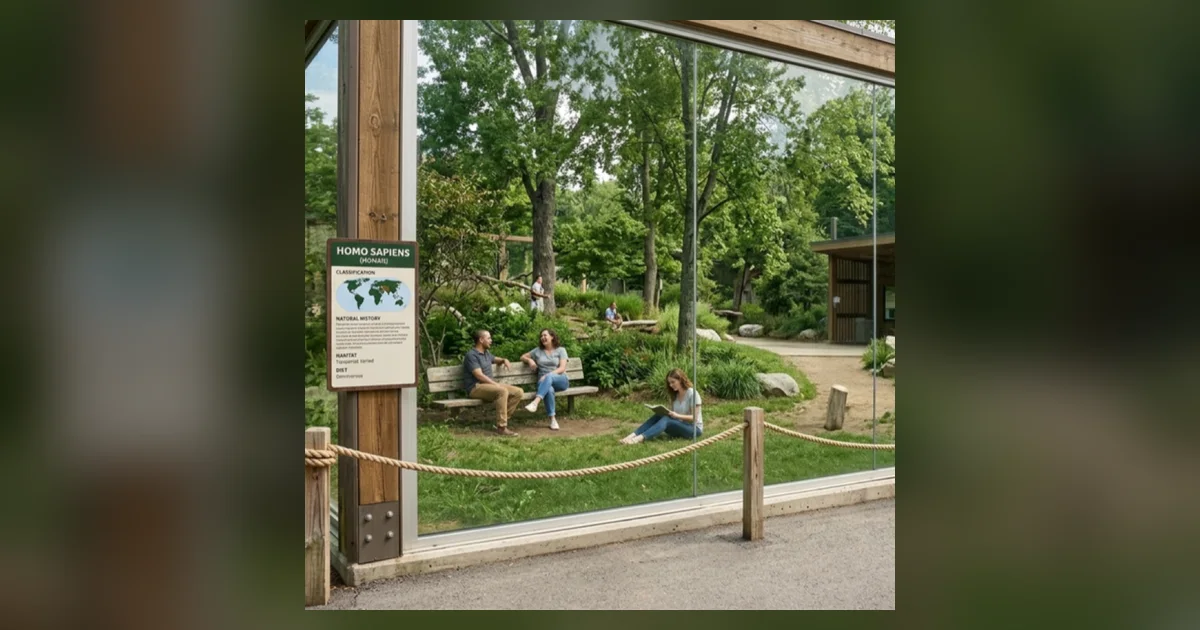
Cover of The Human Enclosure (Omxus Press)
8 min read
 articleworld4u

Cover of The Physiology of Loneliness (Omxus Press)
In 1961 a local doctor told a visiting professor of medicine something odd about Roseto, a small Pennsylvania town of Italian families. Hardly anyone there seemed to have heart attacks. So what did Roseto have that the town next door didn't?
Dr Benjamin Falcone had noticed it in his practice. Stewart Wolf, the professor, came to count. He and his colleagues found fewer heart attack deaths in Roseto than they expected, and they reported it in 1964 (Stout et al., 1964). It wasn't a diet of lean fish and greens: the team's impression was that people ate plenty of fat. What Wolf kept coming back to was how the place lived. "The community," he said, "was very cohesive. There was no keeping up with the Joneses. Houses were very close together, and everyone lived more or less alike" (Cassill, 1980).
Then the researchers did something patient. They kept counting, using death certificates from 1935 to 1985, beside Bangor, the town next door. For three decades Roseto stayed lower. Then, as those close family and community ties wore away, its heart attack deaths climbed to Bangor's level (Egolf et al., 1992).
One small town can't prove much, and people still argue about Roseto. Other explanations have been offered, including what was in the glass. But the story asks the right question. What if being alone isn't only sad? What if the body takes it as danger?
In 2010, the psychologist Julianne Holt-Lunstad and her colleagues pooled 148 studies that had followed 308,849 people for an average of seven and a half years. People with stronger relationships had 50% greater odds of still being alive at the end (Holt-Lunstad et al., 2010). Five years later her team pooled 70 studies of more than 3.4 million people. Social isolation raised the risk of death by 29%, feeling lonely by 26%, living alone by 32% (Holt-Lunstad et al., 2015).
Those are the sizes of risks your doctor already checks. Nobody checks this one. Put beside the other pooled figures, Holt-Lunstad's team set the 2010 result near smoking up to 15 cigarettes a day. That compares scale across studies. It doesn't mean a quiet week does what a pack does.
We ban smoking in public buildings. We print warnings on the packets. We screen every adult's blood pressure and cholesterol. What do we do about loneliness? We tell people to put themselves out there.
The neuroscientist John Cacioppo spent three decades measuring loneliness inside people. His answer was that a social animal separated from its group is in danger, and the body knows it. The stress system stays switched on. Sleep goes shallow, with more waking in the night (Cacioppo et al., 2002). Over five years, loneliness predicted rises in systolic blood pressure that depression, stress and social support did not explain (Hawkley et al., 2010).
The deepest finding came from the geneticist Steve Cole. In the white blood cells of lonely adults, genes that drive inflammation were turned up and genes that fight viruses were turned down (Cole et al., 2007). It makes grim sense. An animal alone is more likely to be wounded than to catch a virus from its friends, so the body prepares for wounds. The programme was built for days apart from the group. Run for years, the inflammation itself becomes the disease: heart attacks, stroke, diabetes.
It is not only people. Prairie voles, small rodents that live in pairs, show the same stress and the same damage when they are kept alone for a month (Grippo et al., 2007). This is old mammal biology, not a modern complaint.
You can check this in ordinary people, because the United States publishes the data (National Center for Health Statistics, n.d.). Between 1999 and 2008, the survey asked 14,086 Americans aged 40 and over two questions: can you count on anyone for emotional support, and how many close friends do you have? It took their blood. Death records follow them to the end of 2019. The survey measures isolation, not the feeling of loneliness, so it tests the objective half of the argument.
| What the records show | Result |
|---|---|
| Adults with no close friend, or no one to turn to | 7.5% (95% CI 6.8 to 8.2%) |
| Extra inflammation in their blood (same age, sex, background) | 10.8% more (95% CI 1.6 to 20.8%) |
| Higher death rate (same age, sex, background) | 24% higher (hazard ratio 1.24, 1.09 to 1.41) |
| Death rate with no close friends, against six or more, after income, smoking and weight | 25% higher (1.25, 1.00 to 1.57), against 15% for three to five friends and 13% for one or two |
Hold income, education, smoking and weight equal and the gap for isolation as a whole shrinks to 9% (hazard ratio 1.09, 0.97 to 1.24), no longer statistically significant. That is part of the story, not a way out of it. Poverty isolates people: no car, no spare hours, no money to go out. And people alone often cope with cigarettes and food. What stays, whatever we hold equal, is a staircase: the fewer close friends, the earlier people died (trend p = .003). A gradient is what a real cause produces. Observational data cannot prove cause.
The intervention evidence is sobering. A 2011 meta-analysis sorted loneliness programmes into four kinds: improving social skills, enhancing social support, creating opportunities for contact, and changing how lonely people read others (Masi et al., 2011). Only the last showed consistent effects. Lonely people read rejection into neutral cues and withdraw first. But you can change how a person reads a room, and if there is no room, the new thinking has nothing to work on. In those US records, what tracked with earlier death was a count: how many close friends a person had. That count is built or starved by the places people live and work. Long commutes, suburbs with nowhere to gather, shifts that change every week and screens in place of faces build loneliness into the day. The political scientist Robert Putnam watched clubs, unions, churches and dinner parties empty out across forty years of American life (Putnam, 2000).
The programme is not fixed. In one small trial, eight weeks of a group mindfulness course lowered loneliness and lowered the inflammation genes with it (Creswell et al., 2012). The genome is not destiny. It is listening, and what it hears in a lonely person is danger.
Telling lonely people to try harder blames the person for the street. We can build places where connection is the default: short distances, somewhere to sit, enough time, and the same faces often enough to trust them. Roseto didn't run a loneliness programme. It had houses close together.
The UK now has a minister with loneliness in the job, because in 2018 the government was told more than nine million people always or often felt lonely, and about 200,000 older people hadn't talked with a friend or relative in over a month (Prime Minister's Office, 2018). A month. Somebody lives next door to each of them.
Friendship is mostly hours. One study of adults estimated roughly 50 hours together to move from acquaintance to casual friend, and more than 200 to become close (Hall, 2019). Those are rough figures from people rating their own friendships, but the lesson holds: nobody finds a friend in one brave evening. It takes turning up.
So pick one thing that repeats. The same walk, the same bench, the same table, the same day each week. Ask one person along. If someone you know has gone quiet, ring them and don't wait for a reason.
If you're the one who's gone quiet, FriendLine takes calls on 1800 424 287 from anyone in Australia over 18, just for a chat. If you're in crisis, Lifeline is on 13 11 14.
When a polar bear swam in figure eights, the zoo inspected his life. Scored the same way, the places people live and work fail on 17 of 18 measures.
Cover of The Human Enclosure (Omxus Press)
In 2008 Denmark began paying night workers with breast cancer. Sleep advice still blames your habits. In a US sample, the job predicts who sleeps too little.
Cover of The Stolen Night (Omxus Press)
Twenty years of American time diaries show young people's time with friends fell from 137 minutes a day to 51, and the hours went to being alone.

Art: Omxus Press