Your nan fell. The ambulance is a quarter of an hour away. You could be there in a minute. Almost everything we were taught about crowds says you won't go. The record says you will, and the story that taught us otherwise began with a number that was wrong.
In March 1964 Kitty Genovese was stabbed outside her apartment building in Queens. Two weeks later the front page of the New York Times ran the headline "37 Who Saw Murder Didn't Call the Police." The story said respectable neighbours watched from their windows for more than half an hour and did nothing.
The number that built a field
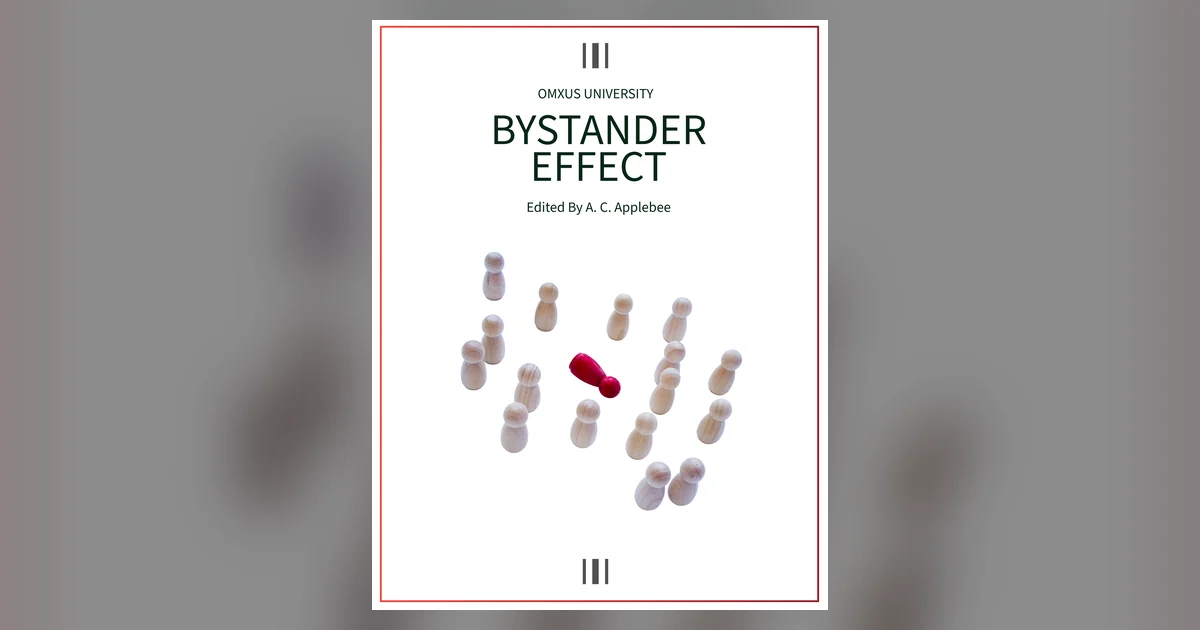
The number became 38, and the 38 became a lesson taught in every psychology textbook. People in crowds don't help. Each assumes someone else will. Psychologists gave it a name, the bystander effect, and set out to measure it (Darley & Latané, 1968).
The trouble is that the story was wrong. The attack came in two parts. After the first, a neighbour shouted from a window and the attacker ran. The fatal attack happened in a stairwell most windows couldn't see. Neighbours did call the police. And a neighbour, Sophia Farrar, ran into that stairwell not knowing whether the attacker was still there. She held Kitty and told her help was coming (Boston Globe, 2020; Cook, 2014; Manning et al., 2007). The most famous story of people doing nothing has a woman in it who did everything she could, and for fifty years almost nobody knew her name. In 2016 the Times itself said its article had "grossly exaggerated the number of witnesses and what they had perceived" (McFadden, 2016).
The figure of 38 came from the city's police commissioner, over lunch with the paper's editor (Rosenthal, 1964). His department had been called and hadn't saved her. The story he supplied put the failure on the neighbours. The story was never evidence of bystander apathy. It was evidence of an institution deflecting.
It didn't stay a news story. It shaped the questions psychology asked: decades on why groups fail to help, very little on when and how they succeed. And it shaped the advice. Don't get involved. Call the professionals. Stand back and let the authorities handle it (Manning et al., 2007).
The lab was right, but only half right
The experiments that followed were real, and they hold up. Students who thought others could also hear someone having a seizure over an intercom helped less, and more slowly, than students who thought they were alone (Darley & Latané, 1968). A review of 105 results from more than 7,700 people found the same pattern (Fischer et al., 2011).
But the same review found where it fades: when the danger is obvious, when there's an attacker in the room, when helping costs something physical. Friends help each other as readily in pairs as alone (Latané & Rodin, 1969). Make people feel personally visible and the effect runs backwards: more onlookers, more help (van Bommel et al., 2012). Football fans helped an injured stranger more when he wore their team's shirt (Levine et al., 2005).
So the effect depends on conditions: whether the emergency is ambiguous, whether the bystanders are strangers, whether anyone is singled out, whether anyone is accountable, whether acting alone looks risky. Every one of those is a design variable. The bystander effect is not a law of nature. It is a failure of system design, and failures of design can be fixed.
Then someone checked the cameras
In 2020, a team of researchers watched 219 real public conflicts caught on city-centre CCTV in Amsterdam, Cape Town and Lancaster, England. Arguments, shoving, punches. In 90.9% of them, at least one bystander stepped in (Philpot et al., 2020). Nine fights in ten, somebody walked in. The bigger the crowd, the more likely someone helped.
They put their data online, which is a generous thing to do. Rerun it and ask the question a sceptic asks: fine, but is each person still less likely to help in a crowd?
The answer is yes. In crowds of one to five people, 44.3% of onlookers stepped in. In crowds of 41 or more, 9.3% did. Double the crowd and each person is 0.72 times as likely to act. That's the real bystander effect, and it's there in the footage.
But double the crowd and the number of people who help still goes up, by 44%. Each person does a smaller share. The victim still gets more help.
The obvious objection: the bystander effect is about individuals, not incidents, so nothing is overturned. We agree. Each person's share does fall. The objection isn't to the effect. It is to what was built on it: the claim that people don't help, and the advice that follows. A victim doesn't care what share of the crowd moved. They care whether anyone did, and in real footage someone almost always did.
Diffusion is real. Apathy isn't.
Both findings are true at the same time. A crowd makes each of us less sure the job is ours. A crowd is also many chances, and enough of those chances get taken. The myth of the watching crowd took the first fact and told us it was the second.
There's a gap, though. If every onlooker had helped at the rate people do in small groups, there would have been 7.2 helpers per fight. There were 3.76. Roughly half the people willing to help didn't move, because nothing told them the call was theirs.
Built to stand back
For sixty years the advice has been: don't get involved, call the professionals, stand back. Then we measured people standing back and called it human nature. If you tell people they won't help, build systems that discourage them from helping, and then measure them not helping, you haven't discovered a fact about human nature. You've manufactured one.
Willingness to help also falls with social distance. When observers believed a woman under attack was the attacker's wife rather than a stranger, help fell from 65% to 19% (Shotland & Straw, 1976). That gradient is a map of where help fails, and so of where design should aim: at strangers, at ambiguous scenes, at the risk of acting alone.
Some systems were built the other way, and they work. In Stockholm, texting trained volunteers within 500 metres of a cardiac arrest raised bystander CPR before the ambulance from 47.8% to 61.6% in a randomised trial (Ringh et al., 2015). Australia's volunteer surf lifesavers have patrolled since 1907. In the 2024 season more than 45,000 of them performed 8,857 rescues (Surf Life Saving Australia, 2024). In Melbourne, the Hatzolah volunteer responder service had a median response to cardiac arrest of about two minutes, and its volunteers reached the patient before the ambulance in most arrests (Chan et al., 2007). The responders don't travel from a station. They are already there.
What these have in common is what the research says switches the bystander effect off. The call is clear. It names you. You can see that others are coming too. It reaches the people closest first.
The people are already there
This doesn't replace ambulances or surgeons. It is a first layer for the minutes between an emergency and professional arrival: CPR before the paramedic, pressure on a wound, a knock on the door. And it doesn't shift the job from institutions onto ordinary people. The system already depends on bystanders. The person who calls the ambulance or starts CPR is the first responder in nearly every emergency. The choice is between bystanders left to guess whether the call is theirs, and bystanders equipped, named and backed up. Equipping them is an institutional job.
People help. They help more when they know each other. They help most when they are personally asked, when the situation is clear, and when they believe others will back them up. The bystander effect is not a fact about human nature. It is a fact about how we ask for help, and we can ask better.
What you can do
If you're ever the one who needs help, or the one on the footpath wondering, don't call to the crowd. Point at one person. "You in the blue shirt, ring triple zero. You, come here and hold this." Everything above says that's the switch. Then the next person moves too.
And if you could do CPR at a pinch, sign up. In Victoria, New South Wales and other states, the free GoodSAM app alerts willing people nearby when someone's heart stops, while the ambulance is on its way, and you can always decline. Ask your ambulance service whether it runs in your state. Fifteen minutes on a CPR video this week is enough to start.
Sophia Farrar went down the stairs. Most of us would, if we knew it was ours to do.
Your nan fell. The ambulance is a quarter of an hour away. You could be there in a minute, if someone tells you.
Sources
- Boston Globe. (2020, September 3). Sophia Farrar, 92, belied indifference to Kitty Genovese attack. https://www.bostonglobe.com/2020/09/03/nation/sophia-farrar-92-belied-indifference-kitty-genovese-attack/
- Chan, T., Braitberg, G., Elbaum, D., & Taylor, D. McD. (2007). Hatzolah emergency medical responder service: To save a life. Medical Journal of Australia, 186(12), 639–642. https://doi.org/10.5694/j.1326-5377.2007.tb01083.x
- Cook, K. (2014). Kitty Genovese: The murder, the bystanders, the crime that changed America. W. W. Norton.
- Darley, J. M., & Latané, B. (1968). Bystander intervention in emergencies: Diffusion of responsibility. Journal of Personality and Social Psychology, 8(4), 377–383. https://doi.org/10.1037/h0025589
- Fischer, P., Krueger, J. I., Greitemeyer, T., Vogrincic, C., Kastenmüller, A., Frey, D., Heene, M., Wicher, M., & Kainbacher, M. (2011). The bystander-effect: A meta-analytic review on bystander intervention in dangerous and non-dangerous emergencies. Psychological Bulletin, 137(4), 517–537. https://doi.org/10.1037/a0023304
- Latané, B., & Rodin, J. (1969). A lady in distress: Inhibiting effects of friends and strangers on bystander intervention. Journal of Experimental Social Psychology, 5(2), 189–202. https://doi.org/10.1016/0022-1031(69)90046-8
- Levine, M., Prosser, A., Evans, D., & Reicher, S. (2005). Identity and emergency intervention: How social group membership and inclusiveness of group boundaries shape helping behavior. Personality and Social Psychology Bulletin, 31(4), 443–453. https://doi.org/10.1177/0146167204271651
- Manning, R., Levine, M., & Collins, A. (2007). The Kitty Genovese murder and the social psychology of helping: The parable of the 38 witnesses. American Psychologist, 62(6), 555–562. https://doi.org/10.1037/0003-066X.62.6.555
- McFadden, R. D. (2016, April 4). Winston Moseley, who killed Kitty Genovese, dies in prison at 81. The New York Times.
- Philpot, R., Liebst, L. S., Levine, M., Bernasco, W., & Lindegaard, M. R. (2020). Would I be helped? Cross-national CCTV footage shows that intervention is the norm in public conflicts. American Psychologist, 75(1), 66–75. https://doi.org/10.1037/amp0000469
- Ringh, M., Rosenqvist, M., Hollenberg, J., Jonsson, M., Fredman, D., Nordberg, P., Järnbert-Pettersson, H., Hasselqvist-Ax, I., Riva, G., & Svensson, L. (2015). Mobile-phone dispatch of laypersons for CPR in out-of-hospital cardiac arrest. New England Journal of Medicine, 372(24), 2316–2325. https://doi.org/10.1056/NEJMoa1406038
- Rosenthal, A. M. (1964). Thirty-eight witnesses. McGraw-Hill.
- Shotland, R. L., & Straw, M. K. (1976). Bystander response to an assault: When a man attacks a woman. Journal of Personality and Social Psychology, 34(5), 990–999. https://doi.org/10.1037/0022-3514.34.5.990
- Surf Life Saving Australia. (2024). National coastal safety report 2024.
- van Bommel, M., van Prooijen, J.-W., Elffers, H., & Van Lange, P. A. M. (2012). Be aware to care: Public self-awareness leads to a reversal of the bystander effect. Journal of Experimental Social Psychology, 48(4), 926–930. https://doi.org/10.1016/j.jesp.2012.02.011