Would a zookeeper pass the way we live?
When a polar bear swam in figure eights, the zoo inspected his life. Scored the same way, the places people live and work fail on 17 of 18 measures.
Cover of The Human Enclosure (Omxus Press)
8 min read
 articleworld4u
Art: Omxus Press
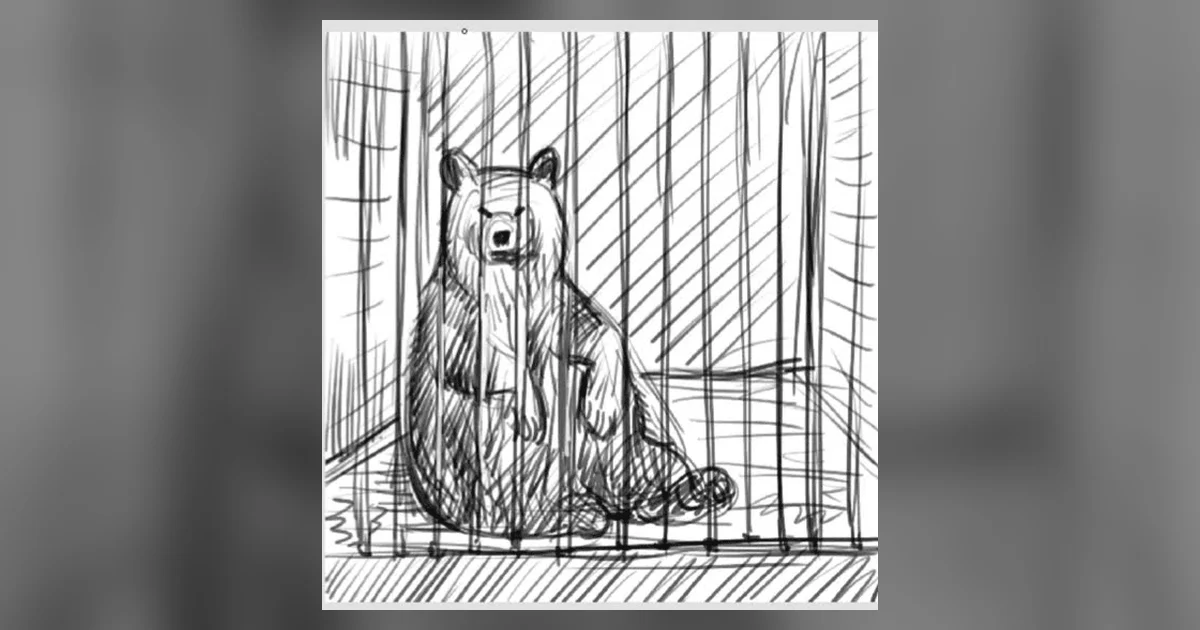
In 1994 a polar bear named Gus was swimming figure eights in his pool at New York's Central Park Zoo, for hours at a time. Visitors loved it. The zoo paid $25,000 for an expert opinion, and the word that came back was boredom. They gave him toys, games and Prozac (Boston Globe, 2018; Tampa Bay Times, 1994). Nobody thought the bear had a character flaw.
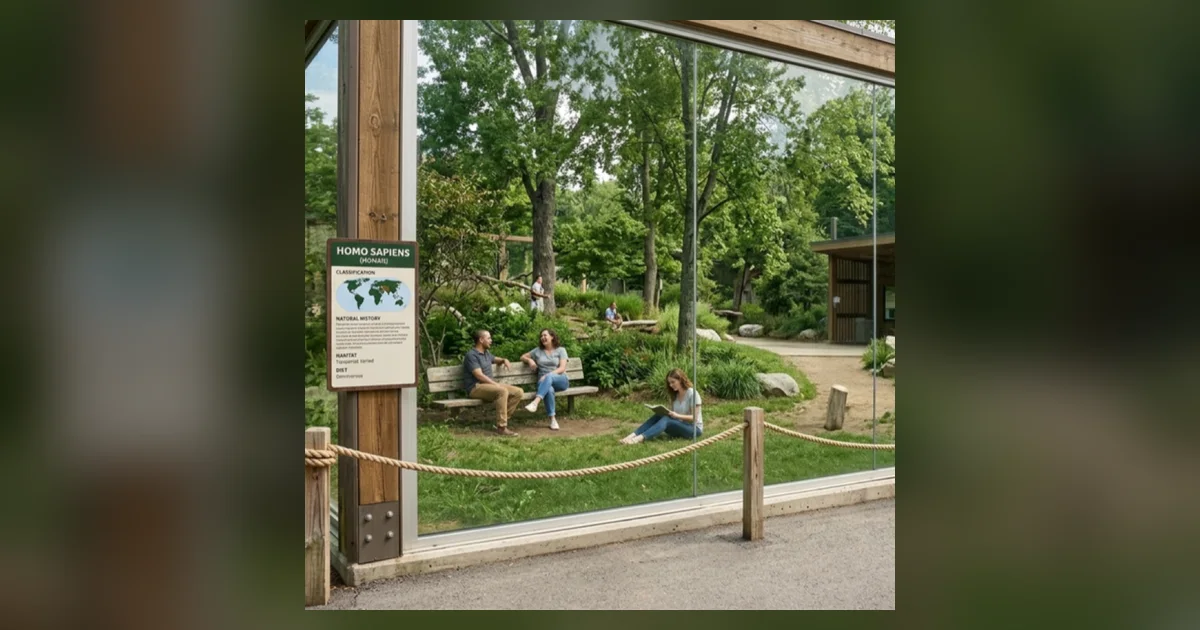
We'd laugh at a keeper who lectured Gus about his choices. Then we go home to a chair. What would a keeper see if they walked past our enclosure?
Start with an animal in its old habitat. Herman Pontzer's team measured total daily energy use in the Hadza of northern Tanzania with doubly labelled water. The Hadza walk, dig, climb and carry far more than Western adults: the men about 11 kilometres a day, the women about 6. Yet they burn about the same total calories per day (Pontzer et al., 2012).
A bigger study across five countries found the same thing. Energy use climbs with activity at first, then flattens out (Pontzer et al., 2016). The body seems to run on a budget.
If a moving body and a sitting body spend the same, the sitting body is spending its budget on something else. Pontzer's answer is that activity pulls energy away from other jobs, among them inflammation and the stress response. Stop moving and the budget flows back to them. The body isn't lazy. It's busy, and some of what keeps it busy is harm.
That idea is still argued over, and it isn't the only thread. Within hours of sitting, idle muscles stop clearing fat from the blood the way they should (Hamilton et al., 2007). Lonely people show a stress hormone that stays up when it should come down, and immune cells that switch on inflammation genes and switch off antiviral ones (Cole et al., 2007). A stress system built for a predator that leaves in minutes, held on for years, ends in the same place. Four separate fields, describing a mammal built to walk all day in company, arrive at one destination: a slow, body-wide inflammation that sits under heart disease, diabetes, dementia and a great deal of depression (Berk et al., 2013).
A story that tidy should leave a trace in real people, and you can look for one in the United States' national health survey, which measures a sample chosen to represent the country and takes their blood. Among 7,266 adults tested between 2017 and early 2020, one in five reported no moderate or vigorous activity at all. Of those people, 46.0% had C-reactive protein, the standard blood marker of inflammation, in the range cardiologists call high risk. Among adults who met the 150-minute weekly guideline, 31.2% did, and their CRP was 22.8% lower once age, sex, income and ethnicity were held equal.
One adult in three sat for eight hours or more a day. They had 41% higher odds of depression and 11.8% more CRP than people who sat less, at the same age, sex, income and ethnicity. And about a fifth of the link between moving and mood ran through inflammation itself. One survey can't prove the direction: depressed people move less too, so some of the arrow points the other way (National Center for Health Statistics, 2021).
Trials don't have that problem. When 120 older adults were randomly assigned to a year of walking or stretching, the walkers' hippocampus, the memory centre hit hardest by stress and dementia, grew by 2%. The stretchers' shrank by 1.4%, the usual loss with age (Erickson et al., 2011). In postmenopausal women with low bone mass, eight months of supervised high-intensity resistance and impact training raised bone density at the spine and hip (Watson et al., 2018). Across 97 reviews of activity trials, moving more eased depression and anxiety (Singh et al., 2023).
None of this is news to a zookeeper. A keeper whose animals paced, overate and stopped mixing would change the enclosure, not lecture the animals. We built a world of escalators, car parks, long commutes and suburbs with nowhere to meet, and then we diagnose the people in it one by one.
The fix the evidence points to is the room, not the person: stairs you see before the escalator, something to climb at the bus stop, a place to meet within walking distance, help that comes from the people who live nearest. People already do this where they can. In London, volunteers alerted by an app to a cardiac arrest nearby roughly tripled the odds the patient left hospital alive when one of them accepted the alert (Smith et al., 2022). A volunteer accepted the alert in only 1.3% of London arrests. The willingness is there. The distance is what we built.
If you were the keeper, you'd start with four rules. Use recognition that fits what people already value, not cash that crowds it out. Use proximity and small groups, where a person feels the job is theirs. Make helping one step, not ten. And make the healthy option the default by how the place is built: the stairs easier to find than the escalator, the meeting place nearer than the drive-through, unprocessed food cheaper than processed.
Gus's swimming eased but never entirely left him, and toys in a concrete pool were never the Arctic. We can do better than that for ourselves, because we're the ones with the plans. Bodies repair a great deal when they're given the chance, and they've had 2.6 million years of practice.
Don't lecture yourself. Change the room. Put the shoes by the door. Move the meeting outside and walk it. Get off a stop early with someone you like. Do whatever movement your body allows, because some is better than none and nobody's marking it.
Then do it for the street. Ask your council who decided your suburb has no footpath, no shade or no bench, and ask them to fix one. Ask your workplace why the stairs are locked. You're not the problem here. You're the one who's noticed the enclosure.
When a polar bear swam in figure eights, the zoo inspected his life. Scored the same way, the places people live and work fail on 17 of 18 measures.
Cover of The Human Enclosure (Omxus Press)
In 2008 Denmark began paying night workers with breast cancer. Sleep advice still blames your habits. In a US sample, the job predicts who sleeps too little.

Cover of The Stolen Night (Omxus Press)
Twenty years of American time diaries show young people's time with friends fell from 137 minutes a day to 51, and the hours went to being alone.

Art: Omxus Press