Why does Australia almost never change its Constitution?
Two Swiss farmers forced a national vote about cows' horns. Australians can't ask a question at all, and haven't said yes since 1977. Here's why.
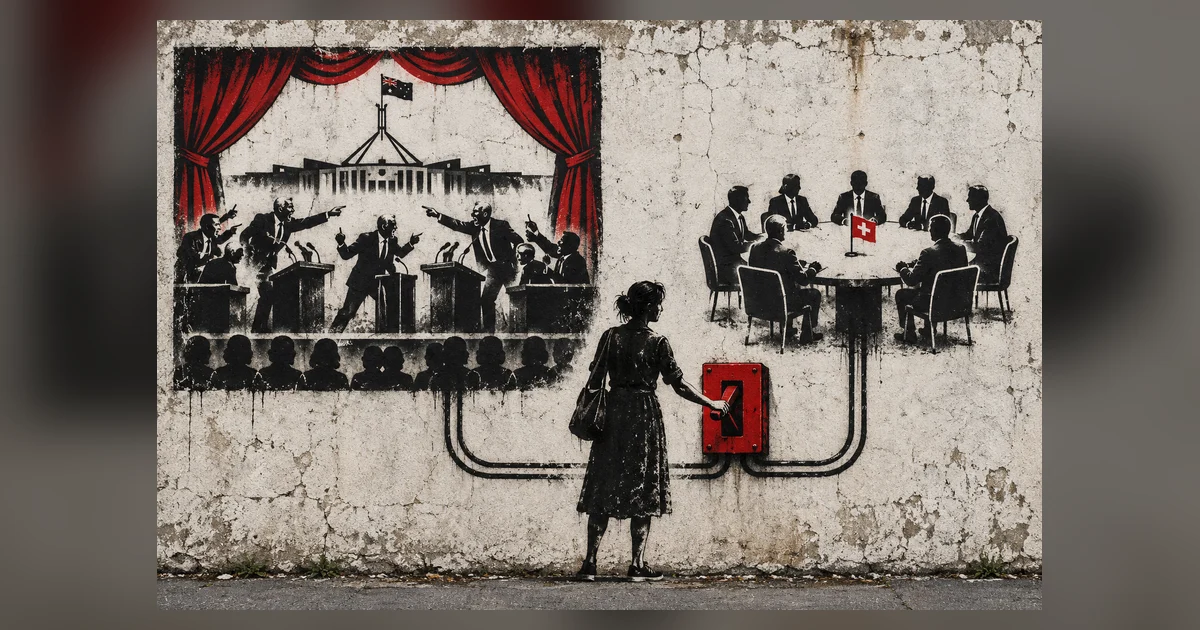
Art: Omxus Press
8 min read
 articleworld4u
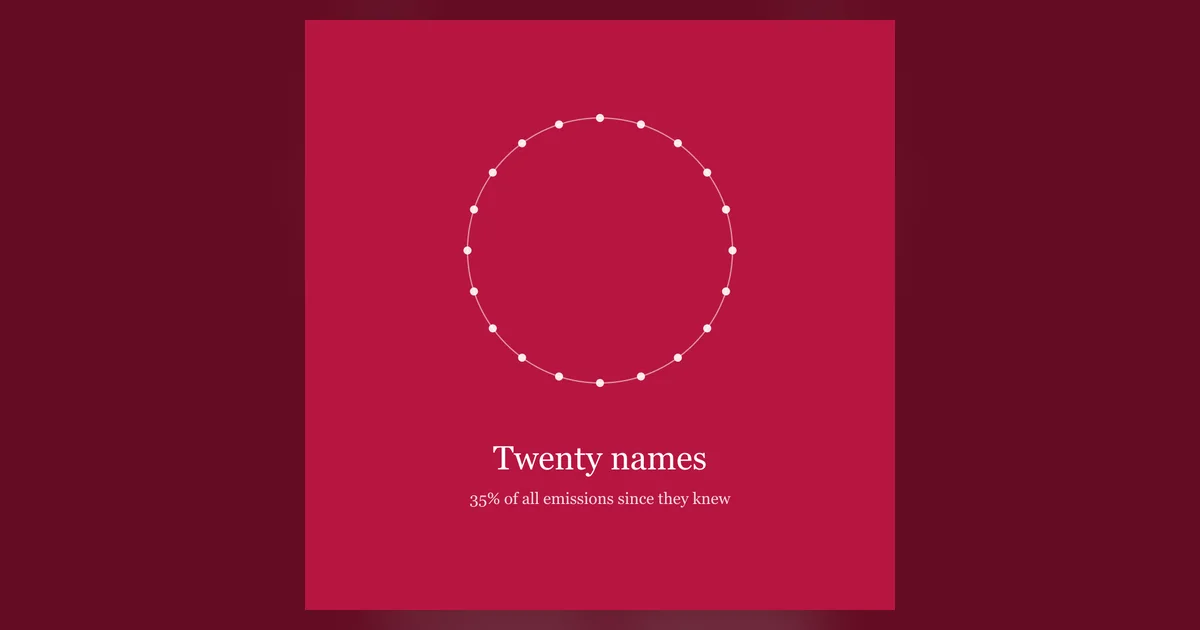
Cover of Twenty Names (Omxus Press)
In November 1965 Frank Ikard, president of the American Petroleum Institute, stood up at the institute's annual meeting and read his industry a forecast from the White House. It had the year 2000 in it. Everyone in that room went home and kept drilling. So who was in the room?
The report was Restoring the Quality of Our Environment. It described carbon dioxide from fossil fuels building up in the atmosphere and the likely consequences for the climate (President's Science Advisory Committee, 1965). Ikard told the room what it predicted:
One of the most important predictions of the report is that carbon dioxide is being added to the earth's atmosphere by the burning of coal, oil, and natural gas at such a rate that by the year 2000 the heat balance will be so modified as possibly to cause marked changes in climate beyond local or even national efforts. (quoted in Franta, 2018)
That was not the first warning. Historians have since shown that oil industry leaders were aware of the warnings from the late 1950s (Franta, 2018), and that one of the largest companies' own scientists confirmed the risk internally while its public communications cast doubt on it (Supran & Oreskes, 2017). Richard Heede, who built the method for tracing emissions to the producers who extracted the fuel (Heede, 2014), takes 1965 as the starting point for this reason: from then on the consequences were known, documented and communicated to both industry and government (Taylor & Watts, 2019).
Heede did what no one had thought to do: going through old company reports and government records, adding up one producer at a time. Everything below is counted from that November.
In 2019 the Climate Accountability Institute traced 35% of all energy-related carbon dioxide and methane emitted worldwide from 1965 to 2017, about 480 billion tonnes of CO2-equivalent, to twenty companies: twelve state-owned and eight investor-owned (Climate Accountability Institute, 2019; Taylor & Watts, 2019). The method counts the emissions from burning the fuel each company extracted and sold, plus the emissions from extracting it (Heede, 2014).
| Rank | Producer | Owner | Share of world emissions |
|---|---|---|---|
| 1 | Saudi Aramco | State-owned (Saudi Arabia) | 4.38% |
| 2 | Chevron | Investor-owned (USA) | 3.20% |
| 3 | Gazprom | State-owned (Russia) | 3.19% |
| 4 | ExxonMobil | Investor-owned (USA) | 3.09% |
| 5 | National Iranian Oil Co. | State-owned (Iran) | 2.63% |
| 6 | BP | Investor-owned (UK) | 2.51% |
| 7 | Shell | Investor-owned (UK/Netherlands) | 2.36% |
| 8 | Coal India | State-owned (India) | 2.10% |
| 9 | Pemex | State-owned (Mexico) | 1.67% |
| 10 | PetroChina / CNPC | State-owned (China) | 1.56% |
| 11 | Peabody Energy | Investor-owned (USA) | 1.15% |
| 12 | ConocoPhillips | Investor-owned (USA) | 1.11% |
| 13 | Abu Dhabi NOC | State-owned (UAE) | 1.08% |
| 14 | Kuwait Petroleum Corp. | State-owned (Kuwait) | 1.00% |
| 15 | Iraq National Oil Co. | State-owned (Iraq) | 0.95% |
| 16 | TotalEnergies | Investor-owned (France) | 0.93% |
| 17 | Sonatrach | State-owned (Algeria) | 0.87% |
| 18 | BHP | Investor-owned (Australia) | 0.73% |
| 19 | Petrobras | State-owned (Brazil) | 0.68% |
| 20 | Rosneft | State-owned (Russia) | 0.65% |
| Top 20 | 12 state, 8 investor | ~35% |
Twelve of the twenty are state-owned and together carry about 20% of all emissions since 1965. Eight are investor-owned. Four of them, Chevron, ExxonMobil, BP and Shell, are behind more than 10% of global emissions since 1965 (Taylor & Watts, 2019). One of the twenty is Australian: BHP.
Five hundred billion tonnes is not an abstraction. Emissions traced to the 90 largest industrial carbon producers caused about 57% of the rise in atmospheric CO2, 42–50% of the rise in global mean surface temperature, and 26–32% of global sea-level rise from 1880 to 2010 (Ekwurzel et al., 2017). To keep a 50% chance of holding warming to 1.5 °C, the world's remaining carbon budget from the start of 2020 was about 500 billion tonnes of CO2 (Intergovernmental Panel on Climate Change, 2021). The twenty producers in the table have emitted about that amount since 1965.
In other words: twenty producers have already emitted about what the whole world had left for a 50% chance of 1.5 °C.
The database has grown since 2019. The 2024 release runs to 2022 and covers 122 producers (InfluenceMap, 2024), and anyone can recount it. Ninety-two per cent of everything those producers have emitted since 1854 came in 1965 or later, after the warning. Sixty-nine per cent came in 1988 or later, the year the world's governments set up the Intergovernmental Panel on Climate Change. Counting nation-state producers, just eight of the 122 carry half of all traced emissions since 1965.
And Paris? InfluenceMap found 58 of 100 state- and investor-owned companies linked to higher emissions in the seven years after the Paris Agreement than in the seven before (InfluenceMap, 2024). Meanwhile the five largest listed oil and gas companies were estimated to spend about USD 200 million a year on lobbying to delay, control or block climate policy (InfluenceMap, 2019).
The producers argue they are not responsible for how their products are used: we supply the fuel; you burn it; the emissions are yours.
The argument fails twice. First, it ignores the record. These producers did not merely supply a product and let the market decide. Their industry was warned in 1965; at least one major's own research confirmed the risk while its public communications cast doubt on it; and the largest listed companies spent heavily lobbying against the policies that would have reduced consumption. A supplier who works to keep customers from alternatives does not get to blame the customer for the purchase. The case for holding producers to account on these grounds is set out in full by Frumhoff et al. (2015).
Second, the attribution debate does not change the conclusion. Blame the producers: a few dozen entities produce consequences that reach all eight billion people, and no individual can opt out. Blame the consumers: an incentive structure makes fossil fuel the path of least resistance for billions of people with no viable alternative, and recycling and consumer choice cannot touch a problem of this scale. Either way, the system is connected. Either way, only structural change to the incentives works. There is no lock for the atmosphere.
It is not eight billion people who need to change their behaviour. It is not "humanity" in the abstract or "consumers" as a faceless mass. It is twenty entities, with addresses, boards, shareholders, annual reports and lobbying budgets, traced to more than a third of all fossil fuel emissions since they knew what those emissions would do.
Climate scientist Michael Mann said of the 2019 analysis: "The great tragedy of the climate crisis is that seven and a half billion people must pay the price, in the form of a degraded planet, so that a couple of dozen polluting interests can continue to make record profits" (quoted in Taylor & Watts, 2019).
Twenty fits on a page. Twenty is a number you can regulate, tax, hold to account and put in front of a court. Twenty makes the problem feel solvable, because it is.
Other problems have been solved by changing incentives rather than pleading with individuals. In 1950 Robert Schuman proposed pooling French and German coal and steel so that war between them would be "not merely unthinkable, but materially impossible" (Schuman, 1950); the incentive for war was removed, and the two have not fought since. The climate needs the same move aimed at twenty producers: make extraction more expensive than transition, and make accountability more certain than lobbying.
France spent the 1930s building the Maginot Line to hold back Germany. It cost a fortune, and in 1940 France fell in six weeks. The European Coal and Steel Community, founded in 1951, cost a fraction of that and has lasted seventy-five years. Recycling programs, voluntary corporate pledges and consumer guilt campaigns are the atmospheric Maginot Line: they defend against the symptom while the cause goes round them. The cause has twenty names. They are in the table above.
The database attributes to each producer the emissions from burning what it extracted. That doesn't settle who should pay. The list changes a little at the bottom with each release: on the 2024 data Occidental and Petróleos de Venezuela come in and BHP drops out. And most of these producers kept selling because the rest of us, governments included, kept buying. None of that changes the shape of it: a small, named group carries a third or more of the world's fossil fuel emissions since 1965.
You may already own a piece of this. If you work in Australia, your super is probably invested in some of these names. In 2018 a 23-year-old named Mark McVeigh asked his fund, Rest, what it knew about climate risk to his money and what it was doing about it. He didn't think much of the answer, so he took it to the Federal Court. In November 2020 Rest settled, acknowledged climate change as a material, direct and current financial risk, and set a net zero target for 2050 (Equity Generation Lawyers, n.d.). One member. One question.
So ask yours. Email your fund this week: "Which of these twenty companies do I hold? How much? What are you doing about it?" If you don't like the answer, you can switch funds, and tell them why. Then send the table to your federal MP and ask which of these names were in their office this year.
It's not eight billion people. Twenty fits on a page, and a list is something you can work through.
Two Swiss farmers forced a national vote about cows' horns. Australians can't ask a question at all, and haven't said yes since 1977. Here's why.
Art: Omxus Press
A small lottery lifted student turnout by 32%. Paying for blood drove women away. What moves us is rarely what we say it is, and somebody designs it either way.
Art: Omxus Press
A dead salmon lit up in a brain scanner because the method expected it to. When a clinician's belief decides the finding, what choice is always safe?

Cover of The Lonely Whisper of the Wind (Omxus Press)