Why does Australia almost never change its Constitution?
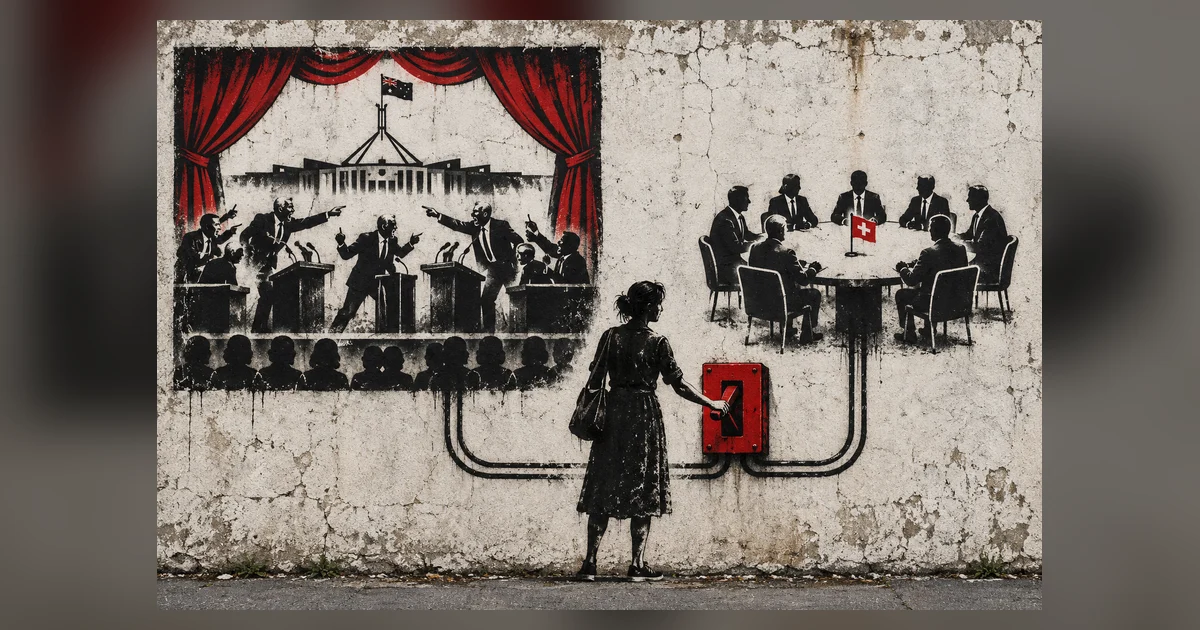
Two Swiss farmers forced a national vote about cows' horns. Australians can't ask a question at all, and haven't said yes since 1977. Here's why.
Art: Omxus Press
8 min read
 articleworld4u

Art: Omxus Press
A capuchin monkey watched its partner get a grape for the same work. It threw its cucumber back at the researcher. That monkey knew something eight billion humans appear to have forgotten: unfairness is not a policy debate. It is a biological insult. You feel it before you think it. You reject it before you can say why. So why does the objection so rarely become action?
Most of us act cooler than we feel, because we think everyone else is fine with it.
In 2003, Sarah Brosnan and Frans de Waal ran a simple trade with two capuchin monkeys. Each handed a stone token to a researcher. One got a slice of cucumber. The other got a grape. The cucumber monkey, having watched the difference, refused to keep taking part and often threw the cucumber back at the researcher. The paper in Nature was titled "Monkeys reject unequal pay" (Brosnan & de Waal, 2003).
When both monkeys got the same reward, they kept working. Inequality, not low pay, broke the cooperation. It was a small study of a few animals, and researchers still argue about how far it stretches. But it travelled for a reason: anyone who has ever found out what the bloke at the next desk gets paid knows that feeling.
Chimpanzees show inequity responses that depend on social closeness. Dogs stop cooperating when a partner is rewarded and they are not. Crows and ravens respond to unequal reward and unequal effort (Brosnan & de Waal, 2014; Range et al., 2009). Three-year-olds already react when they are given less than a peer (LoBue et al., 2011). In fifteen small-scale societies on five continents, from foragers to herders to farmers, nobody behaved as the purely self-interested actor of classical theory predicts; mean ultimatum offers ran from 26% to 58% of the stake (Henrich et al., 2005).
So here is the puzzle. In Australia the wealthiest fifth of households own 63% of all household wealth, and the poorest fifth own 0.7% (Australian Bureau of Statistics, 2022). The working population outnumbers economic elites by at least 99 to 1. If the monkey in us is that old and that strong, why do 99 people sit in a room being robbed by one, and nobody moves?
It's a coordination failure, not a moral one. Good people produce bad systems because the way we coordinate keeps them from acting on what they already know. Four things hold it still:
The capuchin had one advantage: it could see the other monkey getting the grape. You cannot see the 99 other people in the room who agree with you, because every institution between you and them is optimised to make sure you never count. Timur Kuran called the result preference falsification: people say in public what they will not say in private, so each concludes they are in a minority (Kuran, 1995). Real preferences are spoken at kitchen tables, in private messages, in the silence after the news.
In 2024 a team led by Peter Andre published a survey of nearly 130,000 people in 125 countries. They asked two questions. Would you give 1% of your monthly income to fight global warming? And what share of people in your country do you think would (Andre et al., 2024)?
Their country table is public, so you can ask how many countries see themselves accurately.
| Across 125 countries | Result |
|---|---|
| Countries where people underestimate their fellow citizens | 125 of 125 |
| Average share willing | 70.0% |
| Average share people believe is willing | 41.1% |
| Gap | 28.9 points (95% CI 27.3 to 30.4) |
| Countries with a willing majority where the average person believes fewer than half are | 99 of 114 |
| Australia: willing / believed willing | 56.1% / 38.6% |
Those 99 countries hold 61.7% of the population covered: most of the people on earth live in a majority that believes it is a minority. Only 15 of 125 countries believed themselves a majority. Beliefs track reality only weakly: each extra point of real support shows up as 0.43 of a point in belief. The more people agree, the more the agreement is hidden from them.
Climate is the test case because the survey measured both halves: what people want and what they think others want. It tests the mechanism. It says nothing on its own about views of inequality.
When going first costs you and everyone gains if anyone does, each person's chance of going first falls toward zero as the group grows, and the chance that nobody goes first rises toward the ratio of cost to benefit (Diekmann, 1985). Everyone waits. And because thresholds for joining differ and nobody can see them, a crowd about to tip looks identical to one that never will (Granovetter, 1978).
On 21 December 1989 the Romanian leader Nicolae Ceaușescu stood on a balcony in Bucharest and addressed a crowd assembled to cheer him, live on national television. Part way through, the booing started. You can watch the footage: he stops, puzzled, and raises a hand. For the first time Romanians, in the square and at home, could see what everyone else thought. Within days the government had fallen. Systems that looked stable for decades went in weeks across Eastern Europe that year (Kuran, 1991).
If the barrier is the count, the count is the fix. People in the survey are conditional cooperators, more willing to act when they believe others will (Andre et al., 2024). The missing ingredient is not motivation. It is the count.
Nor does cooperating cost performance. In a 2024 experiment, cooperating with a weaker partner and competing with a stronger opponent improved performance by similar amounts, but only competition increased perceived stress and physiological activity (De Francesco et al., 2024).
The capuchin had one advantage: it could see the grape. So make the grape visible.
In Australia you've had a legal right since December 2022 to tell anyone what you earn, and to ask. Your boss can't punish you for it, though nobody has to answer you, and a clause in an older contract can still apply until that contract changes (Fair Work Ombudsman, n.d.). Tell one workmate this week.
Then do the same for what you think. Say out loud the thing you've only been saying in the car. You'll find you aren't alone, more often than you expect. Show the count where you can: a show of hands at the meeting, a petition with the numbers on it, a street where people put the same sign out. And if there's a working example of the thing you want, take someone to see it. That persuades better than arguing.
You don't have to convert anyone. The majority already agrees, it just doesn't know. When both monkeys get the same reward, both keep working. Equality isn't only a moral requirement. It works better.
Now we know we underestimate each other, in every country measured. So when do we start counting?
Nobody in the pool is as cool as they look. Somebody has to say so first.
Two Swiss farmers forced a national vote about cows' horns. Australians can't ask a question at all, and haven't said yes since 1977. Here's why.
Art: Omxus Press
A small lottery lifted student turnout by 32%. Paying for blood drove women away. What moves us is rarely what we say it is, and somebody designs it either way.
Art: Omxus Press
A dead salmon lit up in a brain scanner because the method expected it to. When a clinician's belief decides the finding, what choice is always safe?

Cover of The Lonely Whisper of the Wind (Omxus Press)