Why does Australia almost never change its Constitution?
Two Swiss farmers forced a national vote about cows' horns. Australians can't ask a question at all, and haven't said yes since 1977. Here's why.
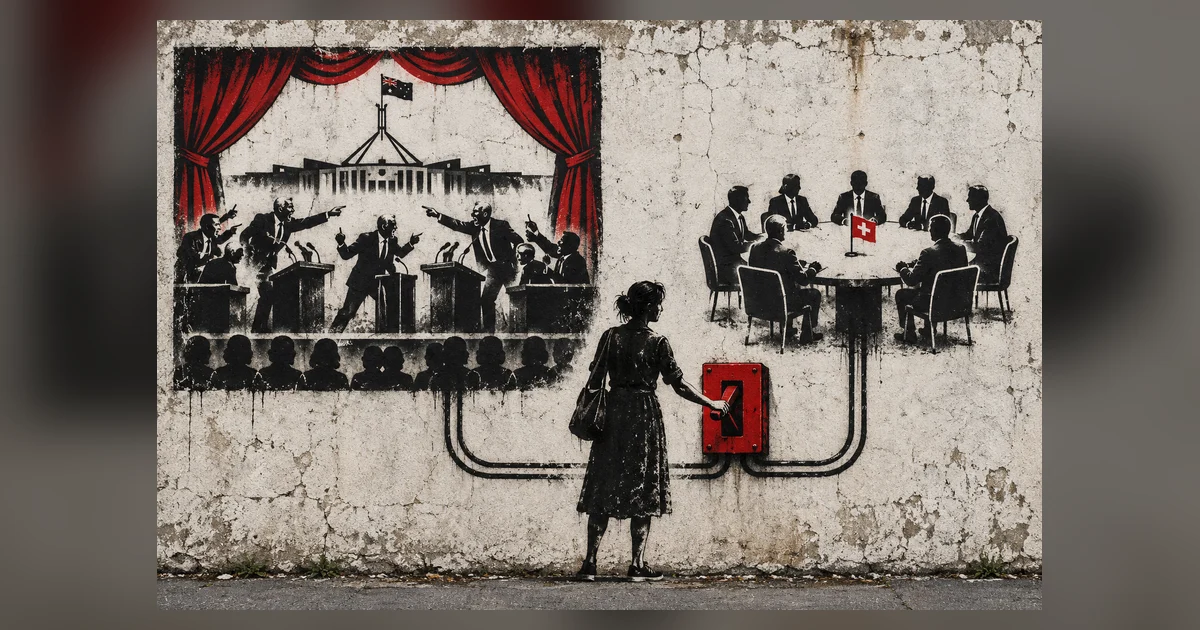
Art: Omxus Press
8 min read
 articleworld4u

Cover of Language Acquisition (Omxus Press)
On the last Sunday in April, in a small Swiss town, the citizens of Appenzell Innerrhoden walk into the square and pass their laws by raising their hands. There are about 16,000 people in the canton. Is that a charming relic, or does it know something the rest of us have forgotten?
That cover is from a book on how children pick up language. They get it from the people around them, and a person can only hold so many of those.
It looks like a museum piece. It isn't. Zurich, with about 1.6 million people, votes by ballot, and both belong to the same federal structure. That structure governs 8.8 million people and has put 710 national questions directly to its citizens since 1848 (Swissvotes, 2026). The presidency changes hands every year.
The square has a flaw, and it's worth knowing. Those raised hands were men's hands until 1990, when Switzerland's Federal Supreme Court ordered the canton to let women vote (Linder & Mueller, 2021). Keep that in mind too. Small and face to face isn't the same as fair. We'll come back to it.
In 1992 the anthropologist Robin Dunbar plotted primates' group sizes against the size of their neocortex, drew a line, and extended it to humans. The line predicted groups of about 150 (Dunbar, 1992, 1993). "Dunbar's number" now shows up in TED talks, management books, start-up advice columns and military history documentaries.
In 2021 three Swedish researchers redid the analysis with better brain data and modern methods. Bayesian models put the average human group at 69 to 109, with a 95% interval of 4 to 520; generalised least-squares models put it at 16 to 42, with an interval of 2 to 336. Across the two methods the intervals span 2 to 520 (Lindenfors et al., 2021). Twenty of their 24 intervals include both 15 and 150.
The data cannot tell a band of 15 from a village of 150. The question was never how many people you can know. The question is what structures let care operate beyond the people you know.
Look at how people actually live, though, and a pattern appears. Studies of phone calls, Christmas-card lists and social media find circles inside circles: about 5 people you would call in a crisis, 15 close friends, 50 good friends, 150 people you know well, each circle about three times the last (Zhou et al., 2005). Facebook did not widen them (Dunbar, 2016).
The same idea shows up in 339 hunter-gatherer societies recorded by the archaeologist Lewis Binford (2001). In the lean season, people forage in groups of about 16. In the good season they camp together in groups of about 46. Every so often they gather in groups of about 156 to marry, trade and settle disputes. Then comes the whole people, 876. Each step is roughly three times the one before, and every society that records both seasons gathers and disperses through the year.
Those layers are not a brain limit. They are jobs. A small group to find food. A camp to live in. A gathering to make decisions bigger than any camp.
Across 1,291 societies in the Ethnographic Atlas, the bigger a community, the more layers of authority sit above it. Among societies whose communities averaged under 50 people, 85.6% had no political authority above the community at all. Among those with cities, none did (Kirby et al., 2016). Growth demands structure.
The question is what kind. The usual answer is a pyramid: decisions flow down, voices at the bottom go quiet. Some communities chose something else.
In Spain's Basque Country, about 100 worker cooperatives employ more than 81,000 people. Each cooperative governs itself, one worker, one vote, and shares a bank, a university and a safety net with the rest (Reuten, 2022). In Chiapas, Mexico, Zapatista communities send delegates to councils that change every one to two weeks, so nobody becomes indispensable (Stahler-Sholk, 2007). In north-eastern Syria, neighbourhood communes of a few hundred households send recallable delegates upward, with a man and a woman sharing every chair (Knapp et al., 2016), an experiment carried on under war, and with critics of its own. Hutterite colonies in North America split when they reach about 150 and start again (Peter, 1987).
And in Switzerland, citizens accepted 75.1% of the constitutional changes parliament put to them and 58.3% of the laws citizens had challenged, but only 10.7% of popular initiatives (26 of 244). Given the pen, the people did not run wild.
Across all of these, the same architecture repeats. Small groups where everyone is known. Medium groups that decide face to face. Councils that link them, made of delegates who carry their group's decision and can be called home. Leaders who rotate. A shared living, so leaving is not free. Inclusion that is required, not just welcome.
The layers are a calendar as much as a map. Power gathers, then disperses, like a foraging band in the good season. Nobody gets to keep it long enough for it to compound.
Inclusion is the part that doesn't look after itself. Appenzell shows that: its square was intimate, ancient and closed to half its people for centuries. The rule has to be written in, and someone from outside may have to enforce it. That's a job for the federation.
The structure humans need already exists, and it's running right now: in the Basque Country, in the Swiss cantons, in Hutterite colonies, and in Aboriginal communities that have governed themselves for tens of thousands of years. None of them is perfect. All of them show the same pieces: small autonomous groups, rotating leadership, a shared economic base, required inclusion, face-to-face deliberation, federation for scale.
The question isn't invention. It's adoption. We've done this for a very long time, on every continent, under conditions far harder than most of us face.
Start with your own layers. Who are your five, the people you'd call at 3am? If you can't name them yet, that's the first job, and it's worth more than most things on your list.
Then build one layer out. Make a group chat for your street, and be the person who says "Who needs anything this week?" If you run a club, a team or a committee, make the chair rotate and put it in the rules. Keep groups small enough that everyone speaks, and when one gets too big, do what the Hutterites do and split it. If you have to send someone to a bigger meeting, send them with your group's decision, and make them come back and tell you what happened.
And look at who isn't in the room. Then write it down so they have to be.
Count the people around you tonight. Then ring the one slipping off the list.
Two Swiss farmers forced a national vote about cows' horns. Australians can't ask a question at all, and haven't said yes since 1977. Here's why.
Art: Omxus Press
A small lottery lifted student turnout by 32%. Paying for blood drove women away. What moves us is rarely what we say it is, and somebody designs it either way.
Art: Omxus Press
A dead salmon lit up in a brain scanner because the method expected it to. When a clinician's belief decides the finding, what choice is always safe?

Cover of The Lonely Whisper of the Wind (Omxus Press)