Would a zookeeper pass the way we live?
When a polar bear swam in figure eights, the zoo inspected his life. Scored the same way, the places people live and work fail on 17 of 18 measures.
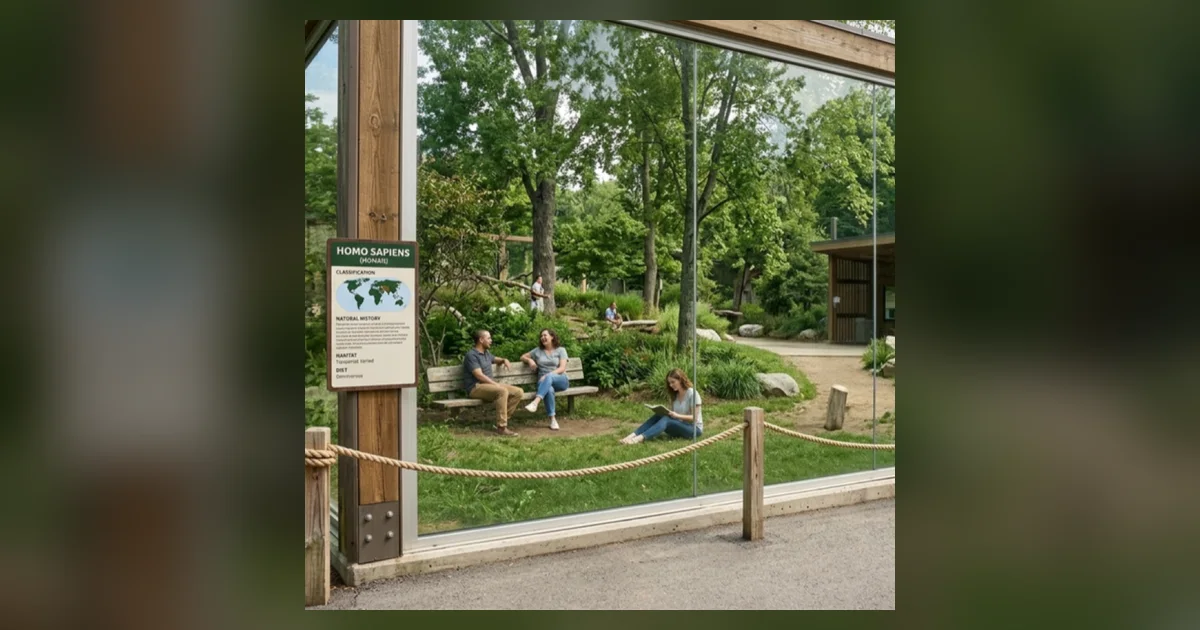
Cover of The Human Enclosure (Omxus Press)
8 min read
 articleworld4u
Art: Omxus Press
In 1943, in Copenhagen, a playground opened with no swings and no slides. It had scrap timber, tools, earth, water and fire. The children came back every day. Why did we tear them down, and what went with them?
The Danish landscape architect Carl Theodor Sørensen noticed in the 1930s that children ignored his designed playgrounds (Sørensen, 1931). They played on building sites, in junkyards and on empty lots, wherever they could move things and make things. So in 1943, at Emdrup, the first "junk playground" opened, with scrap timber, tools, earth, water and fire, and a playleader, John Bertelsen. Children built and demolished shelters and towers, and came back day after day.
After the war a British campaigner, Lady Allen of Hurtwood, visited Emdrup and took the idea home to cities full of bomb sites. She renamed it the "adventure playground" (Allen of Hurtwood, 1968). Through the 1950s, 60s and 70s they spread across Britain. They were staffed by playworkers, whose job was not to direct but to keep a margin of safety and help when asked. From the 1980s they were closed across the English-speaking world, on cost, insurance and liability grounds, and replaced with fixed equipment that could be installed and forgotten (Kozlovsky, 2008).
It looked like a sensible trade. Fewer scraped knees. Here is what the trade cost.
The neuroscientist Jaak Panksepp spent his career mapping the brain's oldest emotional systems, the ones every mammal shares. One of them he called PLAY (Panksepp, 1998). It sits below the thinking cortex: rats with the cortex removed at birth still play (Panksepp et al., 1994). Young rats will work for the chance to wrestle a partner, and when they play, or when a human tickles them, they emit ultrasonic chirps at about 50 kHz, which Panksepp described, controversially but compellingly, as a form of laughter (Panksepp & Burgdorf, 2003). Play is not what animals do when there is nothing better to do. It is a drive, with its own reward.
At the University of Lethbridge, Sergio and Vivien Pellis asked what happens when that drive is denied. Young rats raised without play partners grow up worse at reading other rats, quicker to escalate a fight, and slower to change tack (Pellis & Pellis, 2007). Their brains are different: the amount of play a young rat gets shapes the branching of neurons in the front of its brain, the part that handles self-control and social judgement (Bell et al., 2010). Deny the play during the juvenile window and the adult has weaker cognitive control (Baarendse et al., 2013).
Monkeys tell the same story more painfully. In Harry Harlow's notorious isolation experiments, monkeys raised alone for their first six to twelve months developed rocking, self-harm, social failure and extreme aggression or passivity (Harlow & Harlow, 1962). Monkeys raised with playmates did far better. And when Stephen Suomi put playful younger monkeys in with the damaged ones, gentle, persistent invitations to play partly repaired them (Suomi & Harlow, 1972). Play was the deficit, and play was the treatment.
In 1966 the psychiatrist Stuart Brown was asked to help investigate how an Eagle Scout, piano player and altar boy had become the University of Texas tower shooter. What he found in the man's history was a childhood almost entirely without play. Brown went on to collect more than 6,000 play histories, many of them with men convicted of violence, and the absence of normal, self-directed, physically and socially exploratory play appeared again and again in the backgrounds of people who went on to commit serious violence (Brown & Vaughan, 2009). His histories are clinical and retrospective. They do not prove cause, and Brown never said they did. The animal experiments are what make them hard to dismiss.
In England in 1971, 80% of seven- and eight-year-olds got to school without an adult. By 1990, 9% did (Hillman et al., 1990). In Sydney, the share of five- to nine-year-olds walking to school fell from 57.7% in 1971 to 25.5% by 1999–2003, while car travel rose from 22.8% to 66.6% (van der Ploeg et al., 2008). Up to 40% of US school districts were reported to have cut or scrapped recess to make room for tested subjects (Robert Wood Johnson Foundation, 2010). Over the same decades, five to eight times as many young Americans scored above clinical cut-offs for anxiety and depression in 2007 as in the 1930s and 1940s (Twenge et al., 2010).
The psychologist Peter Gray put those trends side by side and argued that the loss of free play is part of the cause: play is where children learn to solve their own problems and feel in charge of their own lives (Gray, 2011). He was careful to call it a correlation. So is there a test?
A national survey asks the parents of tens of thousands of American children each year how many days their child spent an hour or more exercising, playing sport or being active, and whether the child has ADHD, anxiety, depression or a behaviour problem now. Here are the 2023 numbers, for children aged 6 to 17 (U.S. Census Bureau & HRSA Maternal and Child Health Bureau, 2024).
| Condition now | Active on no days | Active every day |
|---|---|---|
| Anxiety | 21.5% | 8.6% |
| Depression | 13.5% | 2.4% |
| ADHD | 18.8% | 12.0% |
| Behaviour problems | 13.6% | 8.2% |
| Any of the four | 35.2% | 18.4% |
With age, sex, family income and screen time held equal, children active every day had about half the odds of ADHD, anxiety and behaviour problems, and about a third the odds of depression. Only one child in five was that active every day.
A survey can't say which comes first; a depressed child may stop playing. That is why the animal work matters. There, the play is removed first, on purpose, and the damage follows.
In 2007 Panksepp made a suggestion that still has not been properly tested: that daily rough-and-tumble play might reduce ADHD (Panksepp, 2007). He pointed out something uncomfortable. In young rats, methylphenidate, the drug sold as Ritalin, disrupts social play (Vanderschuren et al., 2008). A child's brain says move, wrestle, climb. The classroom says sit. The child who can't is diagnosed, and the treatment quietens the drive.
ADHD is real, and medicine helps a lot of children: if your child takes it, don't change a thing without your doctor. But any diagnosis written for a child who hasn't been allowed to run, wrestle, climb and roughhouse may be a chemical answer to an architectural problem. Before any child is assessed, the first question should be: has this child had enough play?
Some places never made the trade. Finnish schools give children a 15-minute break for every 45 minutes of class (Walker, 2014). Sandseter, watching Norwegian outdoor preschoolers aged three to five, sorted risky play into six kinds: great heights, high speed, dangerous tools, dangerous elements, rough-and-tumble, and wandering out of adult sight (Sandseter, 2007). A review of 21 studies found that risky outdoor play goes with more activity and better social health in children, and that its benefits outweigh its risks (Brussoni et al., 2015).
And in Wrexham, in North Wales, an adventure playground called The Land still runs the Emdrup way: tools, fire, scrap timber, a playworker who doesn't run the games, and children doing what children do when adults step back.
Stuart Brown went looking for the cause of a massacre and found, in the killer's childhood, an absence. Most children who miss out on play will never hurt anyone. But we know what play does, and we built schools, playgrounds and suburbs that take it away, then treat the children who complain.
The answer is to put it back. Every school should run on play, mastery and curiosity as a minimum standard. Every public space should hold places to climb and hang, counted as health infrastructure. Every prison should offer play as rehabilitation. It sounds silly until you remember what Suomi's young monkeys did: they walked up to the damaged ones and kept inviting them, and it worked.
Give a kid a box, some rope and a hammer, then go inside. Let them walk to the shops, climb the tree, and get a scraped knee. You'll hate it. Do it anyway, as far as your street and your kid allow.
Ask your school how long recess is and whether anyone has ever taken it away as a punishment, and ask them to stop. Find the nearest adventure playground: Melbourne still has them at St Kilda and Skinners. Ask your council why you don't have one, and ask who is really worried about the insurance.
And it's not only for kids. Wrestle your sister. Throw something. Whatever your body can manage. Every mammal knows this. You knew it once too.
When a polar bear swam in figure eights, the zoo inspected his life. Scored the same way, the places people live and work fail on 17 of 18 measures.
Cover of The Human Enclosure (Omxus Press)
In 2008 Denmark began paying night workers with breast cancer. Sleep advice still blames your habits. In a US sample, the job predicts who sleeps too little.
Cover of The Stolen Night (Omxus Press)
Twenty years of American time diaries show young people's time with friends fell from 137 minutes a day to 51, and the hours went to being alone.
Art: Omxus Press