Would a zookeeper pass the way we live?
When a polar bear swam in figure eights, the zoo inspected his life. Scored the same way, the places people live and work fail on 17 of 18 measures.
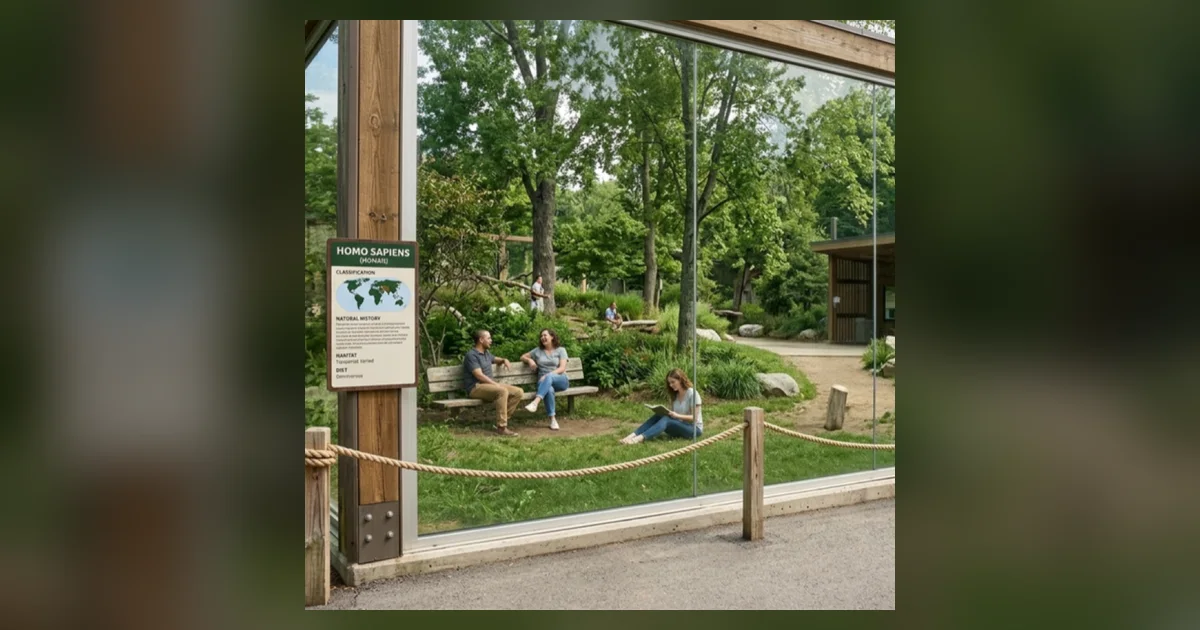
Cover of The Human Enclosure (Omxus Press)
8 min read
 articleworld4u
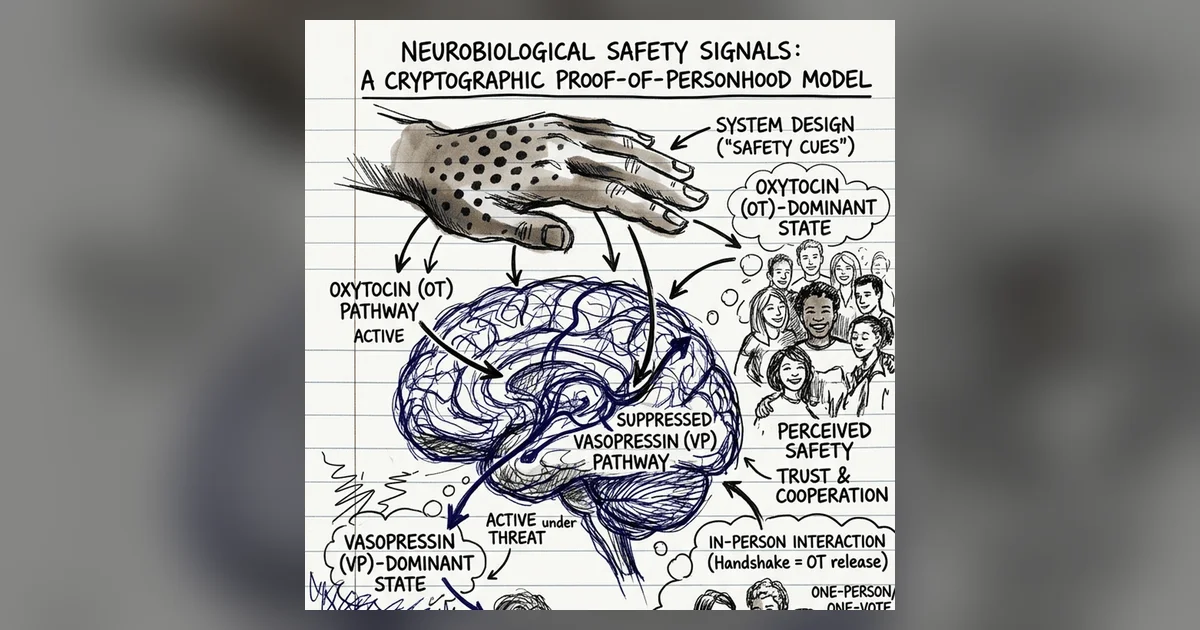
Cover of Neurobiological safety signals (Omxus Press)
In July 1995 a heatwave killed more than 700 people in Chicago in about a week. Two poor, mostly Black neighbourhoods sat side by side on the South Side. In Englewood, 33 people per 100,000 died. Next door in Auburn Gresham, 3 did (Klinenberg, 2002). Same heat. Same sun. What was different?
The sociologist Eric Klinenberg went looking. Englewood had lost its people, its shops and its places to meet. Auburn Gresham still had them, so someone was around to notice an old neighbour hadn't come out, and go and knock. Trust, it turned out, can be a matter of life and death, and it's made of something plain.
There's a question that has been tracking it for half a century. "Generally speaking, would you say that most people can be trusted or that you can't be too careful in dealing with people?" The General Social Survey has asked thousands of American adults every year or two since 1972, in the same words (Davern et al., 2026). In 1972, 46.6% said most people can be trusted. In 2024, 24.8% did. So it moves, and it moves with what people live through.
To find out what, it helps to start inside the body.
Oxytocin is often called the love hormone. That is half the story. It works as one system with a close relative, vasopressin. When the setting is read as safe, the system tilts towards approach, bonding and trust. Under threat it tilts towards vigilance and defence, and the same hormone can push either way depending on context and history (Carter, 2017).
The experiments show the switch. When groups competed, oxytocin raised trust and sacrifice for the in-group and defensive aggression towards the out-group (De Dreu et al., 2010). Oxytocin raised cooperation only when people had social information about their partner; without it, oxytocin lowered cooperation and made people play safe (Declerck et al., 2010). The hormone does not decide. The setting does.
Social safety theory holds that the brain and immune system evolved to track one thing above all: whether the social world is safe or threatening. Predictable, connected, inclusive, fair settings turn threat biology down; exclusion, unpredictability and betrayal turn it up (Slavich et al., 2023). Studies of whole societies find the same from the outside: fair, impartial institutions go with more trust in strangers (You, 2012), and disordered, threatening neighbourhoods with less (Ross et al., 2001).
That gives three safety signals: no threat, familiar people close by, and fair, predictable rules. The survey asks about each. Is there anywhere within a mile of home where you would be afraid to walk alone at night? How often do you spend an evening with a neighbour? How much confidence do you have in the people running the Supreme Court, the referee of the country's rules?
Each signal goes with more trust, comparing people of the same age, sex, race, schooling, income and survey year. Of adults who felt safe walking near home at night, 43.6% trusted most people, against 33.6% of those who were afraid. Of adults with at least some confidence in the Supreme Court, 39.2% trusted, against 27.2% of those with hardly any. Of adults who spent an evening with a neighbour at least monthly, 34.6% trusted, against 32.7%: a smaller gap, but it holds.
The signals add up. With neither felt safety nor fair rules, 26.1% trusted most people. With one, 34.8%. With both, 45.9%.
Threat that actually happened works the other way. From 1973 to 1994, adults burgled or robbed in the past year trusted at 29.7%, against 45.8% of everyone else: a cut of about a third.
It is not only an answer to a question. In 2002 to 2014, adults who saw a neighbour at least monthly were more likely to have looked after someone's pet or plants while they were away: 62.5% against 51.1%. Adults who felt safe at night were too: 58.5% against 50.7%. Trust itself did not predict doing two or more of the three helping acts the survey asked about. The signals predicted help even where the abstract answer about "most people" did not.
Not because Americans grew more afraid of their streets. The share not afraid to walk near home at night rose, from 60.2% in 1973 to 67.2% in 2024. What fell alongside trust was the evening with a neighbour, from 61.1% in 1974 to 38.3% in 2024: six in ten adults to fewer than four. That's Englewood, spreading. A society can make its streets feel safer and still lose trust if it removes the familiar faces and the fair referees. The safety signals that matter are social: people you know, rules you can predict.
Most institutions ask for trust first and offer safety later, if people behave. The biology runs the other way: the nervous system extends trust when it already has evidence of safety.
The institution that fails hardest is the one we built for people who've already hurt someone. A prison removes every signal at once: familiar people are taken away, threat is constant, and from the inside the rules look arbitrary. If threat produces defence and safety produces cooperation, a prison is a machine for producing the defended, uncooperative person it claims to protect us from, and then it releases that person into a neighbourhood. That's not a moral claim. It's cause and effect. The uncooperative guy in prison? He'll be your neighbour one day.
The survey is a snapshot of different people at one time, so it can't rule out that people who trust also feel safer, see their neighbours more and believe in their courts. The burglary result is the strongest hint of direction, because a break-in happens to people. The data are American. Oxytocin nasal-spray trust effects replicate poorly (Navé et al., 2015); the argument rests on the part that holds, that the setting decides which way the system tips. And Klinenberg's two neighbourhoods are one city in one week, though others have since argued about how much of that gap comes from the social life and how much from the buildings.
Have a neighbour over. That's the finding: of the three signals, it's the one that's collapsing, and you don't need anyone's permission to fix it. Knock on the door of whoever lives alone. Before the next heatwave, swap numbers with them and agree you'll check. Say hello to the kid at the bus stop. If your street has nowhere to meet, make somewhere: a table on the verge, a Sunday thermos.
And when your council, your school or your employer asks people to trust them, ask what they've done to be safe first. Cooperation isn't a matter of persuading people to be better. It's what nervous systems do when the setting says safe. Somebody in Auburn Gresham knocked.
When a polar bear swam in figure eights, the zoo inspected his life. Scored the same way, the places people live and work fail on 17 of 18 measures.
Cover of The Human Enclosure (Omxus Press)
In 2008 Denmark began paying night workers with breast cancer. Sleep advice still blames your habits. In a US sample, the job predicts who sleeps too little.

Cover of The Stolen Night (Omxus Press)
Twenty years of American time diaries show young people's time with friends fell from 137 minutes a day to 51, and the hours went to being alone.

Art: Omxus Press