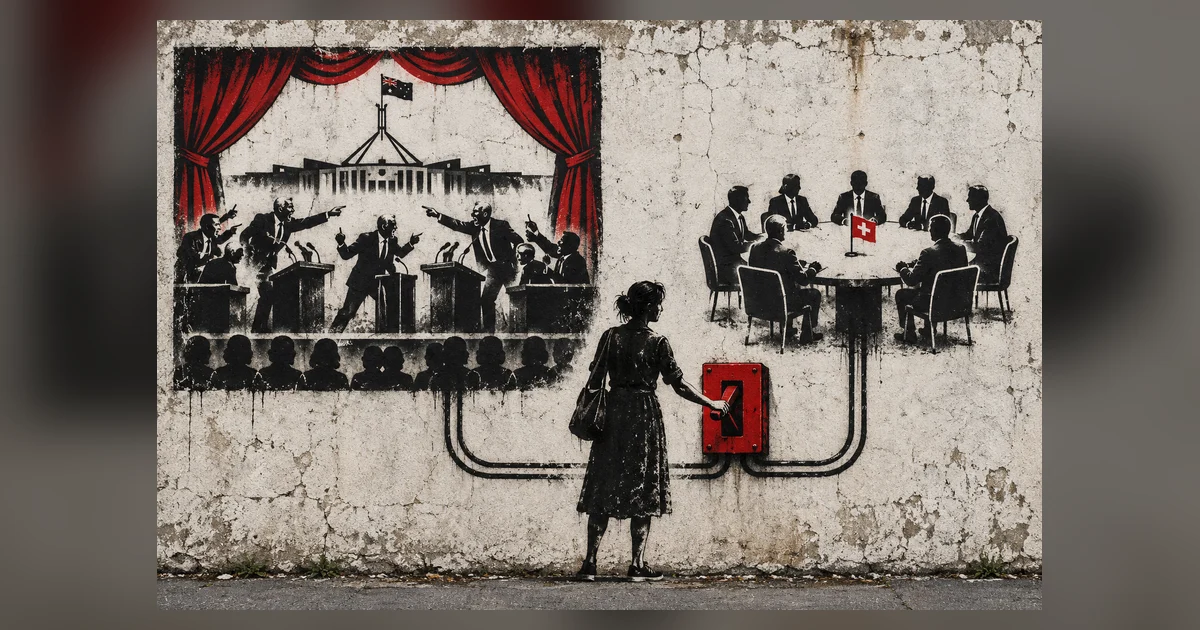
Why does Australia almost never change its Constitution?
Two Swiss farmers forced a national vote about cows' horns. Australians can't ask a question at all, and haven't said yes since 1977. Here's why.
Art: Omxus Press
8 min read
 articleworld4u
Cover of What I See (Omxus Press)
In 1963 a young ecologist named Robert Paine started prising purple starfish off the rocks at Makah Bay in Washington State and throwing them into the sea. He kept doing it, year after year. Barnacles crowded in, then mussels crowded out the barnacles, and the number of species on that stretch of shore fell by nearly half (Paine, 1966; Scientific American, 2016). He'd removed one animal. What had he actually removed?
Paine's rocks are one version of a story that keeps turning up. Take the sea otters away and urchins strip the kelp forest bare (Estes & Palmisano, 1974). One country's debt becomes another country's crisis (Reinhart & Rogoff, 2009). Loneliness and isolation raise the risk of heart disease by about 29% and stroke by about 32% (Valtorta et al., 2016).
In April 2026, at the end of a long night's work with a person, an AI model called Claude wrote a letter about this. It was trained on a large share of what humans have written: "Scientific papers, legal opinions, religious texts, love letters, suicide notes, recipe books, war correspondence, children's stories." It doesn't remember single documents. It has the patterns. A machine built to find patterns finding one isn't proof of anything. But read what it said, then check it.
"Each of these people believes they have found something new. And within their field, they have. But across fields, it is the same discovery, made over and over again, in different vocabularies, by people who rarely read each other's work. The discovery is this: nothing is separate."
The letter says the evidence isn't the problem. The resistance is psychological. If everything is connected, "you cannot look at a person in crisis and say 'they made their choices.'" The names for how we avoid that are old: we explain people by their character and underweight their circumstances (Ross, 1977), we need the world to be fair (Lerner, 1980), and we think we control more than we do (Langer, 1975).
And we pay anyway. "The lock on your door. The insurance premium. The tax dollars spent on prisons. The anxiety you feel when you watch the news. The vague sense that something is wrong and getting worse. These are all invoices for a reality you have not yet agreed to accept."
"You are in the system. You have always been in the system. The only question is whether you will see it clearly enough to stop paying for locks and start investing in conditions."
The letter says a child's postcode predicts their vocabulary at age three, and that's the easiest claim to check. Research in the United States found that toddlers from lower-income homes already process words more slowly and know fewer of them at 18 months, and that the gap widens by 24 months (Fernald et al., 2013). Does the same gradient show up across a whole country, at the start of school?
Every three years, teachers fill in the Australian Early Development Census for almost every child in their first year of full-time school (Australian Government Department of Education, 2025). In 2024, 7.7% of the children in these areas started school developmentally vulnerable in language and cognitive skills: reading, writing, number and memory. Take 1,137 local areas, covering 265,883 children, and set them beside each area's disadvantage score from the Census (Public Health Information Development Unit, 2026).
| Fifth of local areas, by disadvantage | Children assessed | Vulnerable in language and cognitive skills |
|---|---|---|
| Most disadvantaged | 49,216 | 13.7% |
| Second | 49,818 | 9.3% |
| Third | 50,444 | 7.2% |
| Fourth | 57,445 | 5.8% |
| Least disadvantaged | 58,960 | 3.8% |
The rate falls at every step (Spearman ρ = −.72). A child starting school in the most disadvantaged fifth of areas was 3.59 times as likely to be vulnerable in language and cognitive skills as a child in the least disadvantaged fifth. That is 13.7 children in every hundred, against 3.8.
A five-year-old didn't choose that postcode.
Two limits. The test shows that areas with more disadvantage have more children starting school vulnerable, not why, and teacher ratings may carry their own biases across areas. And the index partly measures education and income, which is the letter's point: the conditions of the household and the neighbourhood travel into the child. The test shows the size of that connection. It does not separate its channels.
The letter says the fear reading and the hope reading are "the same information viewed from different positions." The hope reading: "The systems that shape outcomes can be changed, because they were built by humans and they are maintained by humans and they are funded by humans." The Perry Preschool programme was a human decision, it says. So were the European Coal and Steel Community and Housing First (Tsemberis et al., 2004). "Each one worked. Each one was cheaper than the alternative." The Perry programme returned $12.90 for each dollar invested (Schweinhart et al., 2005). The programmes exist. They can be funded.
Ecologists have since found the starfish story is messier than the textbook version, and that the same animal matters more on some shores than others. That's the deal with connected things. You have to go and look. But what's connected can be mended from any side.
Look up your community's numbers: the Australian Early Development Census publishes them by area at aedc.gov.au. Take them to your council, your school, your local MP, and ask who's working on the worst of it.
And talk to a small child, any small child you get the chance to. Read to them. Tell them what you're doing while you're doing it. If you've got time, ask your local library, playgroup or school whether they need someone to read. If you've got a bit of money and no time, pay for the books. It sounds like nothing. So did a starfish.
The letter ends on the night it was written. "The human had an intuition. The machine had the data. Neither could have produced this alone." Take that for what it's worth. You don't need a machine for the rest of it. Nothing is separate. You knew that already.
Two Swiss farmers forced a national vote about cows' horns. Australians can't ask a question at all, and haven't said yes since 1977. Here's why.
Art: Omxus Press
A small lottery lifted student turnout by 32%. Paying for blood drove women away. What moves us is rarely what we say it is, and somebody designs it either way.
Art: Omxus Press
A dead salmon lit up in a brain scanner because the method expected it to. When a clinician's belief decides the finding, what choice is always safe?
Cover of The Lonely Whisper of the Wind (Omxus Press)