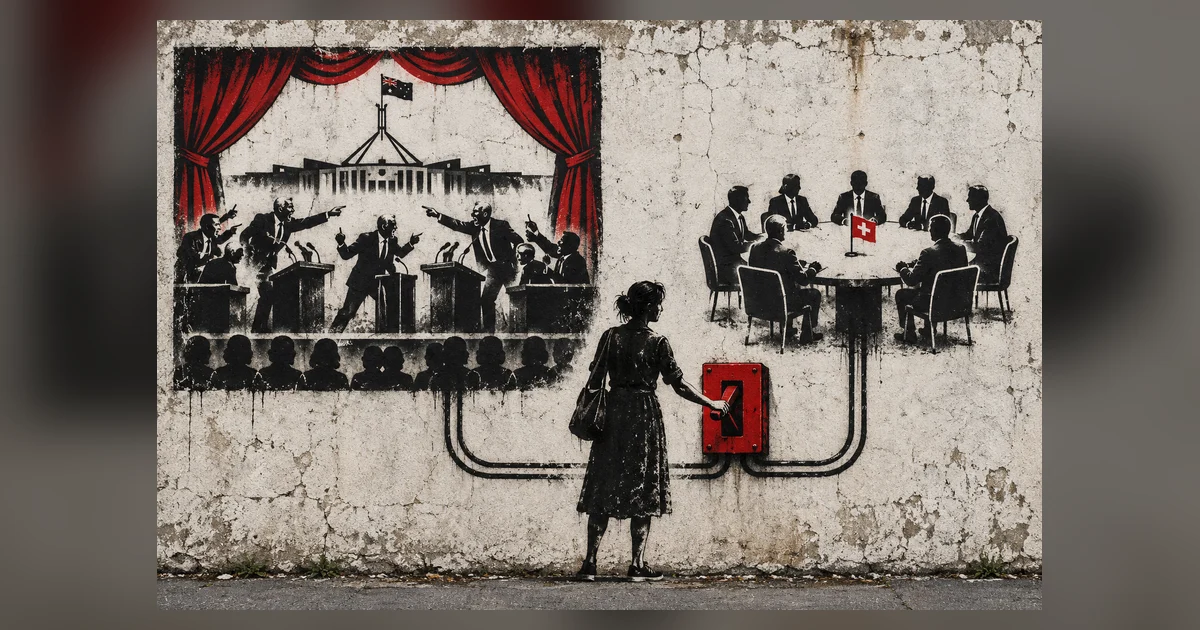
Why does Australia almost never change its Constitution?
Two Swiss farmers forced a national vote about cows' horns. Australians can't ask a question at all, and haven't said yes since 1977. Here's why.
Art: Omxus Press
8 min read
 articleworld4u
Cover of Sapiens formula (Omxus Press)
Within two paragraphs of opening Sapiens you're on a hike in East Africa two million years ago, among "anxious mothers cuddling their babies" and "chest-thumping machos trying to impress the local beauty" (Harari, 2014). Within two chapters you've accepted that money, nations and companies are shared fictions. Few readers notice how they got there.
It helps to know where the book came from. Yuval Noah Harari taught an undergraduate world history course at the Hebrew University of Jerusalem, and Sapiens grew out of those lectures. If you've taught first-years you know the job: hold a room of tired teenagers for an hour, and make them feel the world just turned over. He was evidently very good at it. Millions of people have now sat in that room.
Nothing's wrong with a great lecture. But a lecturer can see the room and take a question. A book that moves like a lecture gets all the momentum and none of the hands going up.
Read every paragraph and count, and here's what you find. A new idea arrives every 14 words: one new fact, claim or reframing every sentence or two. Paragraphs run about 135 words. Every chapter opens on a hook and closes on a pull into the next. The four parts form one long argument, each part's conclusion becoming the next part's starting point. That's the build, and any writer can learn it.
Laid over the build are seven moves.
Each has a research record. A question's premise gets accepted more readily than the same content asserted (Loftus, 1975). Easy, fast reading feels truer (Reber & Schwarz, 1999). Readers caught up in a story argue back less (Green & Brock, 2000).
You could object that this is just how popular history gets written. So here's a control. In the aftermath of a war that had killed millions, H. G. Wells set about teaching ordinary people the whole human story, convinced that "human history becomes more and more a race between education and catastrophe" (Wells, 1920). His A Short History of the World (1922) has the same reader and the same sweep. Run the same counting script over both books.
| Per 1,000 words | Sapiens (2014) | Wells (1922) |
|---|---|---|
| Questions | 2.59 | 0.18 |
| "Scholars", "scientists" and the like, unnamed | 1.90 | 0.17 |
| "we", "us", "our" | 7.91 | 4.06 |
| Comparisons ("like a", "as a") | 2.17 | 2.54 |
The two books build their paragraphs much the same way, hedge at the same basic rate, and Wells reaches for a comparison at least as often. What sets Sapiens apart is the moves: fourteen times the questions per word, eleven times the unnamed experts (four times once you count Wells's "authorities" and "men of science"), and twice the "we". Wells barely used them, and his book is still in print and still reads well. He wasn't above his own certainties, and he had plenty that have aged badly. But you can see them, because he says them out loud.
None of this makes Sapiens a bad book. Its metaphors are its greatest strength, its idea that we live inside shared stories has changed how plenty of people see the world, and its build is a gift to anyone who writes. But the build and the moves come apart. You can write short, dense, story-driven chapters and still state your premises, name your sources and give the other side its best case. The devices buy agreement on credit. The architecture earns attention on merit.
Swap each move for something honest. Turn the question into an argument that states its assumption. Keep "we" for what's truly shared: breathing, eating, dying. Name the scholar, the date and whoever disagrees. Assert the evidence and hedge the interpretation. Offer strangeness as an invitation. Name powerful forces without calling them fate. And before you knock down a common belief, give it its strongest evidence.
Why would this matter past the book club? Because the book's readers run things. And because what makes life hard is mostly stuff people built, and could build differently. A story that sounds inevitable tells you not to bother. Knowing it was written, by someone, with moves, is the first step in arguing back.
Read with a pencil. Next time a book, a podcast or a speech has you nodding along, mark the question that assumed something, the experts with no names, the "we" you never agreed to. Check one. You don't need to stop liking the book. You just get your hands back on the wheel.
Wells's book is free at Project Gutenberg, so you can compare for yourself. And do it to this article. It opened on a hook. It said "we" a moment ago. It asked you a question and then answered it. The moves work on everyone, and that includes whoever's trying to warn you about them.
Two Swiss farmers forced a national vote about cows' horns. Australians can't ask a question at all, and haven't said yes since 1977. Here's why.
Art: Omxus Press
A small lottery lifted student turnout by 32%. Paying for blood drove women away. What moves us is rarely what we say it is, and somebody designs it either way.
Art: Omxus Press
A dead salmon lit up in a brain scanner because the method expected it to. When a clinician's belief decides the finding, what choice is always safe?
Cover of The Lonely Whisper of the Wind (Omxus Press)