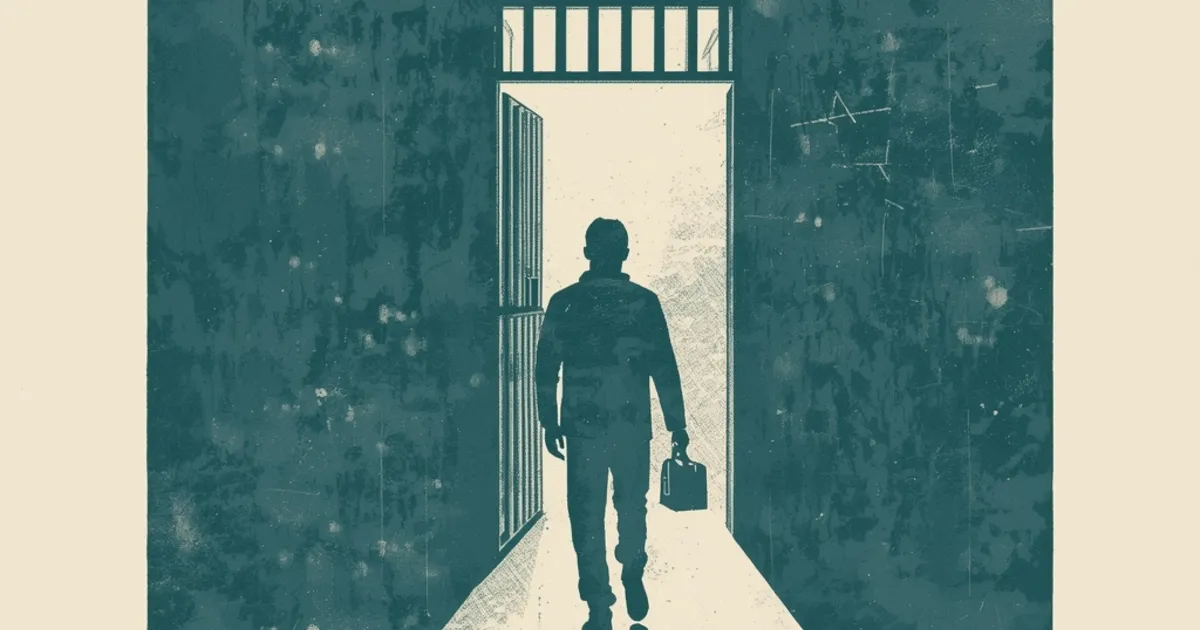
Many people who have served time say it wasn't that bad. The health data disagrees: death rates soar in the weeks after release, trauma is far more common than outside, and about four in ten people released in Australia are back in prison within two years.
Why people play it down
Prison rewards looking hard. Nick de Viggiani spent months inside an English men's prison and found men "front managing": hiding fear, sadness and weakness behind a tough persona, because showing weakness invites exploitation. The habit does not switch off at the gate.
De Viggiani interviewed 35 prisoners and four officers. He concluded that the pressure to perform toughness works against the very thing prison says it is for: helping people return to the community and stay out.
So "it wasn't that bad" often reflects how people had to act inside rather than what prison did to them. To see the harm, look at what happens to people's bodies and lives after release.
The weeks after release are deadly
Ingrid Binswanger and colleagues followed 30,237 people released from prison in Washington State. In the first two weeks out, their risk of death was 12.7 times that of other residents. Their risk of dying from a drug overdose in those two weeks was about 129 times higher. Across the whole follow-up, their death rate stayed 3.5 times higher. The leading causes were drug overdose, heart disease, homicide and suicide.
Australia shows the same pattern. A meta-analysis of drug-related deaths after release, which included Australian data, found the risk in the first two weeks far higher than in the weeks after. For Australia, the risk of a drug-related death in weeks one and two was four times the risk in weeks three to twelve. Tolerance drops inside; people leave with no drug treatment in place and often no stable home, and the risk falls hardest in those first days.
Trauma rates
A review of 56 studies covering 21,099 prisoners in 20 countries found that about 6% of men and 21% of women in prison had post-traumatic stress disorder at the time. Across studies, the rate for women ranged from 12% to 38%. That is several times the rate in the community. Some of that trauma came before prison. Prison adds to it and rarely treats it.
Reoffending in Australia
The Productivity Commission tracks how many people come back. Of adults released from Australian prisons in 2021–22 after a sentence, 43.0% were back in prison within two years. Counting community orders as well, 52.5% were back under corrective services.
A return to prison is not the only cost. Each return means another release, and another set of those dangerous first two weeks.
What Norway does, and a warning about the comparison
Norway is often held up as the model of humane prisons. A Nordic study found 20% of people released from Norwegian prisons received a new sentence within two years, the lowest rate in the Nordic countries.
That figure measures something different from Australia's 43%. Norway counts new convictions; Australia counts returns to prison. Norway also sends fewer, and different, people to prison. Seena Fazel and Achim Wolf reviewed reoffending data from 18 countries and concluded the figures are not valid for comparing countries, because each counts differently.
So do not quote "20% versus 43%" as proof on its own. The fairer claim: a country can run humane prisons and still keep reoffending low, and nothing suggests harsh conditions produce better results.
Who checks the conditions
In Western Australia, the Office of the Inspector of Custodial Services must inspect every prison, youth detention centre and court custody centre at least once every three years and report to Parliament. In practice it visits most prisons several times a year. Its reports are public, and they are the best plain record of what conditions are actually like.
What you can do
- Read your state inspector's latest report on the prison nearest you. Look for time out of cell, lockdowns and health care.
- If someone you love is being released, plan for the first two weeks: a place to stay, a GP appointment, and, if they have used opioids, naloxone and a treatment contact.
- When someone says prison "wasn't that bad", keep listening. It may be the only way they can talk about it.
Sources
- de Viggiani, N. (2012). Trying to be something you are not: Masculine performances within a prison setting. Men and Masculinities, 15(3), 271–291. doi.org/10.1177/1097184X12448464
- Binswanger, I. A., Stern, M. F., Deyo, R. A., Heagerty, P. J., Cheadle, A., Elmore, J. G., & Koepsell, T. D. (2007). Release from prison: A high risk of death for former inmates. New England Journal of Medicine, 356(2), 157–165. doi.org/10.1056/NEJMsa064115
- Merrall, E. L. C., Kariminia, A., Binswanger, I. A., et al. (2010). Meta-analysis of drug-related deaths soon after release from prison. Addiction, 105(9), 1545–1554. PMC2955973
- Baranyi, G., Cassidy, M., Fazel, S., Priebe, S., & Mundt, A. P. (2018). Prevalence of posttraumatic stress disorder in prisoners. Epidemiologic Reviews, 40(1), 134. doi.org/10.1093/epirev/mxx015
- Productivity Commission. (2025). Report on Government Services 2025, Part C, Section 8: Corrective services. pc.gov.au
- Kristoffersen, R. (2013). Relapse study in the correctional services of the Nordic countries: Key results and perspectives. EuroVista, 2(3). PDF
- Fazel, S., & Wolf, A. (2015). A systematic review of criminal recidivism rates worldwide: Current difficulties and recommendations for best practice. PLOS ONE, 10(6), e0130390. doi.org/10.1371/journal.pone.0130390
- Office of the Inspector of Custodial Services, Western Australia. (n.d.). What we do. oics.wa.gov.au