Why does Australia almost never change its Constitution?
Two Swiss farmers forced a national vote about cows' horns. Australians can't ask a question at all, and haven't said yes since 1977. Here's why.
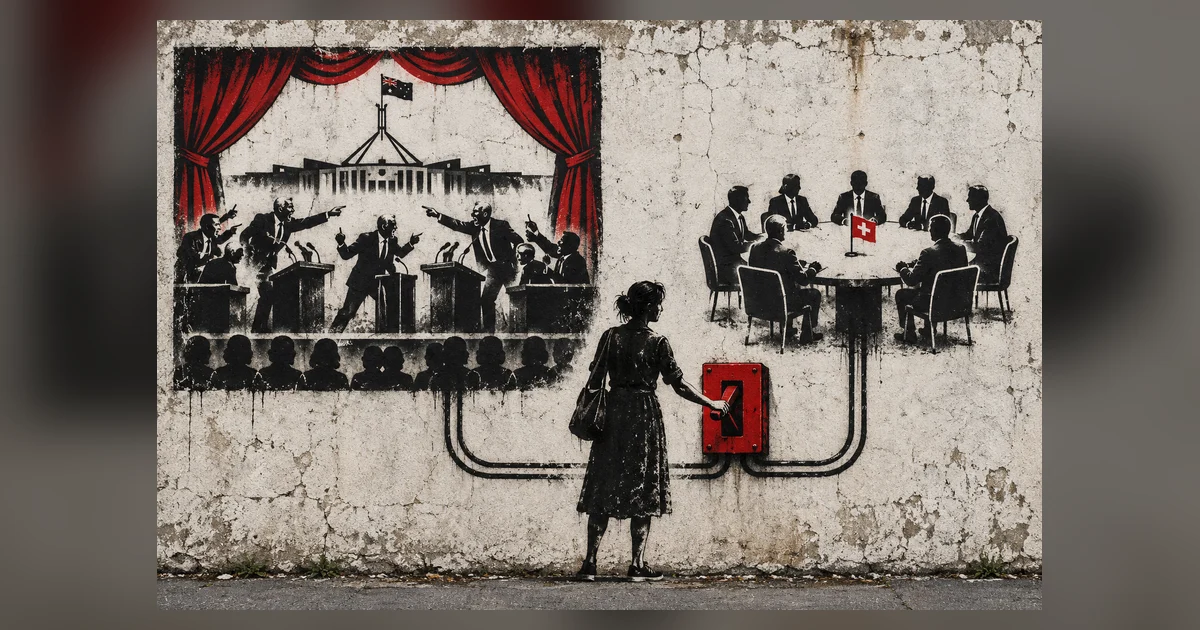
Art: Omxus Press
8 min read
 articleworld4u
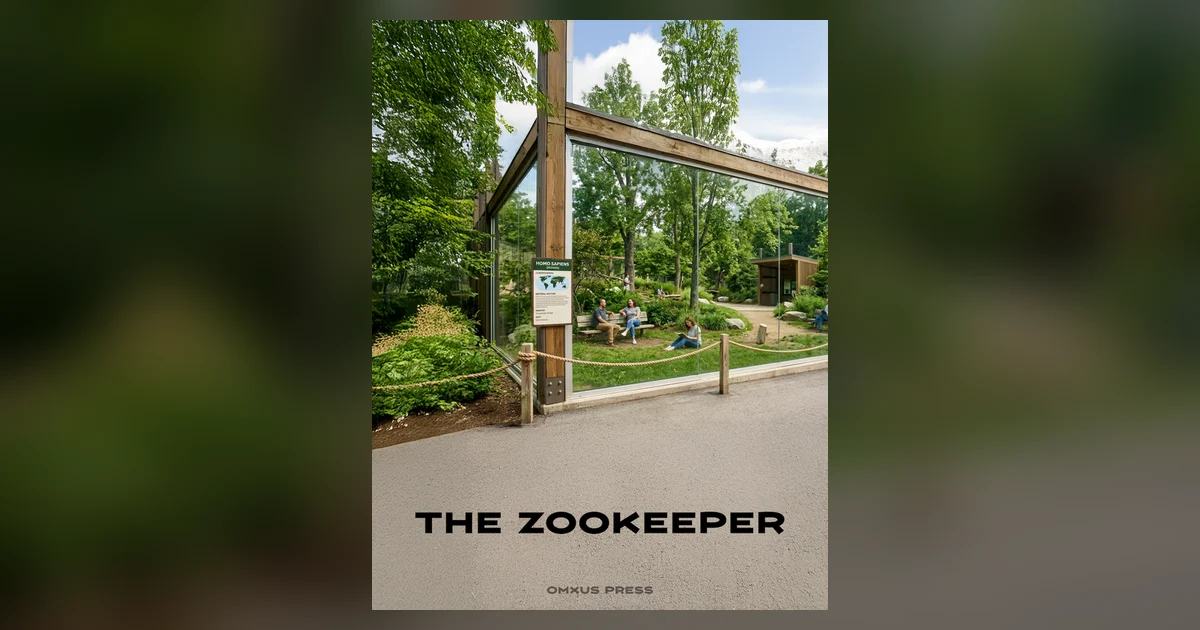
Cover of The Zookeeper (Omxus Press)
Somewhere in your city there is a person who has not been touched by another human being in over a month. They have a job. They have shelter. They have food in the refrigerator and a screen that connects them, in theory, to every other person on the planet. By every metric their civilisation uses to measure welfare, they are fine. They are not fine. A zoologist would recognise this instantly – would flag the isolation, the stereotypic behaviour, the flat affect, the way the organism returns each evening to the same small space and sits in the same position and stares at the same luminous rectangle until consciousness ceases. In any other species, this would be called a welfare emergency. In Homo sapiens, it is called Tuesday.
In 1907 Carl Hagenbeck, an animal dealer, opened his Tierpark in Hamburg and showed the world something odd: an enclosure could be designed around the animal instead of the keeper, with moats instead of bars and landscape instead of concrete. Most zoos ignored him for decades. Big cats paced. Elephants swayed. Isolated monkeys hurt themselves. Everyone assumed the animal's nature was the problem.
Then the question changed. Heini Hediger, a Swiss zoo director, argued that a pacing cat isn't a flawed cat. It's a cat responding to its surroundings (Hediger, 1950). In 1979 Britain's Farm Animal Welfare Council set out the Five Freedoms, a minimum: is the animal not in pain, not frightened, not starving (Farm Animal Welfare Council, 1979). Today's standard, the Five Domains, asks whether it has a life worth living (Mellor et al., 2020).
The method is simple. Start from what the species evolved to do. Measure what the enclosure gives it. Close the gap, one change at a time.
Now picture a keeper walking through your suburb with a clipboard. People with strong social ties had 50% better odds of survival across 148 studies (Holt-Lunstad et al., 2010). Americans spend 87% of their time in enclosed buildings and another 6% in enclosed vehicles, leaving about an hour and forty minutes a day outside (Klepeis et al., 2001). In 2023 the US Surgeon General called loneliness an epidemic (Office of the Surgeon General, 2023). A keeper who saw a social animal kept indoors, alone and still would know what to do. With people, we tend to blame the animal.
Take weight. The usual story says it's about willpower. If so, willpower failed in the same direction, at the same time, everywhere.
| Adult obesity | 1980 | 2024 |
|---|---|---|
| Median country | 7.0% | 24.3% |
| Australia | 7.5% | 32.4% |
| Countries where it rose | 205 of 205 | |
(World Health Organization, 2026.) Not one country went the other way. That can't say which part of modern life drives it, or what's right for any one body. But nobody's character changed in 205 countries at once. Something changed for everyone, and that something is the enclosure. So why does the shame still land on the person?
People have already redesigned pieces of it. In the Netherlands, Buurtzorg runs home nursing with small self-managing teams instead of layers of managers. In Spain's Basque Country, the Mondragon cooperatives have been owned by their workers since 1956. In 1967 Cicely Saunders opened St Christopher's in London, giving dying people a place that treated them as people, and later trials found early palliative care helped people with lung cancer live better and longer (Temel et al., 2010). Each starts from what the animal needs.
Try asking these about your own life.
Is the exhaustion I feel a personal failing or a deficit in the body: too little sleep, too little movement, too much processed food? Is the loneliness I feel a character flaw or a deficit in the herd: too few deep connections, too little physical contact, too much screen-mediated interaction? Is the flatness I feel a mental illness or a deficit in making: months since I last made something with my hands? Is the dread I feel on Sunday evenings a problem with my attitude or a deficit in mastery: nothing in my working week that challenges me at the edge of my competence?
This isn't a diagnosis, and flatness can also be an illness worth treating. If it won't lift, see a doctor. Both can be true. But being able to tell "something is wrong with me" from "something is wrong with my enclosure" may be the most useful shift a member of our species can make. "What's wrong with me?" has no bottom. "What's missing?" has answers: specific, identifiable, actionable. Not "try harder".
Life sucks, and a good share of it isn't your fault. That doesn't make it fixed, but you can stop spending your strength on the wrong question.
Pick one line from those questions and change one thing this week: an early night, a walk with someone, something made with your hands. If you're the person in that first paragraph, or you can't think who you'd call, FriendLine on 1800 424 287 is there for a chat with no reason needed. If you know someone who might be that person, go and see them. Shake their hand. Sit on the couch. A month is a long time.
And ask a keeper's question of whatever you have a hand in: a workplace, a school, a street. What is the animal here missing? We can see it now. That isn't nothing.
Two Swiss farmers forced a national vote about cows' horns. Australians can't ask a question at all, and haven't said yes since 1977. Here's why.
Art: Omxus Press
A small lottery lifted student turnout by 32%. Paying for blood drove women away. What moves us is rarely what we say it is, and somebody designs it either way.
Art: Omxus Press
A dead salmon lit up in a brain scanner because the method expected it to. When a clinician's belief decides the finding, what choice is always safe?
Cover of The Lonely Whisper of the Wind (Omxus Press)