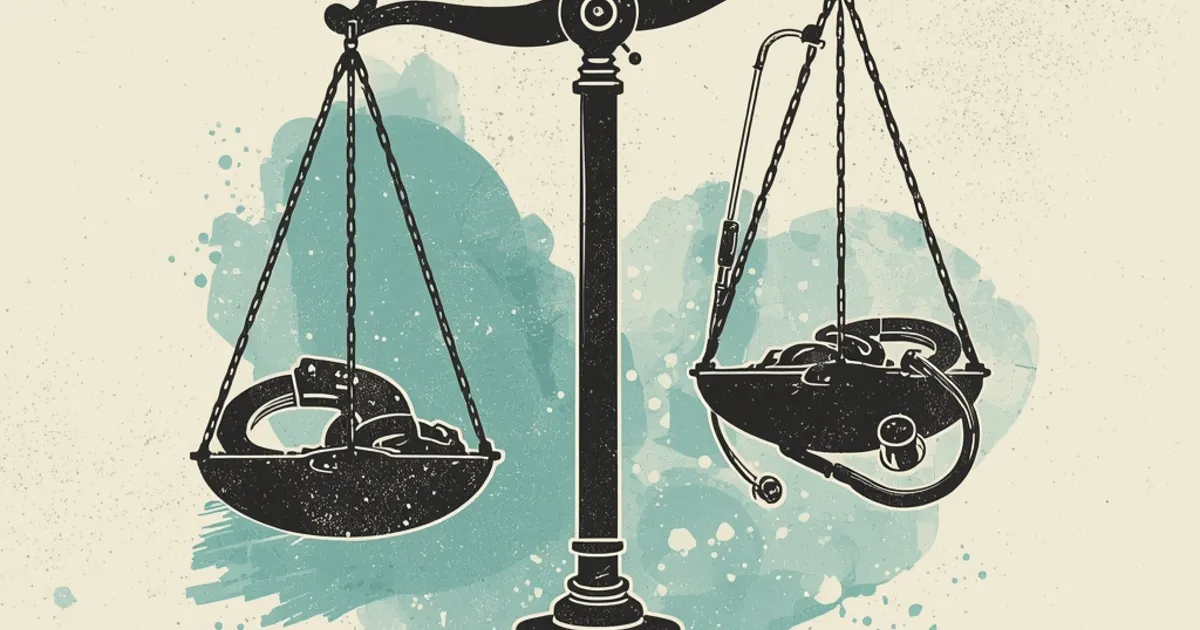
Australian governments spent $5.45 billion on illicit drug policy in 2021–22. About 64% went to law enforcement and 1.6% to harm reduction, about $40 on enforcement for every $1 spent directly on keeping people who use drugs alive.
The drug budget
No government publishes one figure for drug spending, so Alison Ritter and her team at UNSW add it up across every federal, state and territory budget. Their count for 2021–22:
| Area | Spending | Share |
|---|
| Law enforcement | $3.5 billion | 64.3% |
| Treatment | about $1.49 billion | 27.4% |
| Prevention | about $365 million | 6.7% |
| Harm reduction | about $87 million | 1.6% |
Routine policing of drugs alone cost $1.8 billion. States and territories spend most of the money: $4.11 billion, or 76% of the total. Of that, $2.87 billion goes to law enforcement.
Harm reduction is the line in the budget aimed most directly at deaths. It covers what stops people dying or getting sick while they still use drugs: needle and syringe programs, naloxone to reverse opioid overdoses, supervised injecting rooms, and drug checking. It gets the smallest share. Treatment, at about $1.49 billion, gets well under half of what enforcement gets.
Who gets arrested
The Australian Criminal Intelligence Commission records drug arrests each year. In 2020–21 police made 66,285 cannabis arrests. Nine in ten were consumer arrests, meaning possession or use, not supply. About 6,600 were provider arrests, for selling or growing to sell. The total was 14% lower than the year before.
So much of the enforcement budget goes on catching people for what they put in their own bodies, not on the supply chain. Each of those arrests takes police time, often court time, and can leave a record that follows a person into job applications.
What an illegal market leaves out
Prohibition aims to protect people from dangerous substances. But it also hands supply to a market with none of the checks we expect from any other risky product:
- no age check: a bottle shop asks for ID, a dealer does not
- no label: buyers can't know the dose or what else is in the pill or powder
- no recall, no complaint line, no one accountable when a batch is contaminated.
Every one of those checks exists for alcohol, tobacco and pharmacy medicines, because we accept that adults will use risky products and that the risks are better managed in the open.
Drug checking, where a service tests a pill or powder and tells the owner what is in it, fills part of that gap. It sits in the smallest budget line, harm reduction, alongside needle programs and naloxone.
That doesn't make every drug safe to sell. It means the law decides whether the risks get managed or left to chance.
What Portugal did
In 2001 Portugal decriminalised personal possession of all illicit drugs. Supply stayed a crime. People found with small amounts go before a panel that can refer them to treatment rather than to court.
Criminologists Caitlin Hughes and Alex Stevens compared Portugal with neighbouring Spain and Italy, using independent evaluations and interviews with 13 people who worked in the system in 2007 and 2009. Against predictions, drug use did not rise sharply. Problematic drug use and drug-related harms fell, and fewer drug users filled courts and prisons, which had been overcrowded. Portugal also expanded treatment at the same time, so decriminalisation did not act alone.
What Australia has already tried
Australian law on drug possession is mostly state and territory law, so it differs by where you live. Since 31 January 2020 adults in the ACT may hold up to 50 grams of dried cannabis, or 150 grams fresh, and grow two plants each, up to four per household. Selling it is still illegal, and so are cannabis seeds and extracts. Every other state and territory sets its own rules for small amounts.
What you can check
- Look up your state's drug diversion rules before assuming a small amount means a criminal charge, or doesn't. The police or health department website usually explains who qualifies for a caution or a referral instead of court.
- If you or someone near you uses opioids, ask a pharmacist about naloxone, the medicine that reverses an opioid overdose.
- If you write to your MP, quote the split: $3.5 billion on enforcement, $87 million on harm reduction. Then ask what evidence supports that ratio.
Sources
- Ritter, A., et al. (2024). The Australian "drug budget": Government drug policy expenditure 2021/22. Social Policy Research Centre, UNSW Sydney. Summary: unsw.edu.au
- Australian Criminal Intelligence Commission. (2023). Illicit drug data report 2020–21. Figures as summarised by the National Alcohol and Other Drug Knowledge Base, Flinders University. nadk.flinders.edu.au
- Hughes, C. E., & Stevens, A. (2010). What can we learn from the Portuguese decriminalization of illicit drugs? British Journal of Criminology, 50(6), 999–1022. academic.oup.com
- Drugs of Dependence (Personal Cannabis Use) Amendment Act 2019 (ACT). Summary: Cannabis in the Australian Capital Territory