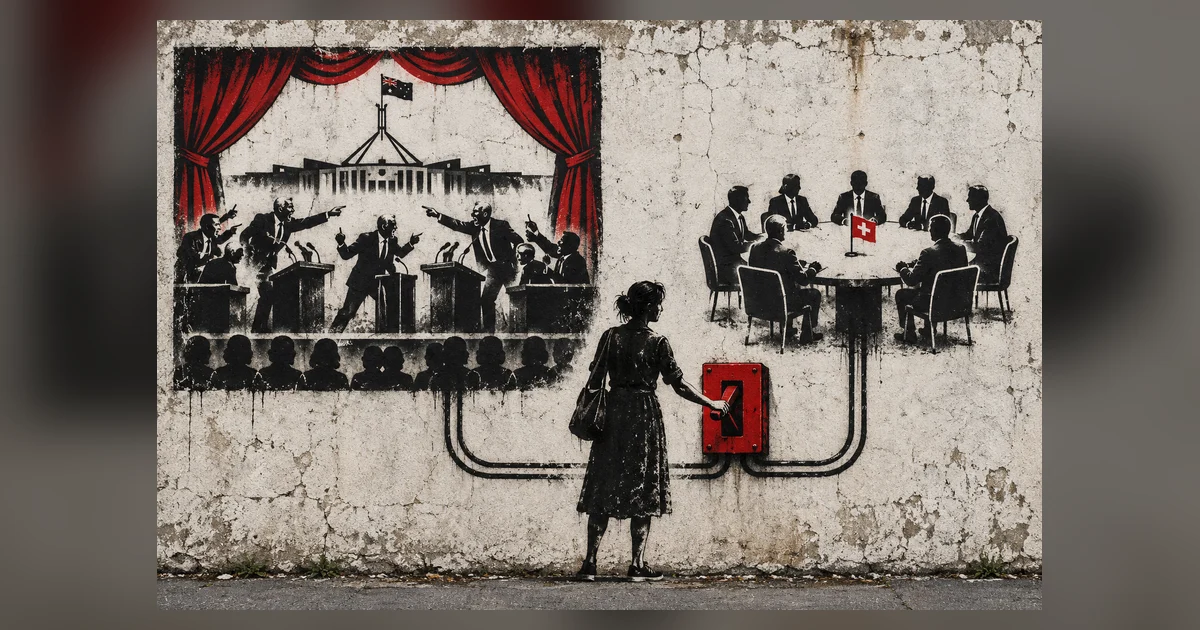
Why does Australia almost never change its Constitution?
Two Swiss farmers forced a national vote about cows' horns. Australians can't ask a question at all, and haven't said yes since 1977. Here's why.
Art: Omxus Press
8 min read
 articleworld4u

Art: Omxus Press
On Saturday 3 January 2009, someone using the name Satoshi Nakamoto ran a program that made the first block of a new money system. Inside it, where nobody had to look, they typed a line from that morning's London Times: "Chancellor on brink of second bailout for banks."
Gold, built in cells, by a hive no queen actually directs.
The headline was real (The Times, 2009). Banks were being rescued with public money for a second time. The people whose mortgages those banks had packaged and sold, whose homes were foreclosed and whose pensions shrank, paid for the rescue (Financial Crisis Inquiry Commission, 2011). Nakamoto stamped that fact into the first block of a system built to make banks optional. It sits there still, in the first block of a ledger anyone can download and nobody can edit.
To see why that matters, go back two thousand years.
Julius Caesar hid his orders by shifting every letter three places (Kahn, 1967). It worked because the enemy could not read. But it had a flaw every cipher shared for the next two millennia: before you could send a secret, you had to deliver the key. That meant couriers, codebooks and trusted carriers. Those belonged to kings, armies and banks. Everyone else trusted that the people carrying their letters were not reading them.
In 1976 two researchers, Whitfield Diffie and Martin Hellman, showed that two strangers could agree on a secret in public, with an eavesdropper listening to every word, and the eavesdropper would still not learn it (Diffie & Hellman, 1976). A year later RSA let anyone sign a document so that anyone else could check it, no notary needed (Rivest et al., 1978). The courier and the notary had just become optional.
Governments noticed. Under US export law, strong encryption sat on the list of munitions, beside missiles, until 1996 (Diffie & Landau, 2007). In 1991 Phil Zimmermann gave away PGP, a free program that let anyone encrypt their email. A criminal investigation for illegal arms export followed. His publisher printed the source code as a book, because books had a protection that software did not (Zimmermann, 1995). After three years the government dropped it, without charges (Levy, 2001).
The people who built digital money's tools weren't trying to build a bank. They were trying to stay out of prison for writing code. And every attempt at digital cash kept hitting the same wall. DigiCash needed banks to issue its coins; it went bankrupt in 1998 (Narayanan & Clark, 2017). e-gold kept its gold in one company's vault; its operators pleaded guilty in 2008 (U.S. Department of Justice, 2008). Whoever kept the ledger held the power, and could switch it off.
Bitcoin's trick was to let anyone keep the ledger, and make cheating cost more than it pays. Miners race to solve a puzzle; the winner adds the next block; every two weeks the code checks how fast blocks came and makes the puzzle harder or easier to bring the pace back to one every ten minutes (Nakamoto, 2008).
You can watch that work, because every block is public. Take the fortnight after the April 2024 "halving", when the reward for mining was cut in half: 2,016 blocks, 24 April to 9 May. Blocks slowed to 10.6 minutes on average. They arrived at random, in the pattern the mathematics predicts. Then the code did its sum. The fortnight had taken 14.83 days instead of 14, so the rule called for the puzzle to get 5.62% easier. The next block carried a difficulty within four parts in a million of that. No meeting. No announcement. Thousands of computers did the same arithmetic and agreed.
So what's it for? Forget the speculators for a minute. In early 2013 Roya Mahboob was running Citadel Software in Herat, Afghanistan, with a mostly female workforce, under threats that made her change her phone number again and again (Bezhan, 2012). She had a problem paying them. Most had no bank account. "If I gave them cash," Mahboob said, "their fathers or husbands or brothers might find out and take it away" (Gladstein, 2021). An Italian business partner told her about bitcoin, and she taught her employees and contractors to set up wallets on their phones.
Then in November 2013 bitcoin lost about 60% of its value. The company's assets and its workers' savings went with it, and competitors called her a fraud who stole from young women. Mahboob offered to buy back the bitcoin of more than 150 employees and contractors at pre-crash prices. The next two years were hard, and Citadel laid off many staff. One of those women, Laleh Farzan, kept her coins through her escape from Afghanistan, and later sold some in Germany for $2,500 (Gladstein, 2021).
Both halves of that story are true. No border guard could confiscate it, and it could still lose more than half its value in a month. It's a poor way for most of us to save. It's a different thing entirely if everyone with a key to your life wants to take your wage.
Here's the part less often said. Bitcoin's safety rests on nobody holding too much of the mining power. With 10% of the power, an attacker trying to reverse a payment after six confirmations, the usual wait, succeeds about once in 1,700 tries. With 30%, about once in six (Grunspan & Pérez-Marco, 2018).
So count who found the blocks in that same fortnight. Two mining pools, Foundry USA and AntPool, found 1,066 of the 2,016: 52.9%. A pool isn't one machine. Thousands of miners point their hardware at it and can leave. But the coordination point is real, and the arithmetic doesn't care whose name is on it.
There are other costs too. Mining burns a great deal of electricity to do what a database does cheaply. Most people hold their coins through exchanges, which puts the same old keeper back in the middle, and plenty of ordinary people have been robbed in its name.
None of that kills the idea. It's the idea, applied honestly. Two thousand years of cryptography say the same thing: concentrated power serves itself, whoever holds it, and the fix is systems that don't need anyone's permission. Bitcoin proved the first half works. The second half, keeping the power spread out, is still up to the people who run it.
Nobody has to buy any bitcoin to take the lesson. Ask of anything that holds your money, your messages or your name: who can switch this off, and who would I appeal to?
Nobody runs the hive. Somebody always ends up holding the honey.
Two Swiss farmers forced a national vote about cows' horns. Australians can't ask a question at all, and haven't said yes since 1977. Here's why.
Art: Omxus Press
A small lottery lifted student turnout by 32%. Paying for blood drove women away. What moves us is rarely what we say it is, and somebody designs it either way.
Art: Omxus Press
A dead salmon lit up in a brain scanner because the method expected it to. When a clinician's belief decides the finding, what choice is always safe?

Cover of The Lonely Whisper of the Wind (Omxus Press)