Largely because children now spend most of the day indoors, studying. Short-sightedness (myopia) has climbed to 80 to 90% of school-leavers in East Asian cities. School trials show that adding outdoor time cuts the number of children who become short-sighted.
How fast it has grown
Myopia means the eyeball grows slightly too long, so distant things look blurred. Glasses fix the blur, but strong myopia raises the risk of retinal detachment and other sight-threatening damage later in life.
A 2012 review in The Lancet reported that 80 to 90% of young people finishing school in East Asian cities are now myopic, and 10 to 20% have high myopia, the strong kind. Similar but smaller rises are happening elsewhere.
A 2016 study pooled data on 2.1 million people from 145 studies. It estimated that 23% of the world was myopic in 2000, and projected nearly half, about 4.8 billion people, by 2050. About 938 million of them would have high myopia.
A rise that fast can't be genetic. Genes don't change in two generations. The review found no major genes for ordinary school myopia. Something in children's surroundings changed.
Outdoors, not "less reading"
The obvious suspect was close work: books, homework, and now screens. The Sydney Myopia Study tested it in 2008, examining the eyes of more than 4,000 schoolchildren and asking about their activities.
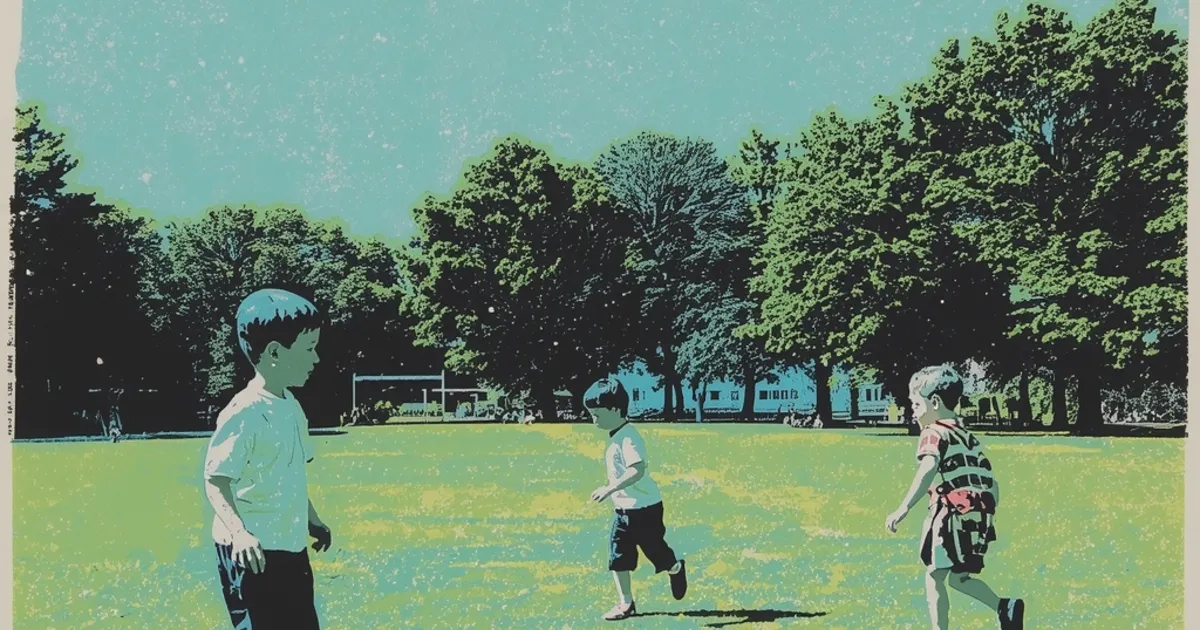
Among the 12-year-olds, total time outdoors mattered most. Children who spent more time outside had less myopia, even when they also did a lot of close work. Indoor sport showed no link, which points to being outside, not to exercise.
Among the 6-year-olds, the study found no consistent link either way. The Guangzhou trial below started with children of about that age, 6 and 7, and followed them for three years as myopia began to appear.
What happened when schools added outdoor time
| Where | What changed | Result |
|---|
| Guangzhou, China (2010–2013) | Six schools added one 40-minute outdoor class to each school day for first-graders. Six schools didn't. | Over three years, 30.4% of children in the outdoor schools became myopic, against 39.5% in the others. |
| Southern Taiwan | One school sent children outside for every recess. A nearby school didn't. | After one year, 8.4% of children at the outdoor school became newly myopic, against 17.7%. |
The Guangzhou trial was randomised, the strongest kind of evidence. An extra 40 minutes a day cut new cases by about a quarter. Outdoor time does less to slow myopia once it has started. The biggest payoff comes before it begins.
What the trials don't show
Outdoor time lowers the number of children who become short-sighted. It isn't a cure.
- In Guangzhou, children in the outdoor schools still became more short-sighted over three years, only a little less so, and their eyes grew about as long as the other children's.
- The Taiwan study compared two schools rather than assigning children at random, so other differences between the schools may play a part.
- In Taiwan, the recess programme slowed the shift towards myopia in children who weren't yet short-sighted. In children who already were, only age predicted how fast it progressed.
So the benefit is real and the evidence is good, but it is prevention, not treatment.
Why children are indoors
A US survey of 9,386 people in the early 1990s found they spent 87% of their time inside buildings and another 6% in vehicles. That was before smartphones. Children's days follow the same pattern: indoor classrooms, indoor homework, indoor screens, and car trips between them.
The Lancet review links the East Asian rise to heavy schooling combined with less time outdoors. The fix doesn't need children to study less. It needs some of the day moved outside.
What you can do
- Give children at least an extra 40 minutes outside each day, more if you can, starting in the early primary years.
- Anything counts: play, walking to school, reading on the verandah, homework in the park. The Sydney study found it's the time outside that matters, not the activity.
- Ask your school whether recess and lunch are spent outdoors, and whether some lessons can be.
- Use a hat, sunscreen and shade. The aim is daylight, not sunburn.
- Get children's eyes checked by an optometrist, especially if a parent is short-sighted. Treatments that may slow myopia once it starts are available and still being studied.
Sources
- Morgan, I. G., Ohno-Matsui, K., & Saw, S.-M. (2012). Myopia. The Lancet, 379(9827), 1739–1748. https://doi.org/10.1016/S0140-6736(12)60272-4
- Holden, B. A., Fricke, T. R., Wilson, D. A., et al. (2016). Global prevalence of myopia and high myopia and temporal trends from 2000 through 2050. Ophthalmology, 123(5), 1036–1042. https://doi.org/10.1016/j.ophtha.2016.01.006
- Rose, K. A., Morgan, I. G., Ip, J., Kifley, A., Huynh, S., Smith, W., & Mitchell, P. (2008). Outdoor activity reduces the prevalence of myopia in children. Ophthalmology, 115(8), 1279–1285. https://doi.org/10.1016/j.ophtha.2007.12.019
- He, M., Xiang, F., Zeng, Y., et al. (2015). Effect of time spent outdoors at school on the development of myopia among children in China: A randomized clinical trial. JAMA, 314(11), 1142–1148. https://doi.org/10.1001/jama.2015.10803
- Wu, P.-C., Tsai, C.-L., Wu, H.-L., Yang, Y.-H., & Kuo, H.-K. (2013). Outdoor activity during class recess reduces myopia onset and progression in school children. Ophthalmology, 120(5), 1080–1085. https://doi.org/10.1016/j.ophtha.2012.11.009
- Klepeis, N. E., Nelson, W. C., Ott, W. R., et al. (2001). The National Human Activity Pattern Survey (NHAPS): A resource for assessing exposure to environmental pollutants. Journal of Exposure Analysis and Environmental Epidemiology, 11(3), 231–252. https://doi.org/10.1038/sj.jea.7500165



,_Mo_i_Rana,_Norway_2017-10-09_a.jpg)
