Why does Australia almost never change its Constitution?
Two Swiss farmers forced a national vote about cows' horns. Australians can't ask a question at all, and haven't said yes since 1977. Here's why.
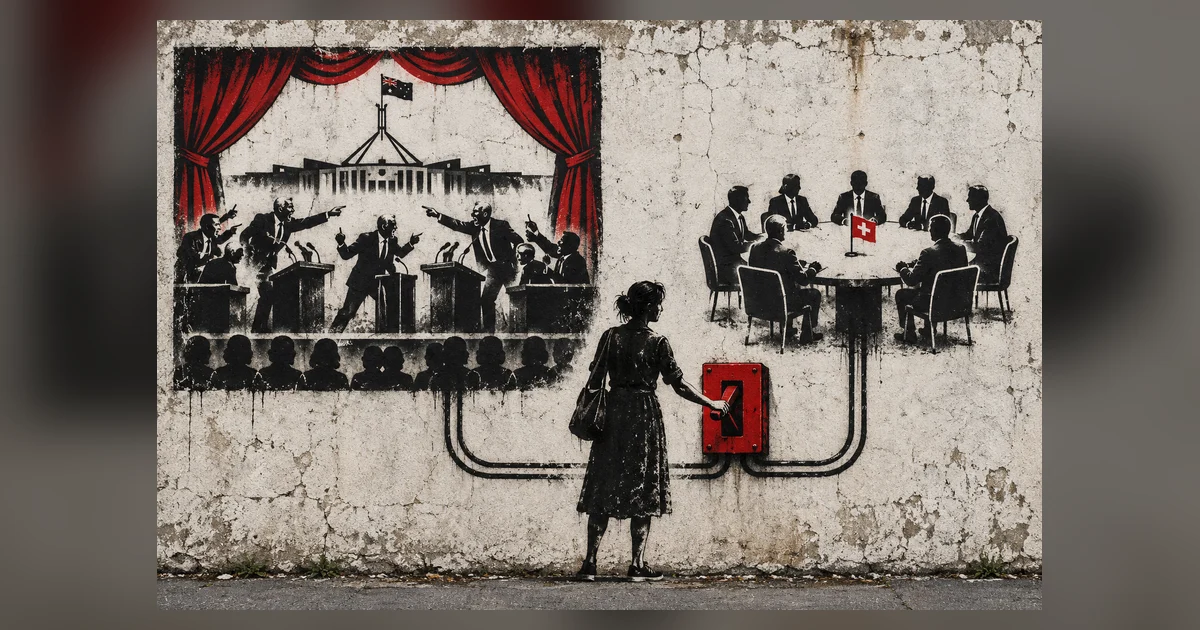
Art: Omxus Press
8 min read
 articleworld4u
Cover of Amicus Cordis (Omxus Press)
A lock costs between thirty and a hundred and fifty dollars. Nobody buys one to keep out rain. The purchase says four things its owner may never say aloud: other people exist whose circumstances I cannot control; those circumstances can produce behaviour that reaches me; I cannot tell in advance whose; so I will pay to manage the consequences. A lock is not a philosophical argument. It is a receipt.
From 1701 to 1945, France and Germany or Prussia went to war nine times: roughly once a generation, long enough for the children of one war to grow up and fight the next. Each generation built better defences. The last was the Maginot Line, a wall of forts that cost billions of francs. In 1940 the German army went around it, and France fell in six weeks.
That September, in occupied Lorraine, the Gestapo arrested a French politician named Robert Schuman. He'd been born in Luxembourg to a father from a village Germany had annexed. He held German citizenship until the map changed, and became French at 32. He spent two years under arrest, escaped in August 1942 and hid until the Liberation (European Parliamentary Research Service, 2025). If you wanted someone who understood what a border was worth, you could hardly do better.
On the morning of 9 May 1950 he was France's foreign minister, with a plan drafted in near-secret by Jean Monnet and his colleagues, and word that the German chancellor, Konrad Adenauer, would back it. His government agreed that day. At the Quai d'Orsay in Paris he read it out: French and German coal and steel, the stuff of guns, under one common authority. The aim was to make war between the two "not merely unthinkable, but materially impossible" (Schuman, 1950).
Six countries signed the treaty in 1951. Its members have not fought each other since. For two and a half centuries those two countries had bought locks. Schuman, who'd seen the inside of one, asked what made them need it.
Look at your own front door. A lock protects against no weather and no wildlife. It protects against the consequences of another person's desperation, illness, opportunity or choice. If nobody else's actions could reach you, a lock would be pointless.
Global insurance premiums reached about €7 trillion in 2024 (Allianz Research, 2025). Add physical security, cybersecurity and public order, and the bill for managing the consequences of other people's actions climbs higher still. Insurance makes the same admission in writing: a premium is the amount your life is expected to be affected by everyone else's.
A lock does not touch the conditions that produce crime. It redirects one instance of their output. The household that buys one has already accepted that a stranger's desperation can become its problem. The lock on the door refutes the politics of the person behind it.
In 1962, in Ypsilanti, Michigan, a school psychologist named David Weikart and a principal named Charles Eugene Beatty started a preschool in a poor Black neighbourhood around Perry Elementary. They identified 123 children and randomly assigned them to the preschool or not, then kept following them for four decades. The preschool cost about US$15,166 per child and returned $12.90 to the public for every dollar, mostly through less crime. By age 40, 36% of the preschool group had been arrested five or more times, against 55% of the others (Schweinhart et al., 2005). That's fewer people in a cell, and less crime done to someone else.
It's one small study, and large programs rarely match it. It still shows what the other road looks like.
Housing tells a plainer story. In New York, people with severe mental illness who'd been homeless used about US$40,451 a year in shelters, hospitals and jails. Giving each a supportive-housing place cut that by US$16,281, against a housing cost of US$17,277 (Culhane et al., 2002). So for a net US$995 a year, somebody slept in a home instead of a shelter, a ward or a cell. Leaving people on the street cost almost the same as housing them.
If managing consequences costs more than changing conditions, the choice should show up in budgets. We took Eurostat's figures for 30 European countries, averaged over 2017 to 2022, and divided what each spends on public order by what it spends on social protection and education.
| Ten countries that spend least on the lock | Ten that spend most | |
|---|---|---|
| Public order ÷ social protection and education | 0.053 | 0.120 |
| Prisoners per 100,000 | 83 | 150 |
| Homicides per 100,000 | 0.94 | 1.17 |
(Eurostat, 2026; our analysis)
The countries that lean on the lock imprison almost twice as many people without being measurably safer. Is it just wealth? It may be. Hold national income constant and the link shrinks until it's no longer significant (partial r = .26, p = .17). Our numbers can't separate the spending from the wealth that makes generosity affordable, and they can't show that prevention lowers violence. What they show is a budget built around consequences, more people in prison, and no fewer dead.
If the cure is cheaper, why do we keep buying locks? Because the lock comes with a story, and we like the story. The belief in a just world says people get what they deserve (Lerner, 1980). We explain other people's misfortune by their character and our own by our circumstances (Ross, 1977). "They're homeless because they're lazy." "They're addicted because they're weak." And we believe we influence outcomes more than we do (Langer, 1975). If outcomes follow choices, I can protect myself by choosing well.
That's comforting, and it's false. Accepting the other view means accepting that bad things happen to good people for reasons beyond their control. It feels like losing control, and the feeling is the barrier.
Seen through fear, the fact that we're connected produces the lock and the blame. Seen clearly, the same fact produces the solutions: if everything is connected, investing in other people's wellbeing protects me too. The lock on your door is the fearful version. Coal and steel was the clear-eyed one. Both acknowledge the same reality. One costs you every month and changes nothing. The other ended the wars.
Surely the comfortable are safe from all this? Not from what a lock can't keep out. Psychologist Suniya Luthar found that among affluent teenage girls, 22% had clinically significant depressive symptoms, about three times the normal rate, and drug use and rule-breaking ran at two to two and a half times national rates (Luthar & D'Avanzo, 1999; Luthar & Becker, 2002). One environment says: you will not survive. The other says: you are nothing without your success. The address differs. The mechanism does not.
And for the biggest risk there is no lock at all. Ninety producers can be traced to 63% of the industrial carbon dioxide and methane released between 1751 and 2010 (Heede, 2014). No premium insures a changed atmosphere, and recycling a bottle doesn't reach them. For every other consequence of our connection there was a lock, expensive and inferior, but available. For this one there's none. Will we invest in the conditions, or keep buying locks until there are no doors left to put them on?
The lock proves it, the premium proves it, the air proves it. The belief in separation never gave you control. It gave you comfort, and the comfort was expensive. The other view doesn't take control away. It gives it for the first time, over the levers that move outcomes, and they're cheaper than locks.
Life does hand us terrible things, and a good deal of them come through someone else's door before they reach ours. A man who'd been through the Gestapo's hands looked across at the country that held him and proposed they share their coal. It's a strange thing to do. It's worked for 75 years.
Two Swiss farmers forced a national vote about cows' horns. Australians can't ask a question at all, and haven't said yes since 1977. Here's why.
Art: Omxus Press
A small lottery lifted student turnout by 32%. Paying for blood drove women away. What moves us is rarely what we say it is, and somebody designs it either way.
Art: Omxus Press
A dead salmon lit up in a brain scanner because the method expected it to. When a clinician's belief decides the finding, what choice is always safe?
Cover of The Lonely Whisper of the Wind (Omxus Press)