Why does Australia almost never change its Constitution?
Two Swiss farmers forced a national vote about cows' horns. Australians can't ask a question at all, and haven't said yes since 1977. Here's why.

Art: Omxus Press
8 min read
 articleworld4u
Art: Omxus Press
In the 1990s, Ambulance Victoria noticed something odd about a few streets of inner Melbourne. The people living there hardly ever called. It was home to one of the largest communities of Holocaust survivors outside Israel, and many of them didn't want a uniformed outside agency coming through the door (Chan et al., 2007).
You can understand that. So the neighbours solved it themselves. From 1995, volunteers in the local Hatzolah group took an 18-month course in first aid, CPR, defibrillation and oxygen, kept the kit at home, and went when someone on their streets called.
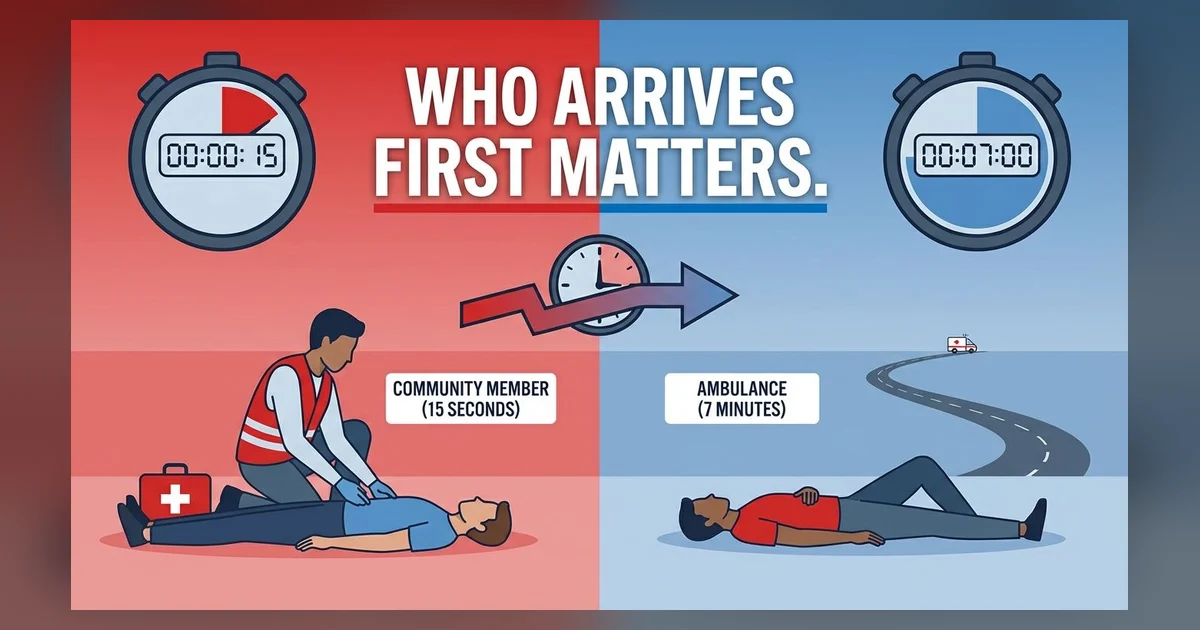
In 35 cardiac arrests, their median time to arrive was two minutes. They beat the ambulance to 29 of the 35, and 19 of those 35 people left the scene alive (Chan et al., 2007).
Today the typical emergency ambulance in Victoria takes twelve minutes. That isn't down to effort or money. It's distance.
When a heart stops, the brain starts dying within minutes. Every minute without CPR and a defibrillator lowers the chance of survival (Larsen et al., 1993). In more than 20,000 Swedish cardiac arrests, 30-day survival fell as the ambulance took longer, whatever the heart's starting rhythm and whether or not bystanders had started CPR (Holmén et al., 2020).
Now the Australian numbers. In 2024-25 the median time from call to arrival ranged from 10.3 minutes in Western Australia to 16.3 in the Northern Territory. In every state one call in ten took longer than 17 minutes, and in the Northern Territory longer than 47. We checked all ten years of the data: in 160 state-years, not one median came inside six minutes, and the median got slower in all eight states and territories (Productivity Commission, 2026a; our analysis).
The paramedics aren't lazy. They're some of the best people we have. A central service has to take the call, pick a crew and drive across a city, and no budget removes the drive. If your husband falls down in the kitchen, the person who can save him isn't at the station. They're three doors up, and neither of you knows it.
Psychologists have known for decades why people stand and watch: when others are around, everyone assumes someone else will help (Darley & Latané, 1968). Single someone out and the effect weakens or reverses (van Bommel et al., 2012).
Stockholm tested it properly. From 2012 to 2013, when someone collapsed, a computer found CPR-trained volunteers within 500 metres by their phones and, at random, either alerted them or didn't. With the alert, bystander CPR rose from 48% to 62% (Ringh et al., 2015). In Victoria, across 9,196 arrests, when a smartphone-alerted volunteer reached the patient before the ambulance, the adjusted odds of leaving hospital alive were 1.37 times higher (Delardes et al., 2025). Those weren't Hatzolah's close-knit streets. Strangers run to strangers, if someone tells them they're needed.
Fewer than you'd think. We did the arithmetic. Suppose only about one alerted neighbour in seven gets up and goes. For a 90% chance of a willing person within 200 metres of any emergency, a suburb of 3,000 people per square kilometre needs about four people in a hundred on the network. They'd arrive on foot in about a minute to a minute and a half. If the whole street were on it, 25 to 40 seconds.
The catch: they must be spread out. If everyone who signs up lives on the same few streets, coverage can halve. That's a recruiting problem, not a reason to give up.
Imagine it built for everything, and built properly. An alert goes to the nearest people by name and distance, and widens if fewer than two answer within 45 seconds. The person in trouble sees who's coming. It runs beside Triple Zero, never instead. Responding is always optional, and "stand at a safe distance and call 000" counts as a full response. Privacy sits in the protocol, not a policy an administrator could change: no identity in the broadcast, coarse location only during an active alert, keys rotated every 15 minutes. Someone escaping violence at home could raise a silent alarm that the person hurting them can't trace.
That's an untested design, and the honest first step is one suburb: about 500 adults for 12 months, every result published, null or not. The willingness figure comes from trained volunteers at cardiac arrests. Real people cluster and get tired, and only a pilot can show what happens.
The idea itself isn't new. Surf lifesavers have done it on beaches since 1907, and volunteer brigades protect most of rural Australia. Only the phone is new.
So why does public safety money go almost entirely the other way? Because of history, more than evidence. London's police of 1829 were championed by property owners anxious about the urban poor (Emsley, 2009). Slave patrols in South Carolina, organised from 1704, passed their functions to post-war police in the American South (Hadden, 2001). In colonial Australia, mounted police secured land for pastoral capital through the subjugation of Aboriginal people (Nettelbeck & Smandych, 2010). We inherited that institution, and we still reach for it when what we need is someone nearby.
Australia spent $17.9 billion on police in 2024-25 (Productivity Commission, 2026b). Across 264 US cities, every ten additional community nonprofits per 100,000 residents cut the murder rate by 9% and violent crime by 6% (Sharkey et al., 2017). Nobody's saying stop sending anyone. A vehicle from across town for a stopped heart is simply a product of how we got here, and moving some money to close that gap is a political choice, not a scientific gamble.
Those survivors in Melbourne had good reason to know what a knock from a uniform can mean. They built something better, and their neighbours lived. What remains is to build it for everyone, measure it honestly, and pay for safety that arrives.
Chan, T., Braitberg, G., Elbaum, D., & Taylor, D. M. (2007). Hatzolah emergency medical responder service: To save a life. Medical Journal of Australia, 186(12), 639-642. https://doi.org/10.5694/j.1326-5377.2007.tb01083.x
Darley, J. M., & Latané, B. (1968). Bystander intervention in emergencies: Diffusion of responsibility. Journal of Personality and Social Psychology, 8(4), 377-383. https://doi.org/10.1037/h0025589
Delardes, B., Gregers, M. C. T., Nehme, E., Ray, M., Hall, D., Walker, T., Anderson, D., Okyere, D., Dantanarayana, A., & Nehme, Z. (2025). Smartphone-activated volunteer responders and survival to discharge after out-of-hospital cardiac arrests in Victoria, 2018-23. Medical Journal of Australia, 222(10), 504-509. https://doi.org/10.5694/mja2.52673
Emsley, C. (2009). The great British bobby: A history of British policing from the 18th century to the present. Quercus.
Hadden, S. E. (2001). Slave patrols: Law and violence in Virginia and the Carolinas. Harvard University Press.
Holmén, J., Herlitz, J., Ricksten, S.-E., Strömsöe, A., Hagberg, E., Axelsson, C., & Rawshani, A. (2020). Shortening ambulance response time increases survival in out-of-hospital cardiac arrest. Journal of the American Heart Association, 9(21), e017048. https://doi.org/10.1161/JAHA.120.017048
Larsen, M. P., Eisenberg, M. S., Cummins, R. O., & Hallstrom, A. P. (1993). Predicting survival from out-of-hospital cardiac arrest: A graphic model. Annals of Emergency Medicine, 22(11), 1652-1658. https://doi.org/10.1016/S0196-0644(05)81302-2
Nettelbeck, A., & Smandych, R. (2010). Policing Indigenous peoples on two colonial frontiers: Australia's mounted police and Canada's North-West Mounted Police. Australian & New Zealand Journal of Criminology, 43(2), 356-375. https://doi.org/10.1375/acri.43.2.356
Productivity Commission. (2026a). Report on Government Services 2026, Part E, Section 11: Ambulance services [Data set, table 11A.5]. Australian Government.
Productivity Commission. (2026b). Report on Government Services 2026, Part C, Section 6: Police services. Australian Government.
Ringh, M., Rosenqvist, M., Hollenberg, J., Jonsson, M., Fredman, D., Nordberg, P., Järnbert-Pettersson, H., Hasselqvist-Ax, I., Riva, G., & Svensson, L. (2015). Mobile-phone dispatch of laypersons for CPR in out-of-hospital cardiac arrest. New England Journal of Medicine, 372(24), 2316-2325. https://doi.org/10.1056/NEJMoa1406038
Sharkey, P., Torrats-Espinosa, G., & Takyar, D. (2017). Community and the crime decline: The causal effect of local nonprofits on violent crime. American Sociological Review, 82(6), 1214-1240. https://doi.org/10.1177/0003122417736289
van Bommel, M., van Prooijen, J.-W., Elffers, H., & Van Lange, P. A. M. (2012). Be aware to care: Public self-awareness leads to a reversal of the bystander effect. Journal of Experimental Social Psychology, 48(4), 926-930. https://doi.org/10.1016/j.jesp.2012.02.011
Two Swiss farmers forced a national vote about cows' horns. Australians can't ask a question at all, and haven't said yes since 1977. Here's why.
Art: Omxus Press
A small lottery lifted student turnout by 32%. Paying for blood drove women away. What moves us is rarely what we say it is, and somebody designs it either way.

Art: Omxus Press
A dead salmon lit up in a brain scanner because the method expected it to. When a clinician's belief decides the finding, what choice is always safe?

Cover of The Lonely Whisper of the Wind (Omxus Press)