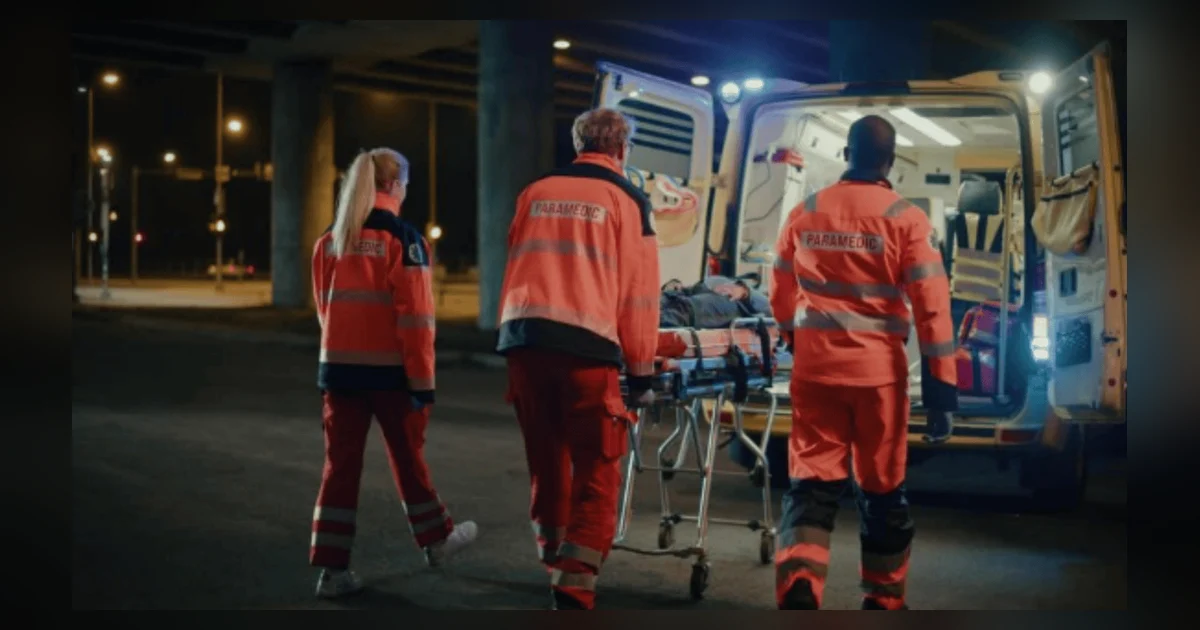
Richard Price was fire chief of the San Ramon Valley in California. One day he was having lunch with colleagues at a deli when they heard a siren, and one of their own engines pulled up out front. Someone had collapsed next door. Price knew CPR. He had a defibrillator in his car. He'd sat there through all of it, a wall away, because nobody had told him (EMS1, 2013).
Thousands of people know CPR. Most of them, on most days, are sitting a wall away from someone, eating a sandwich. Price went on to help build an app to do something about that. But the proof that it could work came from Stockholm.
Same city, one phone call
Between April 2012 and December 2013, whenever someone in Stockholm collapsed in cardiac arrest, a computer searched for trained volunteers whose phones were within 500 metres. For half the arrests, picked at random, it rang them. For the other half, it stayed silent.
Where the phones rang, bystanders started CPR before the ambulance arrived in 62% of arrests. Where they didn't, 48% (Ringh et al., 2015). That's one more person getting CPR for every seven arrests, in the minutes that decide whether a heart restarts. The volunteers weren't braver than anybody else on the street. For them, the emergency had stopped being everybody's and become theirs.
What the bystander effect really is
In 1968, two psychologists had students overhear what sounded like another student having a seizure over an intercom. The more people the students thought were listening, the less likely they were to help, and the slower they were when they did (Darley & Latané, 1968). A year later, a woman was heard to fall and cry out behind a curtain. Seventy per cent of people waiting alone went to her. Beside a stranger who did nothing, 7% did (Latané & Rodin, 1969).
It's easy to read that as proof that people are cold. They aren't. Watch real street fights on CCTV, as researchers did across the UK, the Netherlands and South Africa, and someone steps in nine times out of ten (Philpot et al., 2020). What freezes a crowd is a question nobody answers out loud: is this mine? Each person looks at the others and quietly says no. Someone else will do it, someone closer, someone more qualified.
So the bystander effect isn't a fact of human nature. It's a fact of how a call for help is addressed. That should cheer you up. We can't rewire people, but we can certainly change an address.
Make it someone's
In 2012, Dutch researchers showed the effect can run backwards. When people in an online forum were made to feel personally visible, more onlookers led to more help, not less (van Bommel et al., 2012). A good alert does the same thing. It says: you, here, now, and you know how. That closes all three exits at once.
In Florida's Alachua County, bystander CPR rose from 42.9% before the PulsePoint app to 56.8% after it (Hwang et al., 2025). In England, when a volunteer on the GoodSAM app accepted an alert to a cardiac arrest, the patient's odds of leaving hospital alive were about three times higher (Smith et al., 2022). CPR before the ambulance arrives goes with more than double the survival: 10.5% against 4.0% in Sweden's national registry (Hasselqvist-Ax et al., 2015). A review of 13 apps around the world finds more CPR and more survivors (Tong et al., 2025).
The catch
Most alerts go unanswered. In London, a volunteer accepted in only 1.3% of arrests (Smith et al., 2022). The method works. Too few people carry it.
And who an alert calls matters. In Turkey, a panic button for women at risk, linked to police, gave women more independence, and violence against them rose by more than 5 percentage points (Tumen & Ulucan, 2024). A neighbour summoned to a collapse is one thing. Police summoned into a home is another. Nobody should copy this idea without asking who answers, and what that person brings through the door.
Five rules for an alert that works
- Personal address. Speak to the person, not the population, in words that make plain the call is theirs.
- Proximity. Tell them how close they are. "You are 300 metres away" turns a duty for everybody into a duty for the nearest.
- Accountability without punishment. Let people see their answer mattered. Never penalise anyone who couldn't go: people decline for good reasons, and fear of blame would shrink the pool.
- Competence matching. Call people with the skill the emergency needs first.
- Backup cascade. If the first people called don't accept, call the next ring automatically, so nobody's silence becomes the patient's wait.
We live in a world with plenty of people who'd help and plenty of people who need it, and often only a wall between them. Tell the nearest capable person they're needed, and they come.
What you can do
- Learn CPR, then sign up to a responder app if your area has one. Victoria uses GoodSAM. Ask your ambulance service what yours offers.
- When you need help in a crowd, don't shout "someone help". Point: "You, in the blue jacket, call 000."
- If you're the one who could step in, assume nobody else has. Ask out loud: "Has anyone called?"
Sources
- Darley, J. M., & Latané, B. (1968). Bystander intervention in emergencies: Diffusion of responsibility. Journal of Personality and Social Psychology, 8(4), 377–383. https://doi.org/10.1037/h0025589
- EMS1. (2013, February 1). Lifesaving CPR app adopted in LA. https://www.ems1.com/ems-products/communications/articles/lifesaving-cpr-app-adopted-in-la-kmWiwNwh8bTOQPys/
- Hasselqvist-Ax, I., et al. (2015). Early cardiopulmonary resuscitation in out-of-hospital cardiac arrest. New England Journal of Medicine, 372(24), 2307–2315. https://doi.org/10.1056/NEJMoa1405796
- Hwang, C. W., Meyer, A. J., Harmon, I., Climenhage, B. P., Nordhues, E. M., & Becker, T. K. (2025). Impact of a 9-1-1-integrated mobile app on bystander CPR: Implementation of PulsePoint in an urban county. Journal of Clinical Medicine, 15(1), 5. https://doi.org/10.3390/jcm15010005
- Latané, B., & Rodin, J. (1969). A lady in distress: Inhibiting effects of friends and strangers on bystander intervention. Journal of Experimental Social Psychology, 5(2), 189–202. https://doi.org/10.1016/0022-1031(69)90046-8
- Philpot, R., Liebst, L. S., Levine, M., Bernasco, W., & Lindegaard, M. R. (2020). Would I be helped? Cross-national CCTV footage shows that intervention is the norm in public conflicts. American Psychologist, 75(1), 66–75. https://doi.org/10.1037/amp0000469
- Ringh, M., et al. (2015). Mobile-phone dispatch of laypersons for CPR in out-of-hospital cardiac arrest. New England Journal of Medicine, 372(24), 2316–2325. https://doi.org/10.1056/NEJMoa1406038
- Smith, C. M., Lall, R., Fothergill, R. T., Spaight, R., & Perkins, G. D. (2022). The effect of the GoodSAM volunteer first-responder app on survival to hospital discharge following out-of-hospital cardiac arrest. European Heart Journal: Acute Cardiovascular Care, 11(1), 20–31. https://doi.org/10.1093/ehjacc/zuab103
- Tong, Q., et al. (2025). Mobile applications enhance out-of-hospital cardiac arrest outcomes: A systematic review and meta-analysis. BMC Health Services Research, 25, 256. https://doi.org/10.1186/s12913-025-12416-2
- Tumen, S., & Ulucan, H. (2024). Empowered or impoverished: The impact of panic buttons on domestic violence. Review of Economics of the Household, 22(4), 1423–1459. https://doi.org/10.1007/s11150-024-09697-7
- van Bommel, M., van Prooijen, J.-W., Elffers, H., & Van Lange, P. A. M. (2012). Be aware to care: Public self-awareness leads to a reversal of the bystander effect. Journal of Experimental Social Psychology, 48(4), 926–930. https://doi.org/10.1016/j.jesp.2012.02.011