Would a zookeeper pass the way we live?
When a polar bear swam in figure eights, the zoo inspected his life. Scored the same way, the places people live and work fail on 17 of 18 measures.
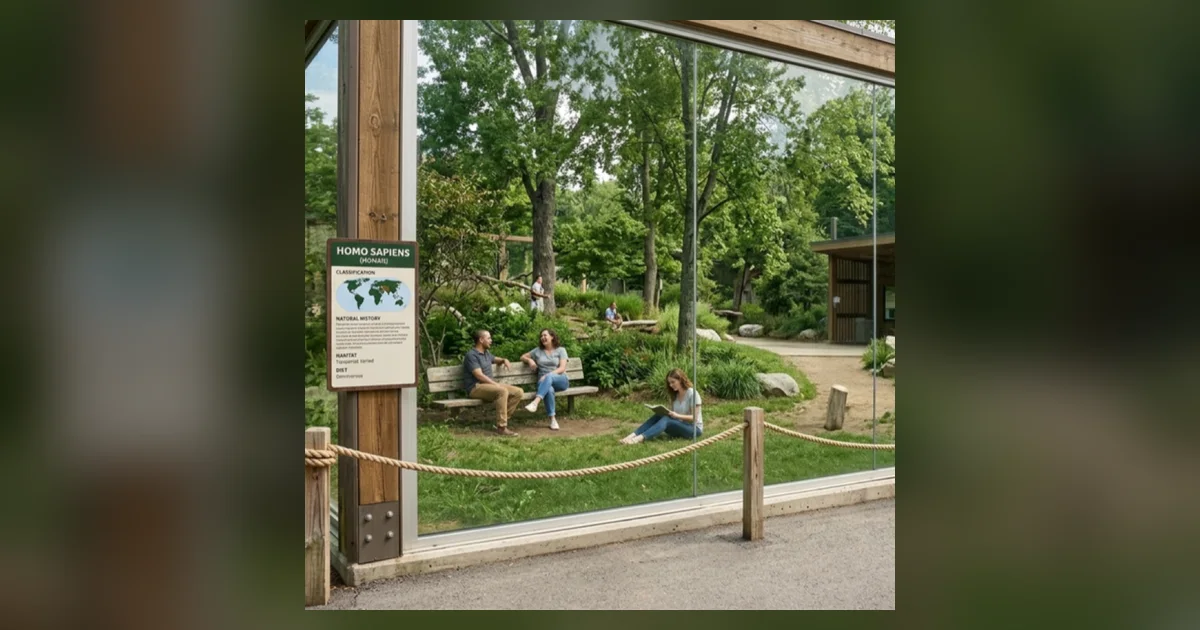
Cover of The Human Enclosure (Omxus Press)
8 min read
 articleworld4u

Art: Omxus Press
On 7 August 1974, for the only time in the nation's history, both houses of federal parliament sat together as one and voted 95 to 92 to give every Australian health cover. Within six years that scheme was gone. It came back in 1984 as Medicare, because unions gave up pay rises to get it.
A bridge is what you get when both sides finally meet in the middle.
Think about the last time someone you love got sick and the first question wasn't "how much?" That's not how it works in most of history, and it took a very odd Australian fight to get it.
Australians once paid for the doctor through friendly societies, mutual funds that workers paid into for sick pay and medical care. In 1913 they covered 46% of the population. By 1953 private insurance covered "all but 17%" of Australians, and by 1969 the federal government was paying a large share of the cost of private cover to keep it affordable (Green & Cromwell, 1984; Boxall & Gillespie, 2013).
It still missed people. In 1972, outside Queensland, which ran free public hospitals, 17% of Australians had no health insurance, and most of them were on low incomes (Scotton & Macdonald, 1993). Cover followed the wage. The people least able to pay a doctor were the people least likely to be insured.
John Deeble was born in Donald, a farming town in western Victoria. Richard "Dick" Scotton was born in Lithgow, a coal-mining town west of Sydney. In 1965 both were at the University of Melbourne's Institute of Applied Economic Research, and between 1965 and 1970 they designed a replacement for the patchwork: one public scheme covering everyone, in place of each family buying its own policy from a private fund (Scotton & Deeble, 1968).
Bill Hayden, the Whitlam government's Minister for Social Security, took up their plan. Scotton went on to chair the Health Insurance Commission, which ran the scheme. Deeble chaired the planning committees for both Medibank and, later, Medicare (Scotton & Macdonald, 1993; Boxall & Gillespie, 2013). Hold on to that. It matters later.
The Senate rejected the health insurance bills three times. Whitlam used them, with four other bills, to call a double dissolution on 11 April 1974. The government won the election but still lacked a Senate majority, so under section 57 of the Constitution both houses met together. On 6 and 7 August 1974 they passed the health bills 95 to 92, on party lines. It remains the only joint sitting in Australian history (Parliamentary Library, n.d.).
Medibank started on 1 July 1975, run by the Health Insurance Commission. Four months later, on 11 November 1975, the Whitlam government was dismissed (Boxall & Gillespie, 2013).
| Date | What happened |
|---|---|
| 7 August 1974 | Joint sitting passes the health insurance bills, 95 to 92 |
| 1 July 1975 | Medibank starts: public cover for every Australian |
| 1 October 1976 | Fraser government's "Medibank Mark II": a 2.5% income levy, or private insurance instead |
| Late 1981 | The universal scheme is dissolved entirely |
| 1 February 1984 | Hawke government reinstates it, renamed Medicare |
Most reforms this size get one attempt. This one got two, partly because its architects were still there. Deeble, who had planned Medibank, planned Medicare too.
Medicare returned as part of a deal. In 1983 the Labor Party and the Australian Council of Trade Unions negotiated the Prices and Incomes Accord. Unions agreed to limit their wage demands. In exchange, the government delivered a "social wage": tax cuts, welfare, better superannuation, and the return of universal public health cover under a new name, Medicare (Boxall & Gillespie, 2013).
That tells you something about how Australia settles questions of fairness. Workers didn't win Medicare by striking for it. They won it by trading, accepting smaller pay packets so every household got a doctor without a bill. Australians call the idea a fair go: where you start shouldn't decide whether you get care when you're sick. The Accord put a price on that idea, and working people paid it.
Today the Medicare levy is 2% of a resident taxpayer's taxable income (Australian Taxation Office, 2025).
The United States kept cover tied to the job. In 2024, employment-based insurance covered 53.8% of Americans, and 92.0% had some cover for at least part of the year (Keisler-Starkey & Bunch, 2025). Lose the job there and you can lose your insurance with it. In Australia, who employs you never comes up at the doctor's desk.
Medicare's everyday promise is bulk billing: the doctor accepts the Medicare rebate as full payment and bills the government, so the patient pays nothing. It's the doctor's choice, not a guarantee.
In January 2023 a national survey of clinics found only 42.7% of available clinics bulk billed new adult patients. In the ACT it was 5.1% (Cleanbill, 2023). Bulk billing has been a live political fight ever since, so check today's figure for your area. A promise built for everyone came to depend on your postcode.
That's a funding problem, not a failure of the idea. The rebate sets what a free visit is worth to a doctor. When it falls behind costs, more practices charge a fee on top.
Two economists from country towns designed a system, watched it torn down, and built it again. It has happened here twice. For another question about what a country chooses to share, see What if Australia shared its $19 trillion?
We built this one in 1974 and we're still walking on it. What's next?
When a polar bear swam in figure eights, the zoo inspected his life. Scored the same way, the places people live and work fail on 17 of 18 measures.
Cover of The Human Enclosure (Omxus Press)
In 2008 Denmark began paying night workers with breast cancer. Sleep advice still blames your habits. In a US sample, the job predicts who sleeps too little.
Cover of The Stolen Night (Omxus Press)
Twenty years of American time diaries show young people's time with friends fell from 137 minutes a day to 51, and the hours went to being alone.

Art: Omxus Press